A young company straddling the US and Europe is about to show a laptop that moves air without a single blade, motor or vent grille, using technology borrowed from spacecraft and wind-tunnel labs.
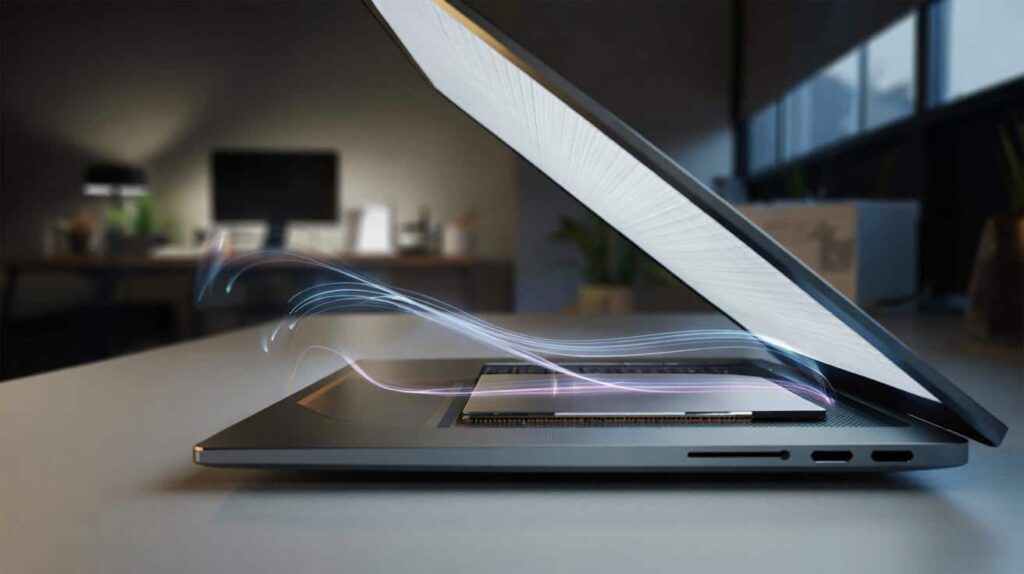
A silent laptop that breathes with plasma
The prototype comes from YPlasma, a start-up based between Newark in the US and Madrid in Spain. From the outside, its machine looks like any slim notebook you might see on a coworking desk. Inside, the cooling system is anything but ordinary.
Instead of a fan, the laptop relies on what engineers call dielectric barrier discharge, or DBD. In plain language, it uses “cold plasma” to push air across hot components. No moving parts. Almost no sound. And a level of temperature control precise enough to keep power-hungry AI chips in check.

YPlasma’s laptop prototype circulates air using a sheet-thin plasma actuator, reaching just 17 dBA — roughly the rustle of leaves.

DBD is not new to science. It has been studied for years in aerodynamics labs and aerospace programmes as a way to shape airflow around aircraft wings or spacecraft surfaces. The novelty here is the scale: YPlasma claims to have shrunk that lab equipment into something that fits, quite literally, inside a backpack.
How do you cool a CPU with a 200-micron film?
The heart of the system is what YPlasma calls a plasma actuator. It is essentially a flexible film around 200 microns thick — about five times thinner than a human hair. This film can be stuck onto a heat sink or the inside of a laptop chassis like a sticker.
When a voltage is applied, it creates a tiny layer of ionised gas — cold plasma — just above its surface. The ions drag nearby air molecules with them, creating a smooth, quiet airflow known as an “ionic wind”. That flow pulls heat away from chips and spreads it out across cooler surfaces where it can dissipate.
- Thickness: ~200 microns (0.2 mm)
- Moving parts: none
- Noise level: around 17 dBA
- Main role: move air over hot components without a fan
This movement of air is directional and can be tuned. Engineers can place multiple actuators along a laptop’s internal surfaces, steering airflow over the CPU, GPU and memory modules, instead of relying on a single fan that blasts air through a cramped tunnel.
Cooling and heating with the same film
The same hardware can also work in reverse. By changing the way the voltage is applied, the actuator can generate heat instead of just moving it. For laptops, that might mean more predictable behaviour when used in a cold train carriage or an unheated workshop.
For other sectors, that dual role is even more attractive. Devices on satellites, high-altitude drones or remote pipelines need to stay within a safe temperature range whether they face sub-zero conditions or scorching sun. A paper-thin film that both heats and cools, without pumps or valves, simplifies design and reduces weight.
A plasma that does not fill the room with ozone
Electrostatic air-moving systems have a reputation problem. Earlier designs based on the “corona effect” could generate significant amounts of ozone, a lung irritant at high concentrations. That has limited their use in consumer electronics.
DBD tackles that issue with, as the name suggests, a dielectric barrier between electrodes. This barrier prevents the electrical discharge from forming a full arc. The plasma remains controlled and relatively cold instead of forming intense, hot sparks that split oxygen and generate ozone.
The dielectric barrier keeps the plasma discharge stable and cold, limiting ozone generation and protecting both lungs and electronics.
There is also a durability gain. Traditional ion wind systems used exposed metal needles that slowly eroded, a failure mode known as “tip erosion”. YPlasma’s electrodes are shielded within the layered structure of the film, designed to last as long as the laptop itself.
That brings side benefits: no fan bearings to wear out, no dust-clogged grilles, and no whirring blades for hair or cables to get caught in. For manufacturers, a sealed system means one less mechanical component that can fail under warranty.
Debut at CES 2026, with ambitions beyond laptops
YPlasma plans to showcase its first plasma-cooled laptop at CES 2026 in Las Vegas, the annual technology fair where component makers court PC brands and car giants alike. The prototype is as much a demonstration platform as a product. The goal is to convince hardware makers to integrate these thin films into future designs.

The company is not only eyeing notebooks. It is targeting:
- Gaming consoles chasing higher frame rates in smaller boxes
- Servers running AI workloads in already overheated data centres
- Electric vehicles where every watt of auxiliary power counts
- Aerospace and defence hardware that must remain reliable in harsh environments
In cars and planes, DBD actuators could do something different: shape the air outside the machine. By energising patches on a car’s body or an aircraft wing, engineers can influence how air flows over the surface, reducing drag. Less drag means better fuel economy or longer electric range.
The same principle could apply to wind turbines, where altering airflow over blades could reduce turbulence, noise and structural fatigue.
From NASA wind tunnels to your backpack
DBD actuators have already logged time in NASA wind tunnels, where researchers used them to control tricky airflow around wings and tail fins without moving flaps. YPlasma’s twist is to shrink and industrialise that technology.
What once required bulky power electronics and rigid panels now fits into a strip that can be bent around a curve and attached with adhesive. The company describes it as “a space-grade cooler for your laptop”, a catchy line that reflects its aerospace roots.
For device makers, the pitch is straightforward: thinner machines with more powerful chips, quieter operation and fewer mechanical parts. For users, the immediate promise is fewer sudden fan blasts during a Zoom call or a late-night gaming session.
What this shift could mean for everyday devices
If YPlasma or similar firms succeed, the entire thermal design of laptops and consoles could change. Without the need to reserve a corner for a plastic fan and a thick heatsink, designers gain freedom. Batteries might grow larger. Speakers could move. Ports could cluster in more convenient places.
At the same time, expectations around performance could shift. AI acceleration has pushed laptop chips closer to the thermal limits of their slim cases. A more efficient, directed airflow system makes sustained high performance less of a balancing act. Less heat stress may also help extend component lifespan, which matters to users trying to keep a machine for five years instead of three.
| Cooling method | Main advantages | Main trade-offs |
|---|---|---|
| Traditional fan and heatsink | Cheap, well understood, easy to replace | Noise, dust build-up, mechanical wear, limited airflow paths |
| DBD plasma actuator | Near-silent, no moving parts, flexible placement | New supply chain, higher initial cost, needs careful electronic control |
Risks, questions and early adopter headaches
Any new cooling method faces tough scrutiny. Engineers will want long-term data on reliability, especially in hot, dusty environments. While the design avoids moving parts, the high-voltage drive circuits need to be robust and safe in case of liquid spills or physical damage.
There is also the question of cost. Plasma actuators require precise manufacturing and specialised materials. At first, they are likely to appear in premium devices where silent operation or ultra-slim designs justify a higher price tag. Mainstream adoption will depend on how quickly the supply chain scales and prices fall.
Regulators may ask for detailed studies on ozone levels, electromagnetic emissions and interference with nearby components. If those hurdles are cleared, the regulatory position could even turn into an advantage: sealed, fanless systems are often easier to certify for dust resistance or operation in clean rooms.
Key concepts behind the tech, in plain language
The phrase “cold plasma” can sound ominous, so a bit of context helps. A plasma is a gas where some particles are electrically charged. In this case, the plasma layer is extremely thin and at a temperature close to room air. It is “cold” compared with the scorching plasmas used in welding or fusion research.
“Dielectric barrier” describes the insulating layer between the two electrodes. It might be glass, ceramic or a polymer. That barrier limits current and forces the discharge to stay spread out and gentle, instead of forming a bright arc. The result is a controlled, flicker-like discharge along the surface that nudges air rather than burning it.

From a user’s perspective, the science sits under the keyboard, invisible and silent. What they notice is that their AI-enhanced laptop feels cooler on the wrists and less like a hairdryer at full blast. For many, that alone could justify the leap from whirring fans to whispering plasma.