The way we stack our books, leave dishes in the sink, or label every storage box is rarely random. Psychologists say our living spaces tend to mirror deeper patterns: how we handle stress, how much control we crave, and even how we see ourselves in relation to other people.
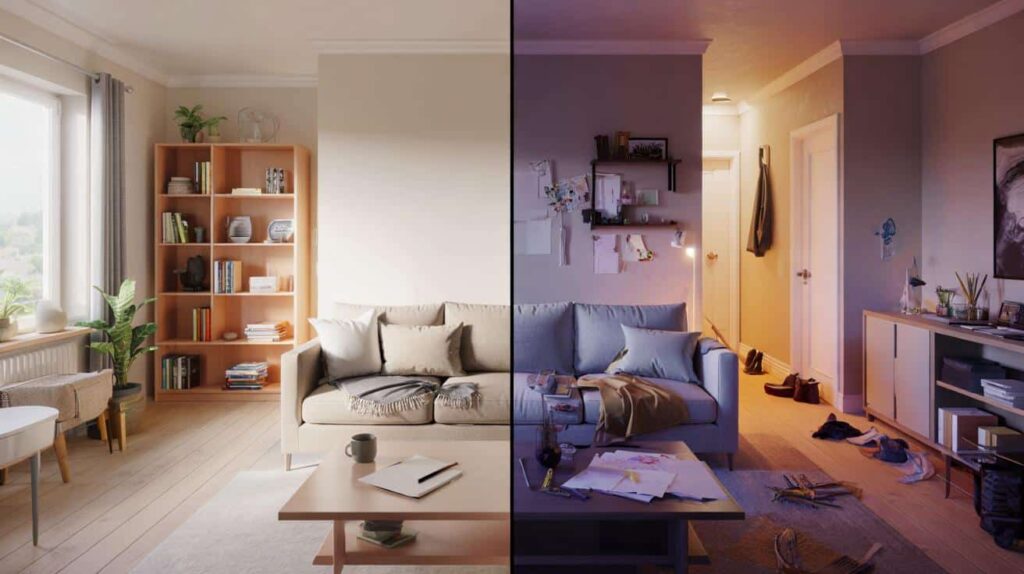
What your living room says before you say a word
Personality research has long suggested that our surroundings act like a second CV. One of the strongest links is between tidiness and conscientiousness, a trait associated with reliability, planning and self-discipline.
People who keep their homes very orderly are often the same ones who meet deadlines, remember birthdays and show up on time. Their environment reflects an inner rhythm: lists, routines, and a clear sense of what needs doing next.

When a home feels structured and predictable, it often belongs to someone who values control, planning and emotional stability.

Psychologists at several European universities, including Heidelberg and Munich, have pointed out that orderliness also dovetails with a desire for control and predictability. For some, a neat flat is not just a preference; it’s a buffer against feeling overwhelmed.
A carefully arranged room can send a quiet signal: “I know what’s going on here.” In times of uncertainty at work, in politics or in family life, the act of tidying can feel like reclaiming a small piece of certainty.
Why a tidy home can boost your brain
There is also a practical side. Studies on productivity and attention show that visual clutter competes for our focus. Every pile of paper or overflowing chair silently asks for a decision.
In a reasonably orderly home, your brain has fewer distractions to process. That makes it easier to concentrate, even on small things like cooking a new recipe or finishing an online course after work.
Less clutter usually means fewer competing signals for the brain, which can bring sharper focus and lower stress levels.
Health researchers, including those whose work informs World Health Organization housing guidelines, point to several concrete benefits of well-organised living spaces:
- Fewer tripping hazards and domestic accidents
- Easier cleaning, which can mean less dust and better air quality
- Lower risk of pests attracted by rubbish or leftover food
- A stronger feeling of safety and control at home
Order also has a social function. Someone whose wardrobe, desk and hallway are always curated may be using them as a form of self-presentation. The polished hallway and colour-coordinated bookshelf are not only for personal comfort; they show guests a particular image: reliable, tasteful, in control.
When tidiness shades into perfectionism
Not every neatly folded towel is a sign of inner peace, though. For some people, order becomes a rigid rule rather than a helpful tool. The urge to keep every surface spotless can tip from comfort into compulsion.
Psychologists talk about perfectionistic tendencies when a person feels genuine distress if things are “wrong” by their own standards – a mug left out, children’s toys visible in the lounge, shoes not aligned by the door.
If a slightly messy room feels like a personal failure rather than an everyday reality, tidiness may be serving anxiety more than wellbeing.
Living spaces are meant to be used. A sofa with a blanket left from last night’s film, or a kitchen where breakfast plates are still on the side at noon, often signals a life actually being lived. That does not equate to laziness.
The key difference is flexibility. People with a balanced approach to order might enjoy a deep clean on Sunday, yet feel no shame when Tuesday looks a bit chaotic. Those with harsher inner rules can struggle to relax unless everything is “perfect”.
What mess might really mean
At the other end of the spectrum lie the chronically messy. Piles of unopened post, floors dotted with clothes, and a permanently overloaded dining table can point to several underlying patterns.
Types of mess and what they often signal
| Type of mess | What it can suggest |
|---|---|
| Creative clutter | High curiosity, many interests, ideas starting faster than they’re finished |
| Procrastination piles | Difficulty making decisions, fear of starting or finishing tasks |
| Overwhelm chaos | Stress, burnout, or mental health strains such as depression or anxiety |
| Sentimental hoarding | Strong attachment to objects, fear of loss, or a shaky sense of identity |
A busy kitchen counter covered in recipes, art supplies and half-finished projects might belong to someone with high creativity and low patience for routine. They focus on ideas, not storage solutions.

In contrast, teetering stacks of paperwork that never move can signal something less cheerful: avoidance. The unopened letter from the bank, the unfiled contract, the parking ticket shoved under other envelopes – each one is a tiny decision postponed, often because it triggers discomfort.
How much mess is “normal” for a healthy mind?
Psychologists increasingly argue against a binary view of tidy versus messy. Most people sit somewhere in the middle, and what really counts is the impact on daily life.
Ask yourself three questions:
- Can you usually find what you need within a few minutes?
- Does the state of your home stop you inviting people in?
- Do you feel ashamed, panicked or stuck when you look around?
If the answers lean towards “yes, I function” and “no, it doesn’t rule me”, your level of order is likely within a healthy range, even if your coffee table is never Instagram-ready.
When mess starts to interfere with sleep, relationships or day-to-day tasks, it might be less about personality and more about a signal: life has become too much, or help is needed.
Using your home as a gentle personality test
One simple exercise used by some therapists is the “home walkthrough”. You mentally tour your space and notice your emotional reactions, room by room.
For example:
- The hallway: Do shoes and coats piled up make you tense or oddly comforted?
- The bedroom: Is it restful or a dumping ground for laundry and laptops?
- The desk or dining table: Is it a working surface or a permanent storage zone?
These reactions can tell you something about how you handle boundaries. A bedroom overrun by work papers can hint at blurred lines between rest and performance. A hall that never feels fully cleared might echo a mental state of being perpetually “in transit”.
Small changes can act like low-stakes experiments. Clearing just the bedside table and seeing if sleep improves, or designating a “messy drawer” where chaos is allowed, can show you how much your mood is tied to control and structure.
When tidying becomes emotional regulation
Many people use cleaning as a way to regulate feelings without realising it. A tough day can trigger an intense urge to scrub, sort and fold. The repetitive movements and visible results give a quick hit of relief.
This can be healthy in moderation. The risk comes when emotions are always channelled into wiping and rearranging instead of being named and talked about. If every argument or stressful email leads straight to bleaching the bathroom, the underlying issues remain untouched.
Order can calm the mind, but it cannot replace difficult conversations, rest or treatment for mental health problems.
On the other side, people in depressive phases often report that washing up, taking out the bins or changing bedsheets suddenly feel like climbing a mountain. Mess then becomes both a symptom and a source of shame, locking them into a cycle where each day looks harder to tackle than the last.
Practical ways to match your home to your personality
Bringing your space into line with who you are – and who you want to be – does not require transforming into a minimalist or buying a label maker. A few tailored strategies can already shift things.

- For the perfectionist: Set “good enough” standards, such as 10 minutes of tidying per night and one clearly allowed messy corner.
- For the overwhelmed: Work by category, not room. Just tackle surfaces today, or only rubbish, so progress is visible fast.
- For the sentimental: Photograph items before letting them go, and keep one box labelled “memories” with a fixed limit.
- For the creative clutterer: Create one large project basket where ongoing ideas can live without covering every surface.
Thinking of your home as a living reflection, not a showroom, changes the pressure. A bit of mess can signal spontaneity and warmth. A bit of structure can act as scaffolding for calmer days. The interesting part lies in noticing where you sit on that spectrum – and how willing you are to shift it when life changes.