
The first time I saw it, it was sitting like a tiny spaceship on my friend’s counter. Silver, glossy, big touchscreen glowing with icons: roast, air fry, steam, bake, grill, proof, slow cook, sauté, dehydrate. A nine-function “smart cooker” promising crispy wings, chewy cookies, fluffy bread, silky soups. She waved her phone and the gadget beeped to life. Dinner was “handled” before we’d even finished our coffee.
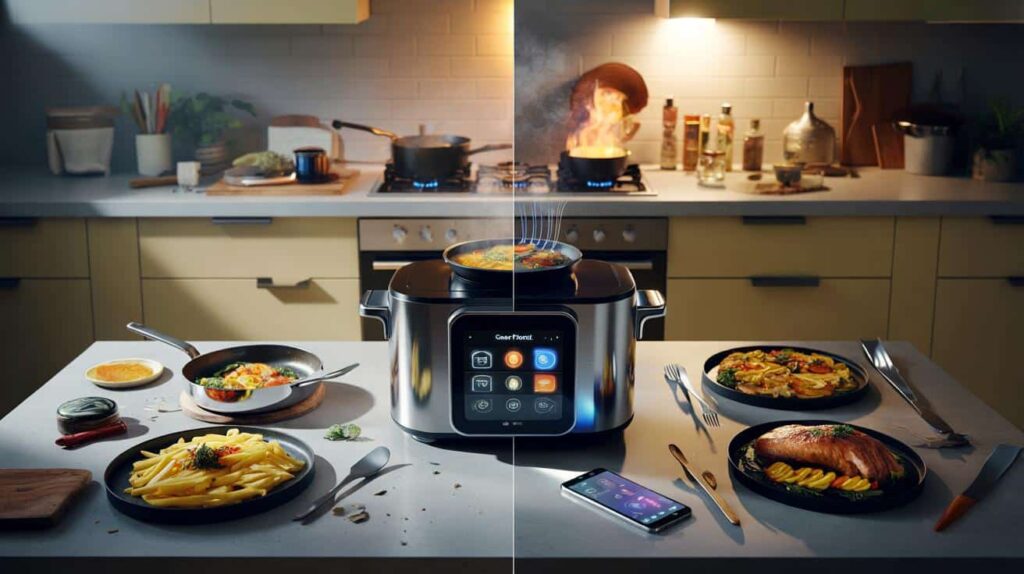
The house smelled good, but something felt off. No chopping board out, no pans heating, no quiet clatter of plates.
Just a soft fan noise and a notification popping up: “Your meal is ready.”

That night, looking at our perfect, identical portions, a thought hit me.
Maybe we’re not just outsourcing effort.
Maybe we’re outsourcing cooking itself.

From miracle machine to silent takeover in the kitchen
Walk into any appliance store right now and you’ll spot it immediately. The air fryers have been pushed to the side, like yesterday’s news, replaced by sleek, all-in-one multi-cookers that claim to do everything except the dishes. These nine-function gadgets promise healthier food, less time, fewer pans, and Instagram-ready dinners from an app-controlled box.
They’re being sold as the new miracle of home cooking.
But miracles always come with a catch.
One London-based retailer told me multi-function cookers are “eating the air fryer’s lunch”. Sales of some models have doubled in a year, while standalone air fryers are already being discounted. Social feeds are overflowing with videos: “Full family dinner in 15 minutes, no skills needed.”
A young dad in Manchester proudly showed me his routine. He scans a QR code on a meal kit, the cooker sets itself, and he gets an alert when his “homemade” lasagne is done. His two kids think that’s what cooking means now: scanning and tapping, not tasting and adjusting.
They love the machine.
The stove rarely gets switched on.
What’s quietly happening is a shift in who holds the steering wheel in our kitchens. First the microwave stole leftovers, then the air fryer hijacked weeknights. Now this nine-function box wants breakfast, lunch, dinner, and dessert. When you let pre-programmed settings run the show, you stop learning why food behaves the way it does.
Heat, texture, timing, seasoning – the stuff our grandparents felt in their bones – get outsourced to algorithms and presets. *The more the machine “knows”, the less we bother to learn.*
And when a recipe doesn’t fit the machine’s format, we just don’t cook it.
How the gadget quietly kills real home cooking
You see the change in small, almost invisible habits. At first, the shiny cooker is just for fries and chicken wings, the quick fixes. Then the brand emails a “30-day meal plan”. There’s an app, recipe packs, auto-updating programs.
Soon, the question shifts from “What do I feel like cooking?” to “What does this thing have a preset for tonight?”
That’s where the slide really begins.
I met a couple in their thirties who used to spend Sunday afternoons batch-cooking stews and sauces. The kitchen would turn into a laid-back chaos of pots, ladles, and half-open spice jars. They joked that their relationship was built on that messy, tomato-splattered countertop.
Now, Sunday is “multi-cooker day”. They buy pre-cut vegetables, pre-marinated meat, and dump everything into the nine-function machine. They sit on the sofa while it beeps through the stages: sear, pressure, keep warm. The food is perfectly fine. Even tasty.

But when I asked when they last argued over whether to add more garlic, they looked at each other and laughed.
They couldn’t remember.
What this gadget really optimizes is friction. It trims away the awkward, uncertain parts of cooking: not knowing how long onions take to brown, tasting a sauce and realizing it’s flat, overcooking the rice and starting again. Those “errors” are exactly where personal style and family recipes are born.
Strip that away and you’re left with standardized food, tuned to the brand’s default palate, not yours. **Traditional home cooking isn’t just about making food at home. It’s about making food your way, in your time, with your hands.**
When most meals become “load, tap, wait”, the kitchen turns into a docking station, not a workshop.
Keeping the gadget – without losing your cooking soul
There’s a way to live with these machines without letting them run your kitchen. One simple gesture changes everything: use manual mode as your default. Instead of scanning recipes and trusting presets, choose a basic setting – like bake at 180°C or sauté on low – and treat the gadget as just another heat source.
Chop your own vegetables. Season without measuring spoons once in a while. Open the lid halfway and trust your nose instead of the progress bar.
Let the machine give you convenience.
But keep control of the decisions.
We’ve all been there, that moment when you get home tired and you just want dinner to appear. That’s the sweet spot where the nine-function gadget quietly wins: it solves a real pain. Use it on those days. No guilt.
The trouble starts when every day begins to look like that. When kids never see a parent stir a pot, or smell onions softening slowly in butter. When the only “recipe” they know is a cooking program name. Let’s be honest: nobody really does this every single day.
So, pick two nights a week when the machine stays off. Light the stove, preheat the oven, pull out that forgotten pan. You’ll probably curse once or twice. Then something in you will relax.
“People tell me they can’t cook,” a Paris-based home cook told me. “I ask them, ‘Or have you just forgotten what it feels like to fail a little, then get better?’ The machine never lets them fail. That’s the trap.”
- Use the gadget for prep, not the whole meal – steam potatoes in it, then crush them in a pan with garlic and olive oil.
- Reserve one recipe per week that can’t be done in the machine – a stir-fry, a big pan of roasted vegetables, a simple risotto.
- Cook with someone else at least once a month – roommate, partner, kid, neighbor – and talk while you chop.
- Teach one dish to a younger person entirely without presets – no app, no timer, just sight, smell, and taste.
- Keep one “signature” dish that you refuse to automate, no matter how clever the gadget gets.
What we risk losing if we let the box decide every meal
Think of the recipes you really remember. The ones you could almost cook with your eyes closed. They’re rarely perfect. They’re slightly too lemony, or never quite the same twice, or stubbornly slow compared with a 20-minute preset.
Those quirks are memory. They’re the reason a child grows up saying, “No one makes soup like my mother,” even though the ingredients are basic. **A nine-function cooker can reproduce a dish with eerie consistency, but it can’t give you that tiny, human flaw that makes it yours.**
If this machine quietly replaces the air fryer, then the oven, then half the stove, it won’t just be about technology winning. It’ll be about us choosing predictability over presence.

Maybe the deeper question isn’t “What can this gadget do?”
It’s “What part of myself am I handing over when I let it do everything?”

| Key point | Detail | Value for the reader |
|---|---|---|
| Limit presets | Use manual modes and basic settings instead of app-controlled recipes for every meal | Regains cooking intuition and confidence instead of relying on the machine’s judgment |
| Protect “analog” nights | Set two evenings a week with no smart gadget, just stove, pans, and simple ingredients | Rebuilds real cooking habits and keeps traditional skills alive at home |
| Keep one signature dish | Choose a recipe you never automate or delegate to the gadget | Preserves personal identity in the kitchen and passes on a real family tradition |
FAQ:
- Question 1Is this nine-function cooker really worse than an air fryer?
- Question 2Can I still be a “real cook” if I use this gadget regularly?
- Question 3How do I stop my kids thinking cooking is just pressing buttons?
- Question 4What’s a good balance between using the gadget and traditional methods?
- Question 5Are there dishes I should never hand over to the machine?
