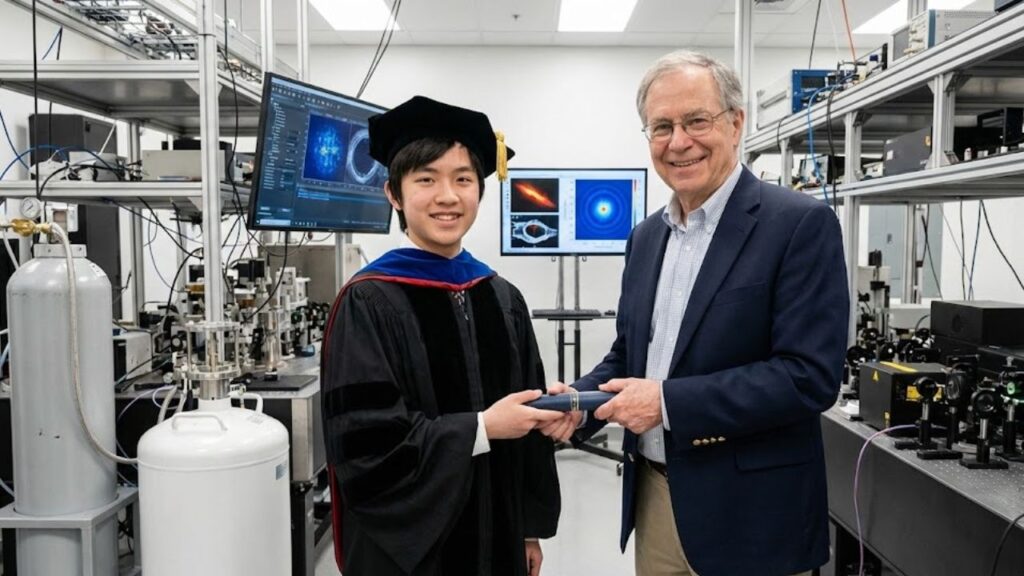
While most 15-year-olds are focused on exams or weekend plans, Belgian prodigy Laurent Simons has already completed a PhD in quantum physics. His ambition reaches far beyond academic records: he aims to harness the most unusual laws of physics to help humans live longer, healthier lives.
A young mind moving faster than the rulebook
Laurent Simons has drawn attention in Belgium for years, yet his latest achievement sets a new benchmark. On 17 November 2025, at the University of Antwerp, he successfully defended his doctoral thesis in quantum physics, placing him among the youngest PhD graduates ever documented in Europe.
His academic pace has been extraordinary from the beginning. Simons completed secondary school at just eight years old, followed by a full science degree in around 18 months. Even among gifted university students, such speed is rare. Still, his mentors emphasise that his path is about more than acceleration.
 Those Who Don’t Feel The Need To Dye Their Hair As They Age Often Share These 8 Remarkable Qualities
From an early stage, Simons was guided toward serious research rather than publicity-driven milestones. He undertook laboratory placements in Germany and chose to stay in Europe, despite interest from major technology firms in the United States and China. Behind the headlines stands a teenager immersed in real laboratories, solving real equations under standard peer review.

University documentation reviewed by multiple outlets confirms his doctoral defence and enrolment. While verifying whether he is the absolute youngest PhD holder globally is difficult due to differing academic systems, even conservative comparisons place him in a remarkably small elite.
Exploring exotic matter: polarons in a supersolid
The subject of Simons’s doctoral work lies far beyond introductory physics. His research centres on polarons within an unusual phase of matter known as a supersolid.
A polaron is not a fundamental particle like an electron or proton. Instead, it is a composite entity. When a single impurity moves through a material, it disturbs the surrounding environment. That disturbance clings to the impurity, forming a combined object that behaves as something new. This coupled system is the polaron.
Simons examined polarons inside a supersolid, a state that blends two properties rarely found together:
- a crystal-like structure, where atoms sit in a regular pattern
- a superfluid flow, allowing matter to move with almost no friction
To reach this state, scientists cool gases to temperatures close to absolute zero, creating a Bose–Einstein condensate. In Simons’s research, the condensate is dipolar, meaning its particles have a tiny built-in polarity, similar to microscopic magnets. This polarity reshapes how particles interact and how the supersolid phase emerges.
By following how a single impurity distorts an ultra-cold quantum fluid, his work clarifies how matter behaves when friction nearly vanishes.
Path integrals and the mathematics of ultra-cold atoms
To describe an impurity moving through this exotic medium, Simons relied on the path integral framework, a mathematical approach introduced by Richard Feynman. In this view, a quantum particle explores all possible paths simultaneously, with each path contributing to the final result.
Using this method, Simons modelled how the impurity reshapes the surrounding quantum fluid and how that deformation, in turn, influences the impurity’s motion. The outcome is a more precise description of polaron behaviour in dipolar Bose–Einstein condensates.
These findings matter directly for ultra-cold atom experiments. Improved theoretical models allow experimental teams to fine-tune their setups and validate new tools, including high-precision spectroscopy capable of measuring energy levels and particle motion with exceptional accuracy.
From quantum theory to healthier ageing
For Simons, the supersolid polaron is not merely an abstract puzzle. It represents the first step in a broader vision: applying fundamental physics, alongside biology and artificial intelligence, to extend the years people spend in good health.
After completing his doctorate in Antwerp, Simons relocated to Munich to pursue a second PhD in medical sciences. His focus there shifts from ultra-cold atoms to biological signals and clinical data.
The underlying principle is simple. The human body constantly generates information. Heart rhythms, brain signals, blood markers, and even subtle changes in movement or speech can indicate disease long before symptoms appear. With suitable mathematical tools, these patterns can be detected earlier.
Simons aims to apply the same analytical rigour used in quantum physics to the noisy, complex data of human biology.
His current work reportedly combines:
- signal processing methods drawn from physics
- machine learning trained on medical datasets
- direct collaboration with clinicians and biologists
The goal is not immortality. Simons has explicitly rejected that framing. Instead, he speaks of adding years free from chronic pain, disability, or heavy medication, compressing the period of ill health at the end of life.
Why quantum physics and longevity intersect
At first glance, frozen supersolids and ageing bodies seem unrelated. Yet the pairing is deliberate. Physics, biology, and AI intersect in several strategic ways.
- Quantum physics supplies tools for modelling complex systems and designing sensitive measurement devices.
- Biology uncovers the cellular and molecular drivers of ageing and disease.
- Artificial intelligence detects patterns in large datasets and flags risks before symptoms emerge.
Ultra-precise spectroscopic techniques, originally developed for low-temperature physics, can also be adapted for medical imaging, blood analysis, or wearable sensors that monitor vital signs more subtly than standard devices.
Likewise, the mathematics used to describe fluctuations in quantum fluids can be repurposed to analyse heartbeat variability or neural firing patterns. Combined with machine learning, these tools may reveal early indicators of cardiac, neurological, or metabolic disorders.
The promises and limits of AI-driven longevity
Beyond the headlines, Simons and his collaborators face substantial scientific and ethical challenges. On the technical side, algorithms can latch onto misleading correlations. Differences in hospital equipment or data collection methods can distort results if not carefully controlled.
Ethically, large health datasets carry risks. Predictive scores could be misused by insurers, employers, or governments if privacy protections are weak. Even beneficial tools can harm patients when safeguards fail.
Simons has consistently argued for strong data governance, reproducible methods, and close cooperation with medical professionals, distancing his work from short-term technology hype.
There is also a biological reality to confront. Ageing does not hinge on a single mechanism. It arises from intertwined processes such as DNA damage, protein misfolding, chronic inflammation, and stem cell exhaustion. Even with better detection, extending healthy life by decades remains an immense challenge.
Key ideas behind the science, made intuitive
Concepts like supersolid and polaron may sound abstract, but they can be understood through imagery. Imagine a skating rink. A normal solid resembles rough ice, where movement always encounters resistance. A superfluid is like perfectly smooth ice, where motion never slows. A supersolid blends a rigid lattice with elements of that frictionless glide.
The polaron is closer to a person running through a crowd. As they move, they disturb those nearby, who then move with them, forming a mobile bubble. That bubble alters the runner’s effective mass and size. Simons’s work calculates how such a bubble behaves when the crowd itself is a supersolid at near-zero temperature.
In medicine, the analogy holds. A heartbeat is not just a single number. It is a sequence of tiny intervals, each fluctuating slightly. Those variations form patterns, like ripples on water. Physics-inspired tools model these ripples mathematically, allowing AI to search for signals of trouble ahead.
If research paths like those pursued by Simons succeed, the future looks less like science fiction and more like gradual change. Health checks become more predictive, treatments more targeted, and later life may involve greater autonomy rather than constant hospital visits.
The real risk lies in expectations racing ahead of evidence. Quantum physics will not deliver a miracle cure for ageing. What it can offer is sharper measurement, better models, and, with careful validation, a steady extension of the years we spend truly well, not merely alive.