At CES 2026, a young US company turned a long‑frustrating laboratory concept into something that looks suspiciously like real hardware for real aircraft. The star of the stand: a compact superconducting motor that cools itself, needs no tangle of cryogenic plumbing, and points directly at megawatt‑scale electric aviation.
A motor that refuses bulky cold
Superconducting motors have been a promise for decades, especially for aviation. On paper, they offer a dream combination: immense power, tiny losses, compact size. In practice, they came with a nightmare: enormous, fragile cooling systems that made them almost impossible to fly.
Traditional superconducting setups rely on external cryogenic systems: tanks, pumps, pipes and fluids constantly circulating to keep the material at extremely low temperatures. That sort of infrastructure might fit a research lab or a ground‑based power station. In an aircraft, where every kilogram and every square centimetre is contested, it becomes a non‑starter.

At CES 2026, Illinois‑based start‑up Hinetics showed a different approach. Its new prototype is a fully self‑contained superconducting motor. No liquid nitrogen tanks hanging off the side. No external cryogenic skid bolted somewhere in the fuselage. Everything needed to cool the superconducting coils sits inside the machine’s own housing.

This is the shift from delicate lab setup to industrial‑grade component: a superconducting motor you can bolt onto a gearbox rather than babysit in a physics experiment.
The principle sounds simple and slightly brutal: instead of designing a motor around a cooling system, Hinetics designed a cooling system around the motor and locked the entire assembly in a kind of ultra‑precise thermos.
How Hinetics wrapped cryogenics inside a motor
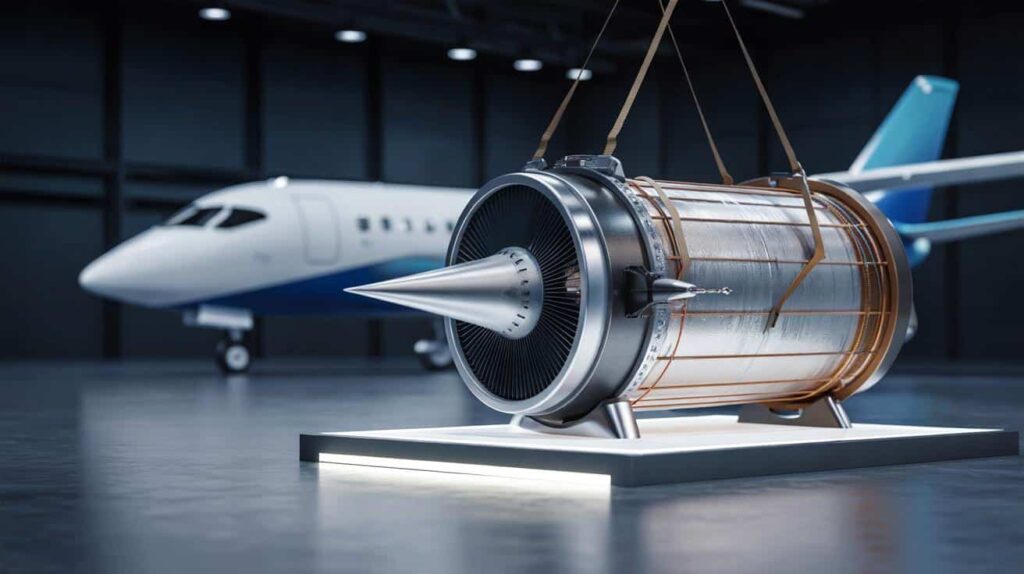
At the heart of the design lies an internal cryocooler, not a bulky external plant. It extends along the axis of the rotor with a “cold finger” that sucks heat out of the superconducting coils and pushes that heat towards the outside casing.
The rotor and cryocooler sit inside a vacuum enclosure. Kevlar cords suspend the rotating assembly, acting like slender thermal insulators: strong enough to hold the rotor in position, poor enough at conducting heat to keep the cold where it is needed. Around this chamber, reflective mylar insulation bounces radiant heat away, just as in high‑performance thermal flasks.
The result is a cold island floating inside a warm machine. The superconducting coils operate at cryogenic temperatures, while the exterior of the motor behaves like a regular industrial component, compatible with aircraft integration or other heavy‑duty uses.
The key step is not a record temperature or record power; it is showing that cooling, mechanics and electromagnetics can live together in one rugged package.
Why superconductivity changes the maths for aviation
When a material turns superconducting, its electrical resistance drops effectively to zero. Current circulates without the usual heating losses that plague copper windings in classic electric machines. That has several direct consequences for aircraft designers:
- Higher efficiency, with minimal energy wasted as heat.
- Smaller and lighter cooling hardware.
- Much stronger magnetic fields for the same input power.
- Higher torque density, enabling compact propulsion units.
In aviation, that last point matters as much as raw efficiency. A lighter, smaller motor allows more passengers, more battery capacity or simply more range. For regional electric aircraft or hybrid airliners, shaving hundreds of kilograms off the propulsion system can change the business case completely.
Chasing 99.5% efficiency at megawatt scale
From “a few kilowatts” to six megawatts
The CES demonstrator itself only delivers a few kilowatts. The figure that grabbed attention was its claimed efficiency: around 99.5%. At that size it sounds like engineering bragging rights. At six megawatts, Hinetics’ stated target for future aviation motors, it becomes a different story.
Half a percentage point of loss sounds tiny on paper. On a multi‑megawatt system, that difference translates into hundreds of kilowatts of heat that no longer need to be removed, ducted away, or accounted for in the aircraft’s thermal management system.
Less heat means smaller radiators, lighter cooling loops and fewer compromises elsewhere on the airframe. Engineers obsess over such numbers because they stack up. A more efficient motor can shrink the energy storage requirement, which then trims structural loads, which then eases wing design.
At ten times the torque density of a conventional motor, designers can trade bulky nacelles for slimmer, lighter pods without sacrificing thrust.
Hinetics reports that its superconducting design operates with magnetic fields two to three times stronger than standard machines. That enables higher torque at lower weight and opens new architectures, from distributed electric fans along a wing to compact pods on tilt‑rotor aircraft.
Built for aircraft, aimed at data centres too
Electric propulsion concepts on the table
On the aviation side, the company is targeting motors in the three‑to‑six‑megawatt range, spinning at roughly 1,800 revolutions per minute. That performance envelope aligns with several emerging concepts:
- Hybrid‑electric regional aircraft with two or four large propulsors.
- Short‑haul commuter planes relying on batteries plus a fuel‑burning range extender.
- eVTOL or tilt‑wing vehicles where compact, high‑torque motors reduce rotor diameter.
Airframe makers already sketch designs that assume such motors exist. Until now, the cooling overhead for superconductors made those numbers look speculative. An integrated, self‑contained machine significantly lowers the engineering risk.
A surprising second market: AI power infrastructure
Hinetics is not just eyeing skies. The company also talks openly about data centres, particularly those feeding generative AI clusters. These sites experience violent, rapid swings in power demand as workloads spin up and down. Traditional rotating generators cope poorly with those fast spikes, leading operators to add layers of batteries and power‑conditioning hardware.
A superconducting motor‑generator with very low inductance and very fast response could plug directly into these systems. Because it can change its electrical power output almost instantly, it can smooth loads on the grid without massive intermediate energy buffers.

Where data centres now juggle batteries, capacitors and complex converters, a responsive superconducting machine could become the grid’s shock absorber.
This kind of application may help fund and scale the technology before it flies on commercial aircraft. Ground‑based installations loosen weight constraints and tolerate easier access for maintenance, which makes them a realistic early step.
Three years, one demonstrator, and an ARPA‑E bet
A scaled‑down proof of concept
The motor shown in Las Vegas is not a ready‑to‑order product. It is a one‑twentieth‑scale demonstrator of a three‑megawatt machine currently in development. The goal is not headline power, but integration.
The prototype encapsulates three years of work on four intertwined problems: reaching and holding low temperatures, maintaining mechanical stability of the rotor, containing the vacuum, and controlling the powerful magnetic field without shaking the machine apart.
The project receives funding from ARPA‑E, the US Department of Energy agency created to back high‑risk, high‑impact technologies. ARPA‑E has a track record of seeding innovations that traditional corporate R&D would judge too speculative, from advanced batteries to novel grid hardware.
“Baby Yoda” and the thermal turning point
Internally, Hinetics staff refer to a key prototype tested in May 2025 as “Baby Yoda”. That earlier device focused not on full motor operation, but on one question: could off‑the‑shelf cryocoolers hold superconducting magnets at around minus 224 degrees Celsius in a practical, repeatable way?
Using a commercial Stirling cryocooler, they managed to maintain the required temperature and stability. That result gave the team confidence that the thermal side could scale without exotic, custom‑built refrigeration equipment. The CES demonstrator is the logical descendant of that small, slightly cheekily named test rig.
Cost, materials and the long road to fleets of electric aircraft
The price of superconducting tape
The main constraint now is not physics. It is the cost curve of the superconducting material itself, often supplied as thin, flexible tapes. These tapes carry large currents without resistance but require sophisticated manufacturing processes involving layered ceramics and precise crystal structures.
According to Hinetics, prices for such tapes have already halved over the past three years. The company forecasts another halving in the next three, driven by broader industrial demand and maturing production lines. If that trend holds, superconducting machines start to compete on pure economics in high‑value niches where power density and efficiency outrank upfront cost.
Superconductivity shifts from scientific indulgence to engineering option once material prices fall into the same order of magnitude as conventional copper‑based solutions.
Until then, aerospace applications are likely to appear first in segments where ticket prices and regulatory pressure justify new technologies: business aviation, regional routes in low‑emission corridors, and military or governmental platforms with special requirements.
Risks and hurdles still ahead
Several challenges remain. Reliability tops the list. Aircraft engines must function for thousands of hours with minimal unscheduled maintenance. Any cryogenic leak, vacuum failure or cryocooler breakdown in flight is not acceptable, so redundancy strategies will matter as much as raw performance.
Certification also looms large. Regulators such as the FAA and EASA need data on failure modes: what happens if the motor loses superconductivity mid‑flight, how quickly it warms up, and whether it can continue to operate at reduced performance without damaging itself.
Then there is the supply chain. Scaling production of high‑temperature superconducting tape, vacuum enclosures and cryocoolers for hundreds of aircraft requires coordination well beyond a single start‑up.
Key concepts behind the tech, in plain language
What “high‑temperature” superconductors really mean
The phrase “high‑temperature superconductor” can mislead. These materials still need chilling to far below freezing, often between –200°C and –250°C. The “high” refers only to the fact that they operate at higher temperatures than the earliest superconductors, which had to be cooled with liquid helium to around –269°C.
In practice, that shift from liquid helium to nitrogen‑class temperatures makes cooling systems cheaper and much simpler. Stirling cryocoolers like those used by Hinetics are essentially precise refrigerators, not rare‑gas liquefaction plants.
A simple scenario: a hybrid‑electric regional plane
Picture a 40‑seat regional aircraft flying 500–700 kilometres. Today it burns kerosene using turboprop engines. Replace those with two six‑megawatt superconducting electric motors. Feed them with a mix of batteries and a small gas turbine driving a generator.
The motors’ high efficiency means less battery mass for the same route or extra reserves for diversions. Their compact form allows sleeker nacelles and potentially distributed propulsion, improving aerodynamic efficiency. On the ground, the gas turbine can run at optimal efficiency or switch off entirely when plugged into a green grid.

| Aspect | Conventional motor | Superconducting motor (target) |
|---|---|---|
| Electrical efficiency | 95–97% | ~99.5% |
| Torque density | Baseline | ≈10× higher |
| Cooling system | Air or liquid, external radiators | Integrated cryocooler, vacuum enclosure |
| Weight for same power | Higher | Significantly lower (target) |
Scenarios like this still depend on battery progress and regulatory acceptance. Yet the arrival of an integrated superconducting motor makes those design sketches less speculative and more like early drafts of future flight plans.