
It’s 3:17 a.m. The room is quiet in the way only winter nights are quiet. You’re awake, not sharply alert, not fully restless—just hovering. One leg sticks out from under the blanket because you’re too warm, but pulling it back in feels wrong too. The clock glows softly, and for a moment you wonder how long you’ve been lying like this.
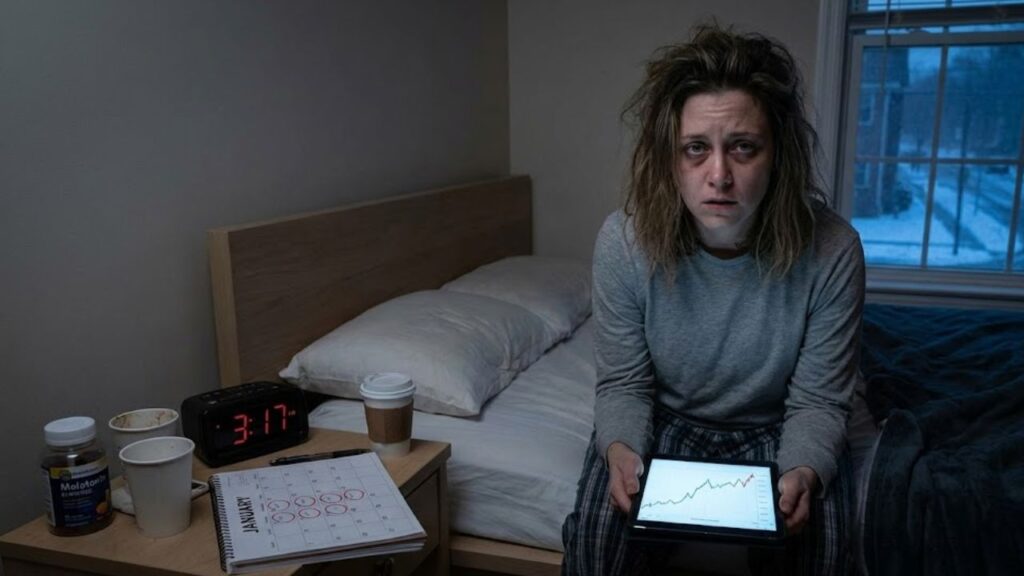
You don’t feel panicked. You don’t even feel especially tired. What you feel is slightly off—like your body and the night have stopped agreeing on the rules.
For many people, especially after 50, this moment shows up more often at the start of the year. Not as a crisis. More as a quiet pattern you can’t quite explain.

The strange feeling of being out of step
January and February can feel oddly disorienting. The world insists it’s a fresh beginning, but your body doesn’t seem to have received the memo. Days feel short. Mornings arrive too quickly. Even when life is steady, something feels misaligned.

You may notice that sleep doesn’t arrive when it used to. Or it arrives, but leaves too early. Or it feels thinner—less restorative—than you remember. You’re not exhausted in a dramatic way. You’re just not quite settled.
This sense of being “out of sync” isn’t about willpower or routine failure. It’s about rhythm—and how sensitive that rhythm becomes as we age.
How the start of the year quietly disrupts sleep
Sleep is deeply tied to timing. Light, temperature, daily movement, and even social cues all help your body decide when to wind down and when to wake. At the start of the year, many of these signals shift at once.
Days are still short, even if the calendar promises progress. Morning light arrives later. Evenings stretch into darkness earlier than feels natural. The body, especially an older one, notices these changes more than we expect.
There’s also a subtle psychological layer. The new year carries an unspoken pressure to reset—to reflect, reassess, and somehow feel renewed. Even if you’re not actively thinking about goals or resolutions, your nervous system picks up on the collective restlessness.
Sleep, which depends on a sense of safety and predictability, doesn’t always cooperate in moments of quiet internal adjustment.
A small, familiar story
Margaret, 62, describes it as “light sleep season.” She falls asleep without trouble, but wakes at 4 or 5 a.m., her mind already halfway into the day. Not anxious thoughts—just a low-level alertness, as if something needs attending to.
She says it doesn’t feel like insomnia the way people talk about insomnia. It feels more like her body has shifted into a different timetable without asking her opinion.
Many people share versions of this story at the start of the year. The details differ, but the tone is the same: quiet, puzzling, and persistent.
What’s happening inside, in plain terms
As we get older, sleep becomes lighter and more sensitive. The systems that once adjusted easily to seasonal change now respond more slowly. Your internal clock—the part of you that tracks day and night—relies heavily on light and routine.
In winter, light exposure drops, especially in the morning. This can delay the body’s sense of “daytime,” which then pushes sleep later at night or causes early waking before rest feels complete.
At the same time, the brain becomes more alert to subtle changes. Hormonal shifts with age mean that stress—even low-grade, background stress—has a greater influence on sleep. Not stress in the dramatic sense, but the kind that comes from change, reflection, and uncertainty.
The result isn’t always classic sleeplessness. Often, it’s fragmented sleep. Lighter sleep. Sleep that no longer feels like a deep retreat, but more like a series of pauses.
Why this surge happens every year
The start of the year compresses several disruptions into a short window. Seasonal darkness, altered routines after holidays, colder temperatures, and social expectations all overlap.

For younger bodies, this overlap may pass unnoticed. For older bodies, it can tip the balance. Sleep doesn’t “break,” but it becomes less predictable.
This is why so many people report new or worsening sleep problems in January and February—even those who slept well for years. It’s not a personal failure. It’s a seasonal convergence meeting an ageing nervous system.
Gentle adjustments that support the rhythm
Rather than fixing sleep, many people find relief in quietly supporting their body’s timing. Small shifts, repeated calmly, often matter more than big changes.
- Letting morning light touch your face, even briefly, without rushing the moment
- Keeping evenings softly consistent, especially with meal and wind-down times
- Allowing sleep to change shape without immediately judging it as “bad”
- Noticing warmth, comfort, and physical ease before focusing on falling asleep
- Giving yourself permission to rest, even when sleep feels incomplete
These are not rules. They’re ways of listening.
A moment of recognition
“I thought something was wrong with me,” one man in his late fifties said. “Then I realized my nights were just asking for a different kind of patience.”
This kind of recognition often brings more relief than any technique. Sleep responds to how safe the body feels, not how hard the mind tries.
Reframing what sleep means now
Sleep in later life is less about depth and more about continuity. Less about long, unbroken hours and more about overall restfulness across the night.
When sleep disorders seem to “explode” at the start of the year, it’s often because expectations collide with reality. The body is adapting, recalibrating, responding to light and time in a more nuanced way.
Understanding this doesn’t instantly restore perfect sleep. But it changes the tone of the experience. Instead of feeling broken, you may begin to feel accompanied—by your own biology, doing its quiet work.
There is nothing to win here. No finish line where sleep becomes effortless again. There is only an ongoing relationship with rest, one that evolves as you do.
And sometimes, especially in the first months of the year, that relationship asks for gentleness above all else.
What this shift can offer
Many people eventually notice that lighter sleep brings a different awareness. Quieter mornings. A deeper sense of the night’s texture. More sensitivity to comfort and rhythm.
It’s not better or worse—just different. And when that difference is understood, it often becomes easier to live with.
The year will move forward. Light will return. Your body will adjust again, in its own time.

Sleep doesn’t need to be forced back into an old shape. It only needs space to become what it is now.

| Key point | Detail | Value for the reader |
|---|---|---|
| Seasonal timing | Winter light and routines shift sleep rhythms | Reduces self-blame and confusion |
| Age-related sensitivity | Older bodies respond more strongly to change | Normalizes new sleep patterns |
| Psychological undertone | Start-of-year reflection affects rest | Encourages emotional understanding |
| Gentle support | Small, calm adjustments help rhythm | Offers permission instead of pressure |
