
The first white hair almost feels like a surprise guest. The day you notice that your temples have gone salt and pepper, the mirror suddenly stops being neutral. You tilt your head, you squint, you smooth one strand, then another. You zoom in on your phone camera, change the lighting, try to convince yourself it’s just the reflection.
Then one morning, it’s obvious. You’re no longer “a few grays.” You’re really gray. So you tell yourself: fine, I’ll lean into it. I’ll ask for a fresh, rejuvenating cut. The kind that makes people say, “You look different… in a good way.”
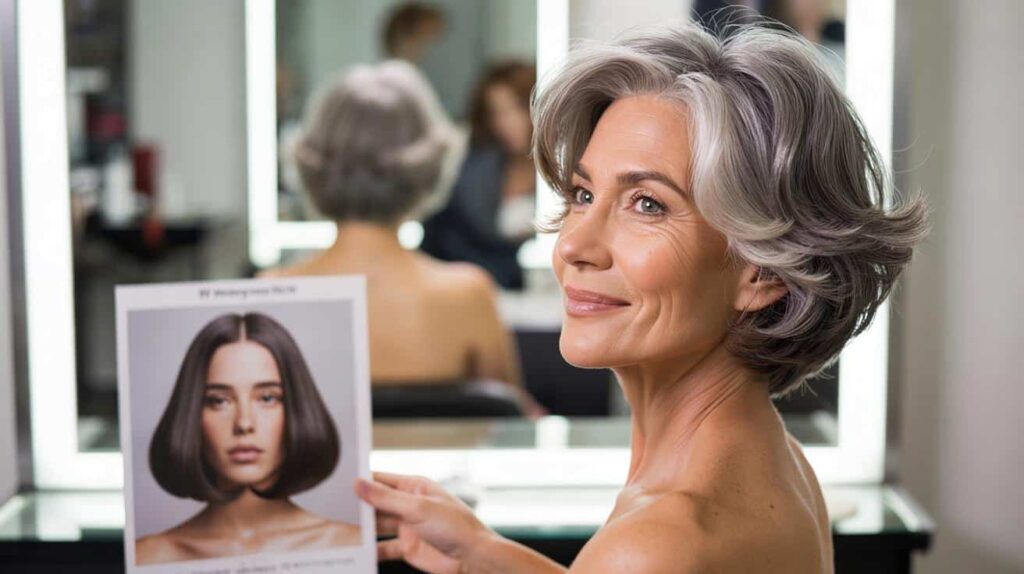
You book the appointment, you bring an inspiring photo, you sit down in the chair. And that’s often where the two worst mistakes begin.
Without you even noticing.
The first big trap: choosing a “young” cut that fights against your salt and pepper
The reflex is almost automatic: you want to erase years, so you ask for a “young” haircut. A fringe that hides the forehead. Long layers “like before.” A hyper-structured bob. Something that looks like your younger self tinted in brown.
Except gray and white hair doesn’t behave like brown hair from 10 years ago. It reflects light differently. It stiffens a little, thickens, or on the contrary gets finer. A cut that worked perfectly when your hair was all chestnut can suddenly harden everything and weigh down your features.
That’s how a supposedly rejuvenating cut ends up aging the whole face.
Picture this. Claire, 54, arrives at the salon with a photo of a 30-year-old influencer: super smooth brown bob, blunt ends, zero volume. Her own hair is naturally wavy, 70% gray, with playful white strands around the face.
The hairdresser does exactly what she asks. He straightens, thins out, polishes. For the first five minutes, under the salon lights, it looks “chic.” Two days later, without the round brush and pro products, her hair falls flat, the bob hugs her jawline too tightly, and the gray strands look scattered instead of luminous.
Claire suddenly looks more tired. Sharper jaw, more visible dark circles, expression hardened. The cut isn’t “bad” technically. It’s just fighting her salt and pepper instead of working with it.

A cut that rejuvenates salt and pepper hair doesn’t try to turn back time. It reframes it. Gray and white bring contrast and strong lines to the face. If the haircut is too geometric, too stiff, or too long with no structure, all the emphasis goes to every little sign of fatigue.
Soft layers around the face, a bit of movement, a shape that respects how your gray hair naturally falls – that’s what brings the glow back. *The goal isn’t to look 25 again, it’s to look wildly alive at your real age.*
Let’s be honest: nobody really does a full blow-dry every single day. A “young” cut that only works with styling tools, and collapses the moment you air-dry, isn’t youth-giving. It’s just exhausting.

The second mistake: ignoring texture and color nuance, and letting the gray “flatten” you
The second big mistake shows up more quietly. You accept your gray, you say goodbye to dye, you go for a short or mid-length, thinking “natural will rejuvenate me.” The intention is great. The problem is when everything is left at the same level: same length, same color block, same volume everywhere.
Salt and pepper is naturally multi-tonal. Some strands are white, others steel gray, others almost blond. A cut with no thought for texture or nuance can turn this richness into a dull mass.
A rejuvenating haircut on gray or white hair always plays with light. It carves movement. It invites softness where the face needs lifting.
Think of Marc, 61, who decided to stop coloring during lockdown. His hair is a beautiful mix of silver and charcoal, thick on top, softer at the sides. After months of growing it out, he walks into a barbershop and says, “Just clean it up.”
The barber goes for the classic machine cut: short sides, slightly longer on top, all the same density. No texture, barely any scissors, no attention to the way the white hair shines in front. The result is neat… and brutally flat. The salt and pepper that could have looked distinguished now gives him a square helmet effect.
When he pushes his hair up with his fingers at home, you can see instantly: a little gradient, a few lighter strands at the temples, a more airy top would have taken years off his face.
Gray and white hair “swallows” light if it’s cut in one compact mass. The eye doesn’t know where to look, so it lands on signs of fatigue or sagging. A nuanced, textured cut creates focal points: a softer strand grazing the cheekbone, lightened tips that catch the sun, a slightly shorter nape that refines the neck.
This doesn’t mean you need aggressive layers or visible highlights. It means treating the salt and pepper as a built-in contouring tool. The white brightens what you want to bring forward, the darker gray sculpts what you want to define.
Without this intention, the hair can look “honest” but a little sad. With it, the same gray suddenly looks sharp, radiant, and strangely liberating.

How to ask for a rejuvenating salt and pepper cut (without falling into the two traps)
The most effective method starts before you even sit in the chair. Take photos of yourself from three angles: front, profile, and three-quarter. Natural light, relaxed expression, hair as it is in real life. Then, instead of looking for celebrities “your age,” look for photos of people with a similar gray pattern and texture.
Bring two or three of those to your hairdresser and explain what you feel, not just what you want. “I feel like my hair drags my features down.” “I want my eyes to stand out more.” “I like that my white streak shows, I don’t want to hide it.”
A good pro will immediately see where to cut to lift, where to keep length to soften, and where your salt and pepper can become your best lighting.
The other key: speak honestly about your daily reality. If you always end up air-drying, say so. If you hate styling products, say it. A cut that needs 15 minutes of blow-drying every morning will not be rejuvenating, it will be annoying.
Ask your hairdresser to show you what your hair will look like with “no effort” styling. Hands, a bit of water, maybe one product, two minutes. If the cut still frames your face nicely and the salt and pepper falls in a flattering way, you’re on the right track.
And if they suggest hiding all your gray or cutting super short “to look younger,” listen to that little voice inside. Often, it’s right.
“Salt and pepper hair ages you only when the haircut disagrees with your story. The day cut and color start telling the same story, everything relaxes,” says a Paris hairstylist who works mostly with clients over 45.
- Ask for softness, not “youth”
Words matter. “Softer around the face” or “more light toward the eyes” leads to better cuts than “make me look younger.” - Use your white strands as an ally
Those lighter pieces near the temples or front can be your natural highlighter when the cut lets them fall in the right place. - Keep movement where your face drops
A tiny flipped end at jaw level, or a gentle wave at cheekbone height, visually lifts without looking forced. - Accept a touch of imperfection
Salt and pepper loves a bit of messy texture. A too-perfect finish can look strict and older. - Test the “hands-only” rule
If you can’t reproduce a decent version of the cut with just your fingers, it may not be your rejuvenating haircut.
When salt and pepper becomes your best beauty filter
Something shifts the day you stop fighting your gray and start designing around it. Instead of obsessing over the years gone by, you begin editing the present. A slightly shorter nape changes your posture. A light, airy fringe opens your gaze. The white streak you used to hide suddenly becomes your signature.
People don’t say, “You’ve gone gray.” They say, “You look… different, rested, kind of luminous.” They don’t always know it’s the haircut, the texture work, the way the strands frame your mouth when you smile. But you know the mirror hurts less. Sometimes it even helps.

We’ve all been there, that moment when the image in the reflection seems to lag behind who we feel we are inside. Salt and pepper hair doesn’t fix that gap. A good cut can narrow it, though. It takes a bit of honesty, a bit of courage, and a pro who doesn’t push you into the two easy mistakes: chasing a fake “young” version of you, or letting the gray flatten everything.
The rest is a slow, subtle shift. You walk past a storefront, catch your reflection, and you don’t flinch. You just think: “Yeah. That’s me. And I like her.”

| Key point | Detail | Value for the reader |
|---|---|---|
| Avoid “young at all costs” cuts | Skip styles that fight your texture or copy your 30-year-old self | Reduces the risk of looking harsher or more tired |
| Work with texture and light | Soft layers, movement, and natural contouring with white strands | Makes gray and white hair look luminous instead of dull |
| Test the real-life version of the cut | Hands-only styling, honest talk about your routine | Guarantees a rejuvenating effect you can keep every day |
FAQ:
- Should I always go shorter when my hair turns gray?
No. Short hair can be very fresh, but a mid-length cut with movement can be just as rejuvenating. The key is harmony with your face shape and your salt and pepper pattern, not automatic “short hair after 50.”- Does gray hair really need a special cut?
It benefits from it. Gray and white reflect light differently and often change in texture, so a cut that worked before can suddenly look heavy or strict. A few targeted adjustments make a big difference.- Can layers age me with salt and pepper hair?
Badly placed, yes. Very thin, choppy layers can make hair look sparse. Soft, strategic layers around the face, on the other hand, bring movement and a lifting effect that often looks younger.- Should I keep a fringe when I go gray?
A fringe can be incredibly flattering on gray hair if it’s light and a bit airy. Heavy, very straight bangs tend to harden the expression. Ask for a soft, tapered fringe that blends into the rest of the cut.- How often should I cut gray or white hair?
On average every 6 to 10 weeks, depending on your length and style. Gray hair shows shape changes more quickly, so regular mini-adjustments help maintain that fresh, rejuvenating effect without drastic overhauls.
