
The woman in front of me at the café looked like she’d just stepped out of a quietly glamorous movie. Soft, luminous hair pulled into a low bun, strands catching the light. Only when she leaned forward to pay did I notice it: not a single solid colour, but a blend of silver and warm tones. No harsh line at the roots. No “I missed my salon appointment” panic.
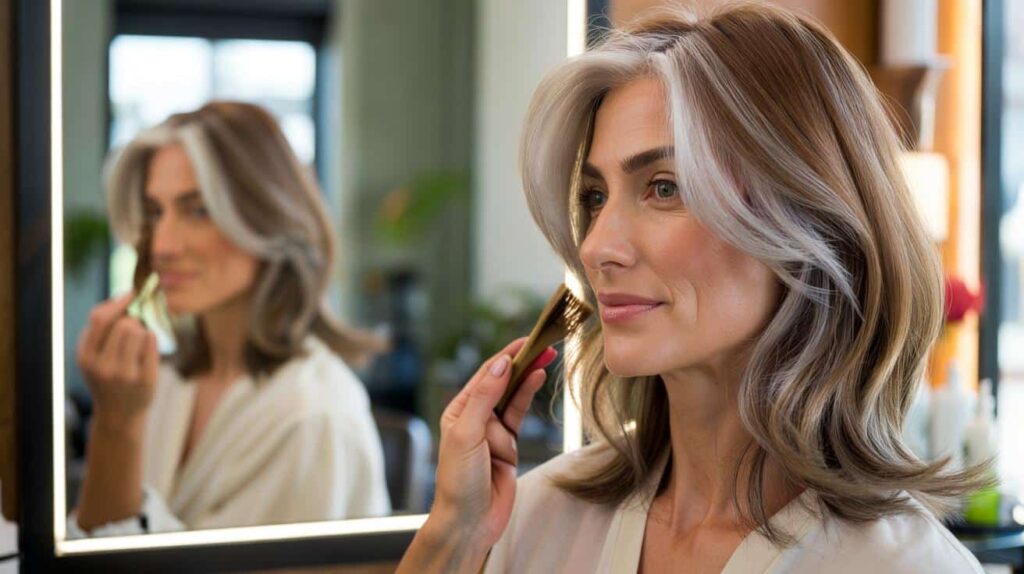
She had the relaxed posture of someone who’s not hiding anything anymore.
As she left, two teenagers at the next table whispered, “That grey looks cool, actually.”

Something has shifted.

The new way to cover grey hair isn’t about pretending it never existed. It’s about reshaping it so cleverly that it makes your whole face look fresher.
The dye box era is quietly fading.
Why harsh dyes are out and “soft coverage” is in
Look closely on the street, in the metro, at school gates: the full, flat, single-tone colour is slowly disappearing. You see it mostly on people who are clinging to an old habit. What’s rising instead is a softer, blurred approach to covering grey, where colour melts into natural tones rather than erasing them.
No brutal dark brown that turns hair into a helmet. No “shoe polish black” that somehow makes your skin look tired.
The new trend plays on transparency. It lets light through.
It’s less “I dyed my hair” and more “my hair just looks…better.”
Hairdressers around Europe and the US are quietly reporting the same thing: fewer all-over permanent dyes, more requests for “something gentle that blends my grey but doesn’t look fake.” One Paris colorist says 70% of his clients over 35 now ask for grey blending instead of a uniform colour.
Think of techniques like glossing, balayage, lowlights, and demi-permanent toners. These don’t fully smother the white hairs. They soften them.
The result is a kind of Instagram filter for your hair.
On social media, posts tagged “grey blending” and “reverse balayage” have racked up millions of views, because people suddenly realise: they don’t have to choose between all-grey and full-dye.
There’s a logic under the trend, and it’s not just aesthetic. Strong dyes with high developer lift the hair cuticle, dry it out, and demand more frequent touch-ups. That cycle ages the hair fibre, which paradoxically can make you look older.
On the face, a very dark, opaque colour deepens shadows, marks wrinkles, and hardens features. Lighter, multidimensional tones soften the contours and reflect light away from fine lines.
*That’s why someone with a slightly grey, softly blended hairline often looks younger than someone with a flat, inky dye job.*

The new movement doesn’t scream youth. It quietly suggests vitality.
The new way to cover grey and look younger without “lying”
The heart of the trend is simple: stop fighting every grey hair, start shaping the overall picture. One practical method that stylists swear by is demi-permanent gloss. It’s a low-commitment colour that wraps the hair rather than stripping it.
You apply it mostly where you need softness: around the hairline, at the temples, on the top where partings reveal more white. The gloss slightly tints the greys instead of blocking them out, giving them a beige, champagne, or light chestnut tone, depending on your base.
Then come lowlights: fine, slightly darker strands woven in between grey and natural hair. This creates depth and breaks up any “salt line.”
Together, these techniques fake the illusion of thicker, fuller hair without a stark, high-maintenance dye.
At home, the same spirit can be adapted with toning masks and semi-permanent colours. The gesture is different from the old box-dye routine. Instead of meticulously coating every millimetre of the root, you work more like you’re applying skincare: targeted, lighter, less obsessive.
You can apply a toner mask on the mid-lengths and ends to refresh shine, then touch the temples with a soft, brush-on root concealer between salon visits.
Let’s be honest: nobody really does this every single day.
The idea isn’t perfection. It’s easing the contrast between grey and not-grey, so that when roots come back, they don’t scream for help. The grow-out phase becomes almost invisible.
“Women arrive in my chair exhausted by the war against grey,” explains Ana, a colourist in Lisbon who has a three-month wait list. “The moment we stop chasing zero grey and start chasing softness, their whole face changes. Their shoulders drop. They look like themselves again, just…rested.”
- Choose transparency over opacity
Opt for demi-permanent or semi-permanent shades instead of strong, permanent pigments that block light. - Blend, don’t blanket
Ask for grey blending, lowlights, or reverse balayage to diffuse grey rather than erase it line by line. - Lighten your base slightly
Going one or two shades softer than your “old natural” colour instantly softens features. - Care like skincare
Hydrating masks, oils, and gentle shampoos keep blended grey shiny, which makes it look intentional, not neglected. - Stretch the schedule
Aim for colour every 8–12 weeks, with quick touch-ups only where the eye goes first: parting and temples.
A new relationship with age, hair, and the mirror
The real revolution behind this trend isn’t just technical, it’s emotional. For years, grey hair has been treated like a problem to fix overnight, like a stain on a white shirt. Now the conversation is shifting to: “How can I live with it gracefully, without fast-forwarding my face by ten years?”
We’ve all been there, that moment when you catch your roots in a harsh bathroom light and feel a stab of betrayal.
Yet the women and men embracing blended grey often talk about a quiet freedom. They’re not “letting themselves go”; they’re curating their appearance in a way that respects both who they were at 25 and who they are at 45, 55, or 65.

Some still colour, but the colour serves their features, not their fear.
 Goodbye footprint marks on your sandals: the trick to erase them and make them look new again
| Key point | Detail | Value for the reader |
|---|---|---|
| Shift from full dye to grey blending | Use demi-permanent gloss, lowlights, and diffusion techniques instead of solid colour | Softer grow-out, fewer harsh roots, and a more natural, youthful effect |
| Lighter, multidimensional tones | Go one to two shades softer with subtle highlights around the face | Brightens skin, reduces the appearance of fine lines, and refreshes the overall look |
| Care and maintenance over constant coverage | Hydrating treatments, spaced-out colouring, targeted touch-ups at the hairline | Healthier hair, less stress, and a routine that fits real life rather than dominates it |
FAQ:
- Question 1Does grey blending work if I’m already mostly grey?
- Question 2How often should I refresh gloss or demi-permanent colour?
- Question 3Can I try this at home or do I need a salon?
- Question 4Will this trend suit curly or textured hair?
- Question 5What if I change my mind and want to go fully natural grey?
