
<strong>Arctic air has gripped North America so hard that one of its most powerful waterfalls has slowed to a ghostly crawl.
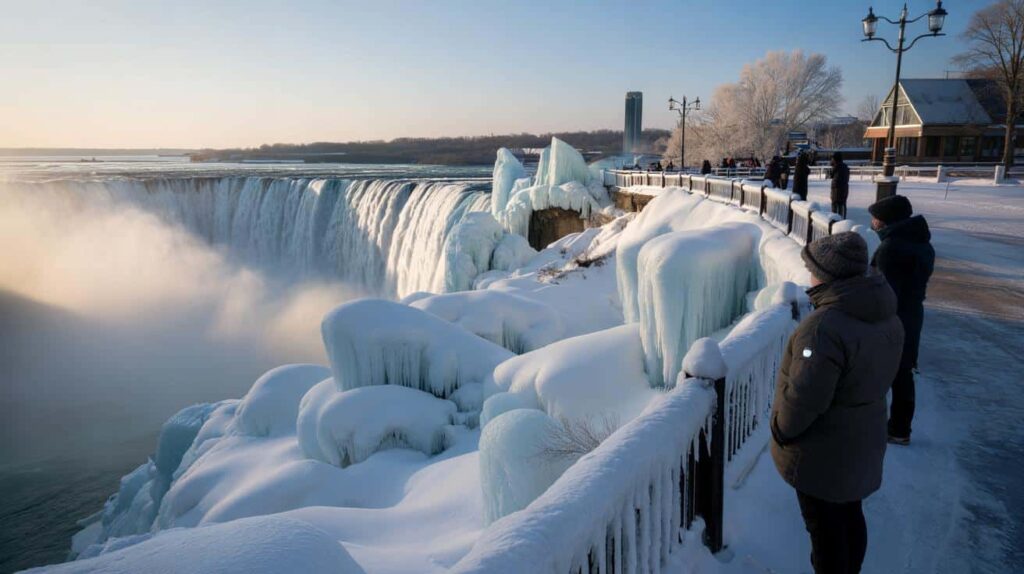
As a brutal cold snap hammers Canada and parts of the northern United States, Niagara Falls has taken on an eerie, icy stillness, with vast sections appearing frozen in place and temperatures plunging as low as minus 55 degrees Celsius with wind chill.
Niagara Falls shrouded in ice and mist
The roar of Niagara Falls rarely fades, yet in recent days visitors have reported an unfamiliar quiet. Sheets of ice now cling to the cliffs, railings and viewing platforms. Chunks of frozen spray form bizarre sculptures that look almost unreal in photos and videos shared from the scene.

Despite the dramatic appearance, the falls are not completely frozen solid. Water is still thundering behind and beneath the ice, but the surface is so crusted with snow and frozen spray that, from a distance, parts of the cascade look like a static white wall.

At air temperatures down to minus 55 degrees with wind chill, the spray that usually drenches tourists turns instantly into ice.
The cold has been driven by a deep Arctic blast that settled over large areas of central and eastern Canada. Weather agencies have issued extreme cold warnings, advising residents to limit time outdoors and layer up against the biting wind.
How waterfalls “freeze” without actually stopping
Niagara Falls is fed by the Niagara River, which drains water from four of the five Great Lakes. That enormous volume makes a complete freeze almost impossible. What does freeze, though, is everything around and above the flowing core.
Why the falls almost never freeze completely
- Roughly 2,400 cubic metres of water flow over the falls every second.
- Movement generates friction and turbulence, which slow the formation of solid ice.
- Engineers regulate some of the flow, but not enough to stop the river.
Instead of turning into a solid block, the falls grow an outer shell. Spray thrown into the air by the falling water hardens into rime ice on nearby rocks, trees and buildings. Slower eddies at the river’s edges freeze first, then larger pans of ice drift toward the brink and pile up into rafts.
The result is a “frozen” façade – a thick coat of ice masking a fierce current still rushing just out of sight.
Historically, eyewitness accounts from the 19th and early 20th centuries describe the falls as having frozen entirely. Modern researchers suspect those reports reflected extensive surface ice and temporary blockages upstream, not a total halt in flow.
Minus 55 degrees: how dangerous is this kind of cold?
The temperatures now being reported in parts of Canada, especially when wind chill is factored in, reach levels that can be life-threatening in minutes. At around minus 40 to minus 55 degrees Celsius with wind, exposed skin can begin to freeze in less than 10 minutes.
| Wind chill temperature | Approximate frostbite risk |
|---|---|
| -20 °C to -30 °C | Frostbite possible on exposed skin after 30–60 minutes |
| -30 °C to -40 °C | Frostbite possible after 10–30 minutes |
| -40 °C to -55 °C | Frostbite possible in less than 10 minutes |
| Below -55 °C | Frostbite and hypothermia risk extremely high, even with brief exposure |
Hospitals and emergency services in cold-affected regions prepare for spikes in slips, falls, traffic accidents and cold-related injuries. Homeless people, outdoor workers and those in poorly heated housing face the greatest risk.
Impact on local communities and travel
The icy spectacle has a double effect on the Niagara region. On one hand, it attracts sightseers who brave the cold for unusually dramatic photographs. On the other, the weather disrupts normal life.
Authorities frequently reduce road speeds, close icy walkways and warn against getting too close to the edge, where surfaces are coated with slick, invisible ice. Some boat tours and outdoor attractions suspend operations during the harshest conditions.
Tourism officials walk a tightrope between celebrating the once-in-a-decade scenery and discouraging risky behaviour in lethal cold.

Cross-border travel between Canada and the United States can also be affected. Blowing snow, whiteouts and extreme wind chill make driving over nearby bridges more hazardous, even if the border itself remains open.
The science behind such extreme cold
Events like this typically occur when a lobe of the polar vortex – a ring of strong winds that circles the Arctic high in the atmosphere – sags southward. That shift allows frigid Arctic air to spill over densely populated regions, dropping temperatures far below seasonal norms.
Scientists are still studying how a warming climate interacts with these cold outbreaks. Overall, winters are trending milder globally, yet some research suggests that disruptions in polar patterns might lead to more frequent or intense cold spells in certain areas.
Regardless of the long-term trends, the current cold snap shows how exposed infrastructure can be. Power lines sag under ice loads, older homes struggle to retain heat, and energy demand surges as people crank up heating systems.
What visitors need to know before heading to the falls
For those tempted by the idea of seeing the “frozen” Niagara Falls in person, preparation matters more than ambition. The scenery can be spectacular, but the environment is unforgiving.
Staying safe in minus 55 degree conditions
- Wear several thin layers rather than one thick one to trap warm air.
- Protect extremities: insulated gloves, thick socks and a windproof hat are vital.
- Cover all exposed skin; a scarf or balaclava reduces frostbite risk to the face.
- Limit time outside, especially for children and older adults.
- Move carefully on paths and stairs coated with frozen mist.
The impressive photos are rarely worth a hospital visit; planning and time limits turn a risky outing into a manageable one.
Visitors should also keep an eye on official advisories, which may close certain lookouts or restrict access for safety reasons. Temperatures can shift quickly with changing wind patterns, turning a tolerable day into a dangerous one in an hour.
From frozen falls to frozen pipes: everyday consequences
Extreme cold does not only remake famous landmarks. It works its way into households and businesses. Water pipes can burst, car batteries fail and heating systems are pushed to their limits.
Homeowners in affected regions often take basic protective steps: letting taps drip to keep water moving, insulating exposed pipes and checking on neighbours who live alone. For people living in better-insulated housing, these measures can prevent expensive damage and long waits for repair services during peak demand.
Understanding terms like wind chill and frostbite
Weather reports from the Niagara region currently refer constantly to “wind chill”. This measure does not change the actual air temperature, but indicates how cold it feels to human skin when wind accelerates heat loss from the body.
Frostbite, a common risk under these conditions, occurs when skin and underlying tissues freeze. Fingers, toes, ears and noses are especially vulnerable. Early signs include numbness and pale or waxy-looking skin. Immediate warming, without rubbing, is crucial, and medical attention is needed if sensation does not return.
For tourists and residents alike, understanding these terms turns an abstract warning into a concrete sense of risk. When a forecast mentions minus 55 degrees with wind chill, it describes conditions where even a short walk without proper protection can lead to permanent injury.
 The forgotten kitchen liquid that effortlessly turns grimy cabinets smooth, clean, and shiny again
This cold spell will eventually ease, and Niagara’s ice shell will crack and melt, sending new torrents downstream. Until then, the falls stand as a stark reminder of how quickly nature can change familiar places into something almost otherworldly.
 Many people don’t realise it, but cauliflower, broccoli and cabbage are varieties of the same plant
