From Hogwarts-inspired worlds to a sunlit beach preserved only in memory, more young people now say they can mentally “shift” into another reality using nothing but focus, ritual, and imagination.
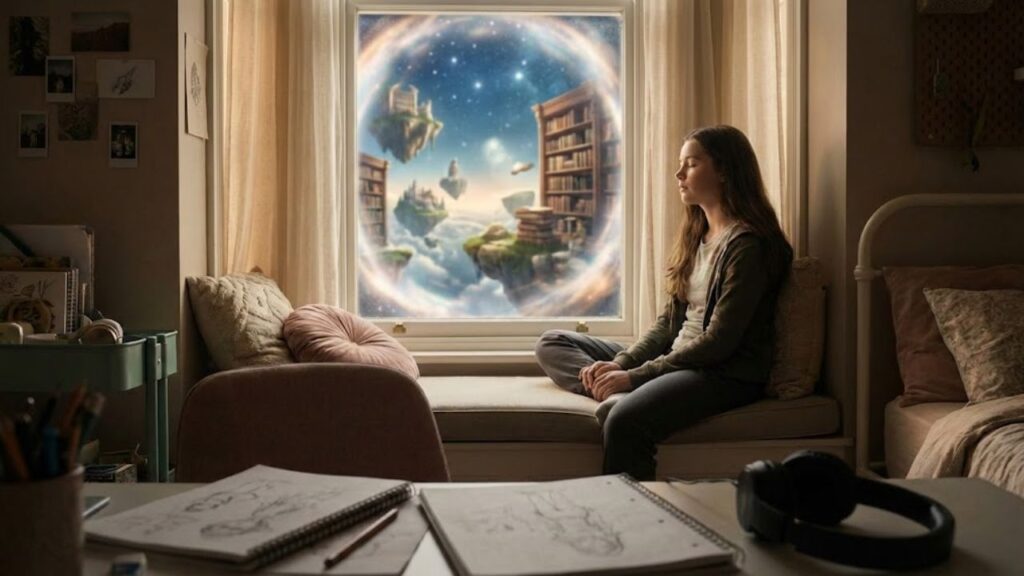
What teens mean when they talk about “shifting”
In online spaces, the term “shifting” is short for reality shifting. While easy to explain, it remains difficult to define scientifically.
At its core, shifting refers to the practice of mentally entering a chosen world with such intensity that it can feel nearly as real as everyday life.
Teens who practise it describe lying still, closing their eyes, and focusing deeply on a place they wish to visit. This destination may be fictional, such as a popular book or film universe, or familiar and real, like a childhood home or a holiday spot they miss.
Many compare the experience to lucid dreaming, meditation, or self-hypnosis. The body remains motionless, but the mind constructs a vivid inner scene. Some report sensing smells, temperatures, or textures within this imagined environment.
How a typical shifting session happens
There is no official or fixed method. Teens exchange routines across platforms like TikTok, Reddit, and Discord, blending relaxation techniques with elements of fan culture.
- Selecting a destination reality, whether fictional or real
- Writing a personal “script” outlining identity, appearance, companions, and time flow
- Lying down in a quiet, dimly lit room
- Using breathing patterns, counting, or affirmations to relax
- Visualising the setting in rich detail until images feel automatic
Those who believe they succeed describe sensations beyond ordinary daydreaming. Others may not reach that point, yet still experience deep calm and relaxation.
Why shifting became popular among adolescents
Shifting existed within fan communities as early as the 2010s, especially in the United States. However, Covid-19 lockdowns dramatically accelerated its spread.
Confined to bedrooms, small flats, or student housing, many teenagers lost access to schools, sports, social events, and relationships. While social media filled part of that gap, it also intensified stress. Shifting emerged as an alternative escape that felt private, free, and controllable.
At a time when physical movement was restricted, the idea of mental travel without limits became especially appealing.
Imagined escapes during uncertain times
Some adolescents pictured themselves on distant beaches, in fantasy adventures, or in calm spaces far from tense home environments. Others used shifting to revisit comforting memories during periods of collective anxiety.
The trend did not fade once restrictions lifted. Shifting-related hashtags still attract millions of views, and for many teens, it now sits alongside journalling, tarot, ASMR, and guided meditation as part of a broader self-soothing routine.
Beyond escapism: new practical uses
Some young adults are now adapting shifting techniques for real-world preparation. They describe mentally rehearsing job interviews, oral exams, or challenging conversations within imagined settings.
In this way, shifting overlaps with methods used in sports psychology, where visualisation helps improve confidence and performance.
When used deliberately, the same mental skills that create a fantasy world can also support stress management and mental rehearsal.
Who practises shifting and why
According to therapists and youth workers, girls and young women tend to speak about shifting more openly than boys. This does not mean boys do not engage in similar practices, but they may describe them differently or avoid public discussion.
Female teens are statistically more involved in fan fiction, fantasy stories, and online fandoms, which provide ready-made worlds and characters. Shifting fits naturally into these narratives.
At its heart, the practice addresses two strong adolescent needs: escape and control. In a shifted reality, teens shape the rules, the identity they inhabit, and even how time behaves.
Emotional relief in a high-pressure era
Rates of anxiety, self-harm, and depressive symptoms among teenagers have risen in many countries over the past decade. Against this backdrop, a practice promising calm or happiness holds clear appeal.
Some teens report feeling lighter and more capable after shifting. For those facing bullying or isolation, an imagined social circle can act as a temporary emotional support.
When fantasy begins to replace daily life
Many professionals compare shifting to reading fiction, writing stories, or role-playing games. In most cases, it is not viewed as harmful.
Concerns arise when the imagined world becomes consistently preferable to everyday life and starts to interfere with school, relationships, or sleep.
Some specialists note that a small number of teens may begin to view their shifted identity as more real or valuable than their everyday self. In such situations, daily functioning can decline.
For adolescents already dealing with depression, trauma, or psychotic symptoms, intense immersion may complicate recovery.
Healthy versus problematic use
- Balanced use: Occasional sessions without disrupting daily responsibilities
- Problematic use: Many hours spent shifting at the cost of sleep or schoolwork
- Balanced use: Continued engagement with friends and hobbies
- Problematic use: Withdrawal from social life and obligations
- Balanced use: Viewing shifting as imagination or mental exercise
- Problematic use: Insisting the imagined world is the only real life
Rather than reacting with fear, professionals suggest observing whether school, sleep, and relationships remain stable.
How adults can respond constructively
Outright bans often push the practice underground. A more effective response is to treat shifting as one form of storytelling and mental training.
Adults can encourage teens to translate their imagined worlds into writing, art, music, or drama, turning inner experiences into creative output.
When adolescents feel listened to, they are more likely to speak up if their inner worlds become disturbing or overwhelming.
Related concepts often discussed
- Lucid dreaming: awareness and partial control during dreams
- Guided imagery: therapist-led or audio-based relaxation scenarios
- Dissociation: mental distancing ranging from mild detachment to severe disruption
- Immersive daydreaming: extended inner narratives with recurring characters
Most teens who describe shifting are likely combining guided imagery and immersive daydreaming. For many, this remains harmless.
Maintaining a healthy balance with imagined worlds
A healthy relationship with shifting includes staying engaged in school, friendships, and daily responsibilities, while viewing the practice with perspective.
The desire to escape is not new. Previous generations turned to novels or video games. Today’s teens may simply close their eyes instead of opening a book, seeking the same things: safety, power, and understanding.