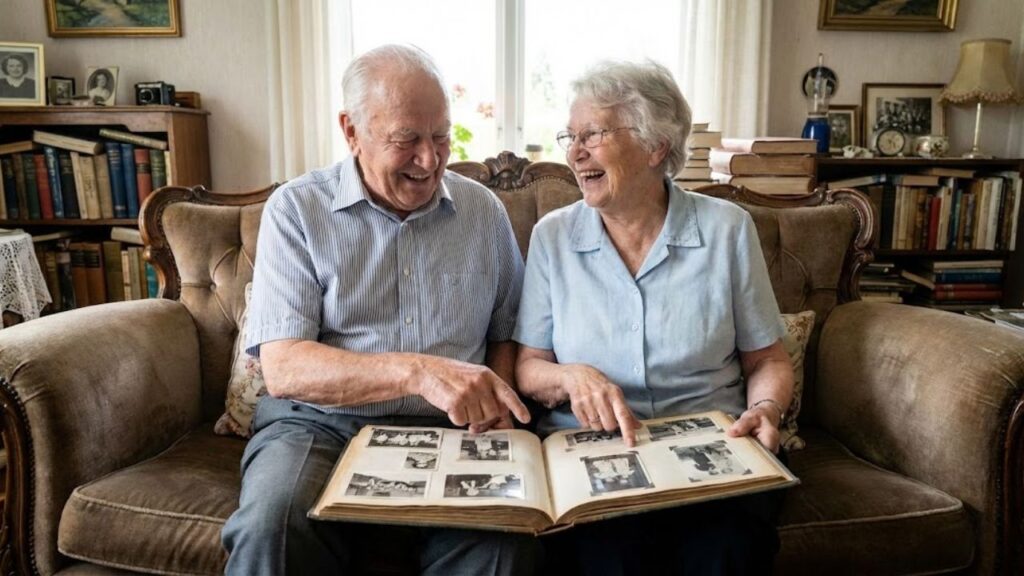
You open it on the kitchen table, sunlight shining on the plastic sleeves, and suddenly you’re transported back to a living room that no longer exists. The brown shag carpet, a TV with wood paneling, and someone yelling, “Don’t touch the antenna!” from the couch.
You hear the click of the rotary phone, smell the wax of school floor polish, and feel the weight of a cassette in your hand. Then, it hits you: some people your age have no memory of these moments at all. But for you, they’re as vivid as ever.
10 Small Moments That Reveal Your Sharp Memory
Think about the last time someone your age asked, “Wait, how did we even listen to music back then?” and you couldn’t help but laugh. For you, it’s not just about “old technology.” It’s the feeling of sliding a mixtape into your Walkman, praying the batteries would last through the bus ride.
These small, oddly specific memories are like mental fingerprints. If you can still picture them clearly, your brain has preserved details that most people have let fade. It’s not nostalgia—it’s recall power.
Take TV Evenings, for Example
If you remember gathering around a single TV screen every Thursday night because your favorite show aired once, live, and never replayed that week, your mind isn’t just storing content—it’s remembering the context.
Maybe you recall your dad calling into the local radio station to request a song or the exact sound of the TV channel going off air at midnight, with the screen shrinking into a white dot. For others, “we watched TV” is the headline. But you remember the small print.
Psychologists call this “autobiographical memory”—the personal movie each of us carries. Strong, detailed memories from decades ago often mean your brain has stored not just facts, but the surrounding emotions and side details.
So, if you can still smell the classroom when the teacher wheeled in the boxy TV, or feel the cold of the metal lunchbox handle in your palm, you’re not just reminiscing. Your memory encoding was rich and is holding up, which is a quiet superpower in a world that forgets quickly.
How to Tell If Your Memory is Still Sharp
You don’t need a brain scan to find out. Instead, see if you can recall any of these 10 moments from your past, like pressing “play” on an old recording in your head:
- Blowing dust from a Nintendo cartridge and insisting it “fixed” it.
- Waiting for photos to come back from the chemist, flipping the paper envelope with a mix of dread and excitement.
- The steady clatter of typewriter keys, and the horror of a mistake on the final line of the page.
If these aren’t just vague concepts but vivid snapshots in your mind, your memory is doing something special.
A woman in her 70s recently shared how she can still picture her first bank card machine: handing her card to the cashier, the heavy “ka-chunk” as they pressed down on the imprint device, and even the carbon paper being peeled back. She remembers the exact color of the cashier’s nail polish.
Her friend, the same age, with the same shop back then, barely remembers the scene. One mind preserved a high-resolution file, while the other stored only a thumbnail. This difference shows up in daily life—in names remembered, recipes recalled, and routes retraced without GPS.
Memory is Like a Library, Not a Switch
Memory isn’t an on/off switch where youth equals sharpness and age equals dullness. It’s more like a library. Some people kept detailed notebooks, others tossed receipts into a box and hoped for the best.
If you can still remember:
- The crackle of the first CD you bought and the exact cover art.
- The pattern on your childhood kitchen curtains.
- The smell of fresh mimeograph sheets in school.
Then your “library” is well-catalogued. You might forget where you put your keys this morning, but your deep memory shows how carefully you’ve filed away those older moments—and how easily you can pull them back off the shelf.
Protecting Your Sharp Memory, Starting Right Now
Here’s the quiet truth about memory in your 60s and 70s: it responds to use, not age. Think of those 10 moments as muscles. You don’t just admire them, you work them.
Talk about these small scenes with someone younger. Describe how it felt to wait for the dial-up modem to connect or to carefully wind a cassette with a pencil after it got chewed up. That act of storytelling lights up parts of your brain that scrolling a screen never touches.
It’s not about “living in the past,” it’s about exercising your past so the present stays clear.
A common trap is quietly worrying about memory and then doing… nothing. You forget a word, feel a twinge of fear, and retreat into routines that demand less from your brain. Gentle challenges are your ally.
Re-learn the lyrics of an old song without looking them up. Try writing down, from memory, the layout of your childhood home—the sofa’s position, where the TV was, and the route from your bedroom to the kitchen.
Let’s be honest: nobody does this every single day. But every time you do, you’re telling your brain, “These pathways still matter. Keep them open.”
“Memory is Not a Drawer, It’s a Bridge”
“Memory is not a drawer you open. It’s a bridge you walk across. The more often you cross, the stronger it stays,” says a neuropsychologist working with older adults.
Revisit Old Moments with All Five Senses
When recalling old moments, go beyond just “I had a record player.” Instead, describe the feel of the vinyl, the crack at the start of track one, and the slight wobble of the turntable.
Keep Stories Specific
Instead of saying, “We used to play outside,” swap it for, “We chalked hopscotch grids on the hot pavement and jumped until the streetlights came on.” Specific details stick better.
Share, Don’t Test
Rather than silently quizzing yourself with “Can I remember this?”, tell the story to a grandchild, a neighbor, or even into a voice note. Memory loves an audience.
Notice Emotional Anchors
We’ve all had that moment when a song from decades ago plays in a supermarket, and suddenly you’re 22 again. Emotional “hooks” help you retain more than just the melody.
Accept That Forgetting is Normal
You can cherish rich, decades-old memories and still forget a name today. That mix doesn’t mean failure. It means you’re human.
The Quiet Pride of Remembering What Others Forgot
If you recognize those 10 small scenes from decades ago, there’s a quiet pride in that. It’s not superiority; it’s the knowledge that your inner archive is fuller than most.
You carry the sound of coins dropping into a payphone, the flash of a disposable camera, and the hollow echo of an empty school hallway during summer break. These aren’t just nostalgic memories—they show that your mind has been carefully recording details for a very long time.
Key Takeaways
- Vivid old memories = strong encoding: Recalling small sensory details shows your brain stored deep, rich information.
- Storytelling keeps memory fit: Talking through past moments exercises recall pathways, offering a simple social way to maintain cognitive health.
- Small challenges support brain health: Reconstructing old scenes, lyrics, or layouts gently pushes your memory to work, offering practical steps without special tools.