Ten minutes after cranking up the thermostat, the number on the wall climbs, but your toes stay numb, and your hands clutch a mug of tea tighter. The radiators hiss, the boiler hums, and the bill increases. Yet, the air in the living room feels oddly thin.
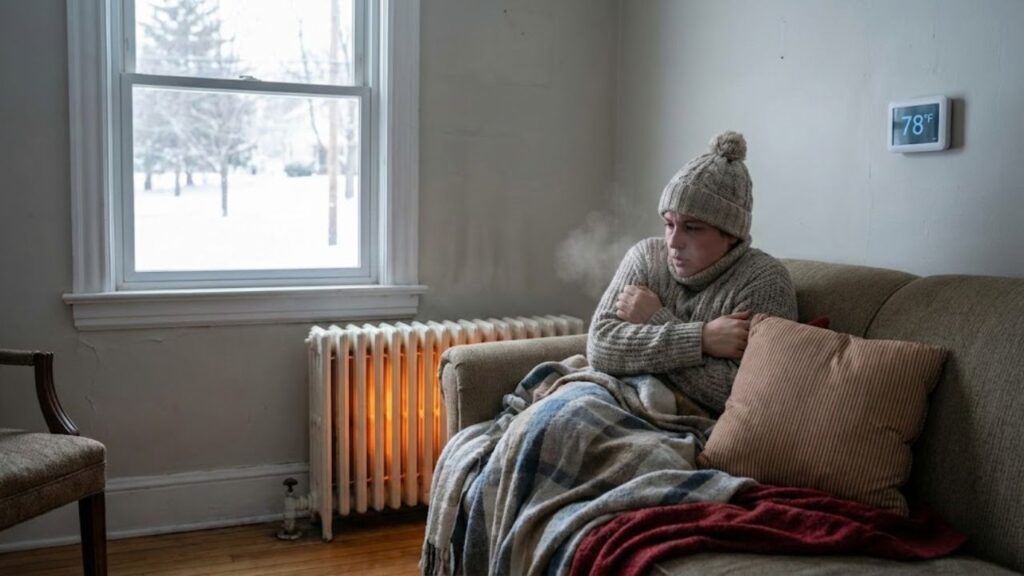
You add another sweater, adjust the dial a little higher, and convince yourself that the house just needs “some time.”
One hour later, your nose is still cold. Something doesn’t add up.
Why Your Home Feels Cold Even When the Thermostat Says It’s Warm
Walk into many homes in winter, and you’ll see the same scene: the thermostat proudly displaying 22°C, while family members huddle under blankets as if they’re camping in the Arctic. The number on the wall promises comfort, but the body says, “Not buying it.”
This disconnect between the thermostat reading and the actual warmth felt is something heating experts focus on. They call it “thermal comfort,” a fancy term for “do you actually feel okay sitting on the sofa.” You can have the right temperature and still feel miserably cold, and it’s not all in your head—it’s physics.
Take Emma, a 37-year-old who lives in a semi-detached house in Manchester. Last winter, her bills shot up by 40%. In a panic, she cranked the thermostat to 24°C, then 25°C, hoping the extra heat would finally warm up her living room.
“I was sweating when I moved around,” she said, “but the minute I sat still, I started shivering again.” Her kids complained about cold feet on the laminate floor. The corners of the room felt draughty, and her partner kept checking the radiators, suspecting the boiler was broken. But it wasn’t the boiler—it was the house.
When experts visit a “cold” home, they don’t typically look at the thermostat first. They focus on the floors, windows, walls, and air leaks. Warm air was rising to Emma’s ceiling and escaping through poorly insulated loft space. Thin curtains let cold air radiate from the windows straight onto the sofa. That shiny laminate floor? It acted like a cold plate, constantly drawing heat away from her body.
The simple truth: **you don’t feel the thermostat, you feel the surfaces around you**. If your walls, floor, or windows are cold, your body will sense that chill, even in a room that’s 22°C.
The Real Reasons Your Home Feels Cold Despite a “Heated” Thermostat
Ask heating engineers what they fix in homes that “never feel warm,” and you’ll rarely hear them mention a “faulty boiler.” They’ll talk about under-sized radiators, radiators hidden behind furniture, and rooms heated unevenly. In some areas, one corner of the room might be roasting while another feels like a cold bus stop at midnight.
Practical rule from the pros: heat should circulate, not get trapped. When radiators are boxed in, blocked by large furniture, or covered by heavy shelves, you end up paying to heat the back of a cabinet. This leaves cold patches of air that your body notices immediately—even if the thermostat doesn’t.
Picture a typical two-bedroom flat. The living room has an L-shaped sofa pushed against the wall, swallowing half of the radiator. A TV unit is pressed in front of another radiator, “because it fit nicely.” The thermostat is placed in the warmest inner hallway, far from the windows and drafts.
The hallway hits 21°C, and the heating turns off. But the living room, with its blocked radiators and large glass patio door, never truly gets there. The family turns the thermostat higher, thinking that will push more heat into the cold space. What they’re really doing is heating the hallway to 24°C while the sofa area stays stubbornly chilly.
Experts also warn about the “cold sink” effect: large windows, poorly insulated external walls, and bare floors. These act like invisible heat thieves. Your body radiates warmth toward colder surfaces, so even if the air feels fine, you still feel cold.
*This is why you can sit by a big window and feel cold on your skin, even though the thermostat says everything is normal.* The science is simple: your body is losing heat faster than the heating system can compensate. Your instinct is to turn up the boiler, but the smarter move is to address what’s stealing the heat in the first place.
Practical Fixes to Warm Up Faster Than Turning the Thermostat Higher
The first thing professionals do in a cold-feeling home is tackle the draughts. Not the glamorous stuff—just the effective, straightforward work: sealing gaps around windows and doors, adding foam strips, and blocking the icy breeze under the front door.
If you feel a “mysterious” chill when sitting on the sofa, grab a candle and watch the flame near the skirting boards and window frames on a windy day. A flickering flame indicates air sneaking in. This is a direct pipeline for your expensive heat to escape before it ever reaches your cold toes.
Another expert trick: think from the floor up. If your feet are cold, your whole body will feel cold, no matter what the thermostat says. A simple rug on a bare floor can change the way a room feels faster than adding two degrees on the dial. Radiator foil behind external-wall radiators, thick curtains that close fully at night, and leaving space above radiators for air to rise all work together to optimize heat distribution.
We’ve all been there: pulling on a second jumper instead of moving the furniture a few inches away from the radiator. It might feel silly, but those tiny layout changes can cut the chill much more effectively than another layer of knitwear.
Heating consultant Mark Lewis told me, “People think their boiler is lazy, when most of the time their house is just badly set up for heat. **I’d rather see a 20°C room with good insulation and smart radiator placement than a 24°C room leaking warmth through every crack.** Comfort isn’t just about heat; it’s about where that heat goes.”
- Move large furniture at least a few centimeters away from radiators to allow heat to circulate.
- Add thermal curtains or blinds to large windows and actually close them as soon as it gets dark.
- Use rugs on cold floors, especially in areas where you sit still for long periods.
- Bleed radiators once or twice a year to ensure they heat evenly from top to bottom.
- Dedicate one weekend to draught-stopping work to get it done all at once.
Rethinking “Warmth” at Home: Beyond the Thermostat Reading
Once you understand that your body feels surfaces, draughts, and humidity as much as the raw temperature, the whole idea of heating your home changes. Many people who say, “My house never gets warm,” are really saying, “My house loses comfort faster than I can pay for it.”
Humidity also plays a role: very dry air can make a room feel cooler. Some experts recommend using small plants, placing bowls of water near radiators, or using low-key humidifiers during the coldest months. They’re not a magic fix, but they can help soften the harsh, dry heat that never seems to stick.
The bigger shift in thinking might be this: stop thinking you’re failing if you feel cold in a “heated” home. Often, it’s the building that’s letting you down, not your tolerance or your jumper collection. The most experienced energy auditors focus less on heroically turning down the dial and more on reducing the hidden losses that force you to turn it up in the first place.
The next time you find yourself muttering, “Why is it still cold in here?”, look around before you look at the thermostat. Where is the heat escaping? Which surfaces feel icy to the touch? Why does one chair feel fine while another feels like a fridge door? That’s where real comfort begins.
| Key point | Detail | Value for the reader |
|---|---|---|
| Heat loss beats thermostat gains | Cold walls, windows, and floors pull warmth from your body even at 21–22°C | Explains why turning up the heat often doesn’t solve the “I still feel cold” problem |
| Room layout can sabotage warmth | Blocked radiators and thermostats in inner hallways create misleading temperatures | Helps readers rearrange furniture and devices for more even, real-world comfort |
| Small fixes, big comfort boost | Draught-proofing, rugs, thermal curtains, and radiator care change how warmth is felt | Offers low-cost, practical actions that quickly improve how warm a home feels |