
I used to blame my job for everything.
The dark circles, the Sunday dread, the way my shoulders stayed tight even when I was brushing my teeth.
In my head, the villain was obvious: too many emails, too many meetings, too many people needing “just five minutes.”
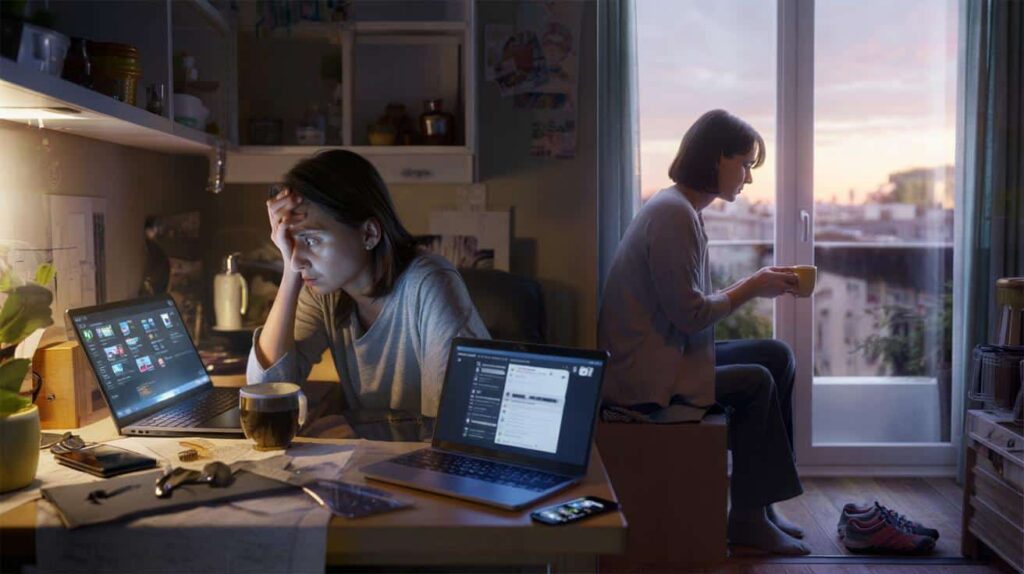
Then one night, close to midnight, I caught my own reflection in the laptop screen.
Slack open, phone next to me, half-drunk coffee gone cold.

And I realized: nobody had asked me to answer messages at 11:42 p.m.
Nobody had ordered me to scroll my phone before getting out of bed.
 Chair exercises after 60 rebuild hip strength better than squats and reduce joint irritation
The workload was heavy, yes.
But the way I was living around it was quietly wrecking me.
That was the night I stopped blaming my boss and started looking at my routine.
That was where the real damage was hiding.
When your “busy life” is really just a rigid routine
Most of us swear we’re overwhelmed because work is out of control.
Deadlines pile up, your calendar looks like a game of Tetris, and your brain feels like a crowded subway at rush hour.
You tell friends, “Work is insane right now,” and everyone nods in solidarity.
It sounds reasonable, grown-up, even a bit heroic.
But look closer at a typical day.
The way you wake up, the way you switch between apps, the way you eat at your desk, the way you “unwind” by staring at more screens.
Sometimes it’s not the number of hours you work that drains you.
It’s the invisible script you repeat without questioning.
Take Lina, 32, project manager in a tech company.
She swore her job was burning her out and fantasized about quitting every Monday morning.
Her day started with her phone in her hand before her head even left the pillow.
Email, notification, Slack, Instagram, news alerts – all before she drank a glass of water.
By 10 a.m. she’d had three coffees and exactly zero real breaks.
Lunch was a sandwich eaten while half reading a brief, half answering DMs.
At night, she scrolled TikTok in bed “to switch off” and looked up to see it was 1:17 a.m.
The next morning, she blamed the job again.
Not once did she think her routine might be the real saboteur.
This is where it gets uncomfortable.
Because if the problem is only workload, the solution is outside: new job, new boss, new company.
If the problem is routine, the solution is inside your everyday choices.
That’s much harder to face.
Workload is visible – people see your long hours and full calendar.
Routine stays in the shadows: the autopilot habits you run without thinking.
Checking emails at red lights.
Saying yes to every meeting invite.
Eating lunch at your desk while reading “productivity hacks.”
*The routines we repeat become the lives we live.*
And those tiny patterns can exhaust you long before your boss ever does.
Turning the spotlight on the real culprit: your daily script
The first real shift comes from observing your day like a documentary, not a drama.
For one week, pretend you’re filming yourself.
What time do you really stop working, not just “kind of log off”?
How often do you pick up your phone for no clear reason?

Write it down brutally, without trying to look good on paper.
No fancy habit tracker, just a scrappy note in your phone or an old notebook.
Circle the moments that drain you more than the actual work.
Late-night email checks, doomscrolling in bed, eating lunch hunched over a laptop.
You don’t need to fix anything yet.
Just seeing your routine in daylight is like switching the lights on in a messy room.
One of the quickest ways to stop your routine from doing damage is to add “anchors” to your day.
Small, non-negotiable pauses that remind your brain it’s a human brain, not a processor.
Think: a five-minute walk without your phone between meetings.
A real lunch away from your desk, even if it’s just 20 minutes.
Change the way you start and end the day.
No emails in the first 30 minutes after waking, no screens in the last 30 minutes before sleep.
These are not wellness clichés to decorate a Pinterest board.
They’re tiny acts of resistance against a routine that’s been allowed to run wild.
Let’s be honest: nobody really does this every single day.
But doing it three days out of seven already changes your mental weather.
There’s a trap most of us fall into when we finally realize our routine is toxic.
We go all or nothing.
On Sunday night you promise yourself a complete life overhaul.
5 a.m. wake-ups, cold showers, zero sugar, digital detox, journal, yoga, new language.
By Wednesday you’re exhausted, behind on everything, and secretly angry at yourself.
So you drop it all and tell yourself “I guess I’m just not that kind of person.”
The problem isn’t you.
It’s the unrealistic script you tried to paste over an already overloaded life.
You don’t need a new personality.
You need one small routine shift that you can repeat on your worst day, not just your best.
“Routines are like background apps on your phone,” a psychologist told me during an interview.
“You don’t notice them, but they quietly drain your battery.”
- Morning guardrail – No work notifications in the first 30 minutes after waking.
Use that time for coffee, stretching, or staring out the window doing nothing. - One sacred pause – Block one 15–20 minute break in your calendar as if it were a meeting.
No screen, no multitasking, just a reset. - Evening shutdown ritual
- Close your laptop at a set time three days a week.
- Write down what’s unfinished and the next small step.
- Physically leave your workspace, even if it’s your kitchen table.
- Weekend reality check – Once a week, review your notes:
Where did your routine help you breathe, and where did it crush you a little?
Living with your workload without letting it live inside you
At some point, the question shifts from “How do I escape my workload?” to “How do I stop my routine from turning my life into a constant sprint?”
The emails will still arrive, the deadlines will still exist, the meetings won’t magically vanish.
What can change is the choreography around them.
The way you enter and exit your workday, the way you protect micro-moments of slowness, the way you treat your own brain when nobody’s watching.
You might still say, “Work is crazy right now,” but it no longer has to own your mornings, your nights, and your nervous system.
Your routine can quietly become a form of self-respect instead of self-sabotage.

And once you taste that, even a busy day feels different.
A little less like drowning.
A little more like swimming in water you chose.
 What psychology reveals about people who feel emotionally drained after small social interactions
| Key point | Detail | Value for the reader |
|---|---|---|
| Identify routine drains | Track one week of real-life habits around work, phone, and rest | Reveals hidden energy leaks beyond “too much work” |
| Use simple anchors | Morning guardrail, one sacred pause, clear shutdown ritual | Reduces stress without needing a full lifestyle overhaul |
| Choose realistic changes | Focus on small shifts you can do even on bad days | Makes new routines stick and prevents guilt-fueled burnout |
FAQ:
- How do I know if it’s really my routine and not just a toxic job?
Start by changing small, controllable parts of your day for two to three weeks: wake-up routine, breaks, shutdown time.
If nothing improves at all – sleep, mood, energy – and you also face disrespect, constant overload, or no boundaries from your employer, then the job itself may be part of the problem too.- What if my workload actually is huge and non-negotiable?
You don’t have to pretend it’s not.
The point is to protect small pockets of your day so that the workload doesn’t spill into every corner of your life: five-minute walks, no late-night emails, one real pause, even on the craziest days.- I’ve tried new routines before and always fail. What should I do differently?
Pick one change that feels almost too small: one screen-free meal, or no phone for the first 15 minutes after waking.
Do that first, and allow it to become boringly normal before adding anything else.- Is scrolling on my phone really that bad for my routine?
The phone itself isn’t evil, but constant micro-checks keep your brain in a half-alert state.
You never fully rest, and your attention gets sliced into pieces, which makes your workload feel heavier than it already is.- How long until I feel a difference if I change my routine?
Some people notice better sleep and calmer evenings within a week, especially if they stop working late at night.
Deeper shifts – like feeling less resentful toward work – usually show up after three to four weeks of consistent, gentle changes.
