
It’s 9:47 p.m. The dishwasher hums, the washing machine clicks, and you’re staring at that mysterious pile of “stuff” on the dining table that never seems to die. You spent the whole weekend “catching up” on housework, but on Sunday night the living room looks like you barely tried. A school project on the sofa, two unmatched socks on the stairs, an empty Amazon box squatting by the door like it pays rent.
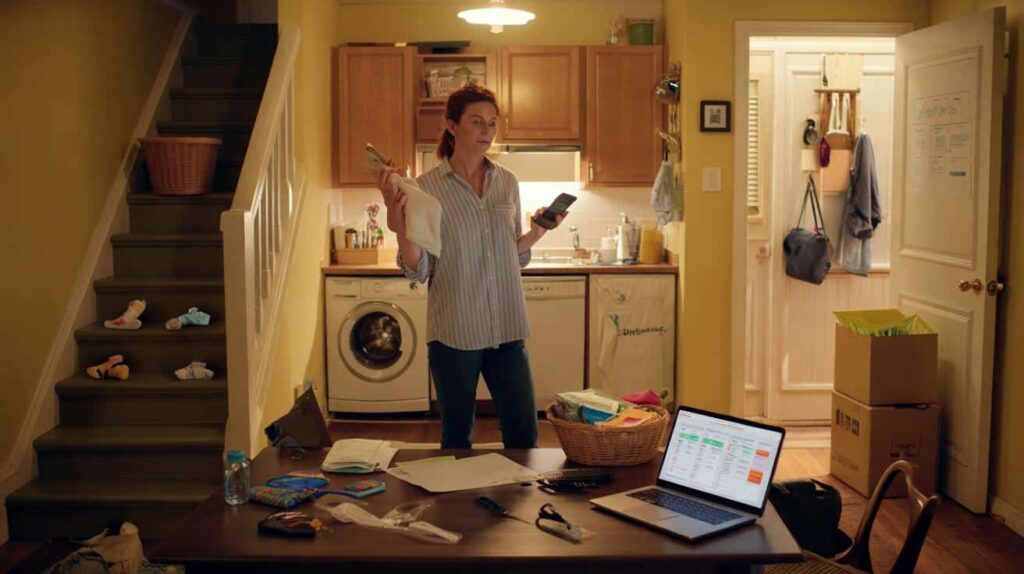
You scroll your phone for a second, look up again, and the mess feels bigger. Sharper. Almost personal.
There’s this subtle, nagging thought you don’t dare say out loud.
 A New Kitchen Device Could Replace the Microwave for Good and Experts Say It’s More Efficient
Maybe it’s not just the mess. Maybe it’s something underneath it.

The invisible workload that turns cleaning into quicksand
The first thing that makes cleaning feel endless in busy households isn’t the dust or the laundry. It’s the fact that you’re never just cleaning. You’re wiping the table while mentally checking tomorrow’s groceries, answering a kid’s question about fractions, and remembering you still haven’t replied to that work email. One body. Five open tabs in the brain.
So the kitchen doesn’t just contain dishes. It holds everyone’s schedules, moods, and random objects that don’t belong anywhere else. That’s not a wipe-down. That’s a full mental marathon.
Picture this: a Saturday “deep clean” day. You start in the hallway to deal with shoes. You pick up sneakers, notice a broken toy, carry it to the kid’s room, see a tipped-over laundry basket, start folding, realize the towels belong in the bathroom, see the empty shampoo bottle, grab your phone to add it to the shopping list, notice an unread message from your boss and suddenly you’re working.
Twenty minutes pass. The hallway still has shoes everywhere. You’ve been busy nonstop, yet the original task is frozen in time. This is how a 15-minute clean-up magically stretches into a full morning that never really finishes.
What’s at play is something psychologists call cognitive load. Every little decision about where something goes, what to keep, what to throw, who needs what next, quietly drains your attention. Busy households often run on one or two people carrying that invisible decision-making burden for everyone else. The result is a home that consumes brainpower before you’ve even picked up the vacuum.
The hidden reason cleaning feels endless isn’t just the mess. It’s that your mind is doing overtime with no clock-out.
Designing the house so it “cleans itself” a little
One way to break this cycle is to stop thinking of cleaning as a heroic event and start hacking the house itself. Not Pinterest-perfect. Just slightly smarter. Instead of relying on motivation, you change the environment so the default option is “less mess.”
That can be as simple as putting a donation box near the front door, a laundry basket where people actually drop their clothes, or a basket on the stairs that collects “stuff going up.” Tiny, boring tweaks. But they shave off dozens of tiny decisions during the week, and that’s where the real magic is.
Most busy families already tried chore charts and “Let’s all clean for 20 minutes!” sprints. The board looks good the first week, then quietly becomes wall decor. Here’s a different picture: a living room where every single item has a very lazy-friendly home. Remote controls in one chunky bowl. Throws in one big basket, not folded like a hotel. Kids’ craft stuff in one ugly-but-useful plastic bin that lives under the coffee table.
Whenever someone finishes something, the “less lazy” option and the “lazy” option are basically the same movement. That’s when habits actually stick.

Let’s be honest: nobody really does this every single day. Homes where cleaning doesn’t feel endless are not run by superheroes. They are set up so the path of least resistance quietly matches the path of **less clutter**. When spoons live next to the dishwasher, when school bags land in the same corner every time, you don’t have to think so hard.
One parent I interviewed told me, “I stopped asking, ‘Why is nobody helping?’ and started asking, ‘Why is this house so hard to help in?’ That changed everything.”
- Create “landing zones” near doors for keys, mail, and bags so they stop wandering.
- Use open baskets and hooks where possible, not closed cupboards that need extra steps.
- Match storage to reality: toys where kids actually play, not where you wish they would.
- Set a visible “outbox” for donations so letting go is always one easy action away.
- Keep one “messy drawer” on purpose, so not everything needs a perfect home.
Sharing the real load, not just the chores
Under the surface, many homes run on one quiet rule: one person is the default “household brain.” They know when the detergent runs out, which kid hates the blue cup, and where the spare light bulbs hide. That’s not just more tasks. That’s project management.
The mess feels endless because the responsibility is endless. There’s no off-switch if you’re the one holding the whole map in your head. *You don’t just see a dirty counter; you see everything that led there and everything that will happen if you ignore it.*
There’s also the guilt spiral. You sit down after a long day, see crumbs under the table, and immediately hear this little internal voice: “You really should get that done.” Meanwhile, someone else in the same room honestly doesn’t notice it. Not because they’re lazy. Because they’ve never had to hold that invisible standard in their own mind.
We’ve all been there, that moment when you’re scrubbing a pan at 10 p.m. while your partner scrolls on the sofa and you start mentally listing every task you’ve done that day like a courtroom defense. The fight isn’t about the pan. It’s about feeling like the only one on duty.
There’s a plain truth sitting in the middle of this: **a chore is not the same as the mental load behind it**. Saying “Just tell me what to do” still leaves the hard part on one person’s shoulders. Real sharing starts when more people in the home learn to notice, plan, and take initiative without waiting for a list.
A family therapist I spoke to put it simply: “If one person always has to ask, they’re not getting help. They’re managing an unpaid staff.”
- Have one weekly 10‑minute “house meeting” where everyone names one thing that’s stressing them out visually at home.
- Swap invisible jobs occasionally: one week you manage laundry, another week you handle meals.
- Ask kids, even small ones, “What needs doing in this room?” so they practise noticing, not just obeying.
- Use shared lists or apps so reminders live outside your brain, not only in it.
- Agree on a “good enough” standard together, not silently on your own.
A different way to look at the never-ending mess
Once you start seeing the real engine behind the endless cleaning feeling, the story shifts. The mess on the table is no longer proof that you’re failing. It’s proof that your home is doing a lot of work: feeding people, housing projects, absorbing the chaos of modern life. That doesn’t make the crumbs any less sticky. It just takes some of the shame out of them.
When you adjust the house so it cooperates, share the mental map with other people, and accept that some corners will always look “in progress,” the pressure eases. You’re not chasing a spotless museum. You’re tuning a living system.
Busy households don’t magically become tidy. They become survivable, then slowly more breathable, one small friction removed at a time. A hook in the right place. A rule that nobody carries a full mental list alone. A quiet decision that some nights, sleep beats shining floors.

The next time you catch yourself thinking “I clean all the time and nothing changes,” maybe pause. Ask what’s really stealing your energy: the dust, the decisions, or the loneliness of running the whole thing in your head. That answer can be the start of a very different home.

| Key point | Detail | Value for the reader |
|---|---|---|
| Hidden mental load | Cleaning feels endless because of constant decisions and invisible planning layered onto physical tasks. | Helps readers understand why they feel exhausted even when the house still looks messy. |
| Environment design | Simple layout changes, landing zones, and easy storage reduce daily micro-decisions. | Gives practical ways to make the house “help” instead of constantly fighting it. |
| Shared responsibility | Moving from one “household brain” to shared noticing and planning. | Opens the door to more balanced, fair routines and fewer resentment-fueled arguments. |
FAQ:
- Why does my house get messy again so fast?Because your current setup and routines are feeding the mess, not preventing it. Items have no easy homes, traffic zones collect clutter, and most decisions live in one person’s head, so things naturally slide back quickly.
- How do I start if I’m already overwhelmed?Pick one small, high-impact spot: the entry table, the sofa area, the kitchen counter. Give every object there a simple home, then protect that zone for a week. One stable area can change how you feel about the whole house.
- What if my partner doesn’t “see” the mess?Have a calm conversation about mental load, not just dirty dishes. Walk through a room together and say out loud what you notice and what you would do. You’re teaching a skill, not nagging about a task.
- How can I involve my kids without more stress?Assign them “zones” instead of random chores and keep tools within their reach. Ask them to check their zone once a day. Praise noticing and effort, not perfection.
- Is it realistic to have a tidy home with a busy life?You can have a home that is functional, welcoming, and not constantly on your nerves. It might never look like a catalog, but a few smart systems and shared responsibility can turn “endless cleaning” into short, predictable resets.
