
The scene usually starts in front of a mirror. The light is a bit too harsh, the bathroom is a bit too quiet, and there they are: those silver roots that came back faster than your last online order. You tilt your head, pull a strand, squint. The lengths are still chestnut, or copper, or “chocolate 5.3” from the box. But at the scalp, a clear border. Two worlds that don’t speak to each other.
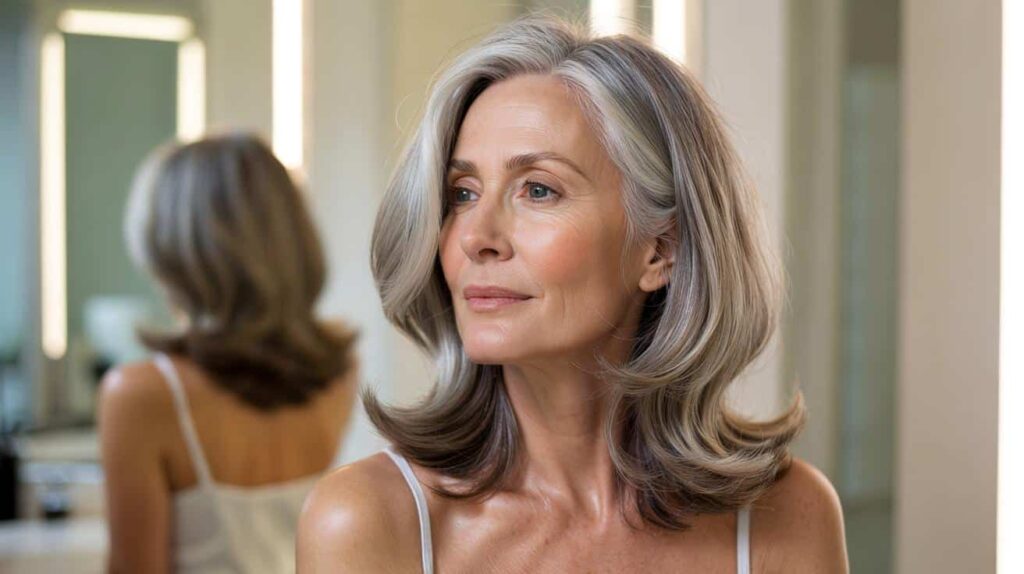
You can touch up, again. You can book yet another “urgent roots” appointment. You can also feel the small, stubborn thought rising: what if I just stopped? Gray hair is beautiful on others, right?
That’s exactly where reverse coloring enters. Quietly, almost secretly.

Why reverse coloring is changing the game after 50
From around 50, hair behaves like a blunt friend: it stops pretending. Pigment drops, texture changes, and the famous “root regrowth effect” suddenly runs the show. Traditional full-head coloring, which looked flawless at 35, starts demanding military-level maintenance. Every three weeks, the white line reappears. Like a calendar reminder you didn’t ask for.

Reverse coloring comes from a very simple idea. Instead of fighting your gray or white base, you let it live and you color… the lengths. Not the scalp. That small shift changes everything.
Take Marie, 57. She spent ten years chasing her roots. Salons, home kits, frantic touch-ups before dinners. Her hairline always slightly darker than the rest, a bit too opaque, like a painted strip. One day, her hairdresser suggested the opposite: stop covering the roots. Use her natural white as a starting point. Add soft, cool highlights and lowlights only on the mid-lengths and ends.
The transition was done in stages, over six months. People started saying, “You look rested”, “Did you change your skincare?” No one pointed at her hair. The regrowth simply disappeared from the conversation. The eye no longer saw a border, only light.
The logic is almost mathematical. With reverse coloring, the lightest area is at the roots, exactly where your hair grows. The color is gently deepened as you go down, using translucent tones a little darker than your gray. The brain reads this as natural.
There’s no more straight “helmet” line, because you’re no longer trying to make the scalp darker than the rest. The base becomes your ally, a luminous canvas. *Instead of camouflaging maturity, reverse coloring organizes it in a pretty way.*
How to do reverse coloring without wrecking your hair
The starting point is always the same: stop touching the roots. For at least two or three months. Let a good band of gray or white appear, even if it bothers you a little when you tie your hair back. The colorist needs this reality to work with. Then, rather than applying one uniform color, they place shades just on the lengths.

The tones chosen are usually semi-permanent, translucent, or “gloss” textures. Think veils of beige, pearl, sand, or very soft taupe, depending on your natural base. The goal is to blur the contrast, not to erase it completely. The roots stay free, luminous, alive.
The big trap is wanting to go too fast. Asking to “go gray” in one appointment, or insisting on erasing all the old dye in a single stripping session. That’s where breakage, straw-like hair, and regrets show up. A good pro will talk about a plan over several visits, not a miracle.
There’s also the reflex of over-pigmenting the lengths, especially for those terrified of “looking old.” The result can harden the features. A more forgiving approach uses softness: transparent shades, fine streaks, and a slightly cooler tone around the face to freshen the complexion. We’ve all been there, that moment when the fear of aging pushes us into choices that age us even more.
“Reverse coloring is like dialling down the volume of color instead of turning it off,” explains Ana, a colorist who sees more and more women over 50 asking for it. “We respect the gray at the root, we play with light on the rest. It looks less ‘done’, more expensive, more free.”
- Start with a consultation focused on your real base color and your skin tone.
- Plan a transition over 3–6 months instead of a one-time radical change.
- Ask for translucent, glossy colors, not heavy, opaque dyes on the lengths.
- Keep the roots natural and bright, only work the mid-lengths and ends.
- Refresh the tones every 8–12 weeks, without touching the scalp.
Living with your new hair: more freedom, less drama
Once the reverse coloring is in place, daily life changes in small, concrete ways. The bathroom shelf empties: no more emergency root kits hiding next to the cotton pads. Salon visits spread out, from every 3–4 weeks to every 8–10. The mirror stops yelling “regrowth!”, it just reflects hair that evolves at its own pace.
The relationship with aging softens too. You’re not suddenly “embracing gray” in a radical, Instagram-worthy gesture. You’re negotiating with it. Turning down the contrast. Allowing some light, some shadow, some nuance. Let’s be honest: nobody really does this every single day, but you might find yourself touching your hair more often, noticing the way the white catches the sun instead of hiding it.
For some, this new space invites other changes: a lighter cut, a fringe that skims the brows, a pair of glasses with a bolder frame, lipstick that’s half a tone brighter. The hair stops being a war zone and becomes a playground again.
 Hairstyles after 50: this cut that was very trendy in the 60s is coming back into fashion in 2026
| Key point | Detail | Value for the reader |
|---|---|---|
| Reverse the logic of color | Natural gray/white at the roots, soft shades on the lengths only | Eliminates the “root regrowth effect” without full-on going gray |
| Transition in stages | Plan 3–6 months with glosses, highlights, and cut adjustments | Smoother change, less damage, fewer regrets |
| Softer, translucent tones | Beige, pearl, sand, or taupe veils instead of opaque dyes | Visibly rejuvenates, brightens the complexion, keeps hair texture supple |
FAQ:
- Does reverse coloring work if I’m only 30% gray?Yes, as long as you have a visible gray band at the roots. The colorist will simply use finer, lighter work on the lengths so the result doesn’t look “patchy”.
- Can I do reverse coloring at home?You can maintain it with glosses or color-depositing conditioners, but the initial strategy is best set up in a salon. The placement and tone choice are very precise.
- Will my hair be damaged by the process?Done right, reverse coloring is gentler than years of full-head roots coverage. You’re coloring less surface, less often, with more sheer textures.
- How often will I need touch-ups?Most women stabilize around every 8–12 weeks, sometimes more, depending on how fast their hair grows and how much contrast they like.
- What if I decide later to go fully gray?Reverse coloring actually makes that easier. The lengths are already lighter and more blended, so you can simply space out the glosses and shorten the cut over time.
