
You run your fingers through your hair expecting that light, airy glide promised by shampoo ads. Instead, your fingertips snag. The roots feel coated, the lengths feel weighed down, and your hair somehow looks clean while feeling anything but. You rinse again, scrub a little harder, even turn up the heat — yet that waxy texture and sticky coating refuse to budge. The surprise for many people is that this film often isn’t leftover product at all.
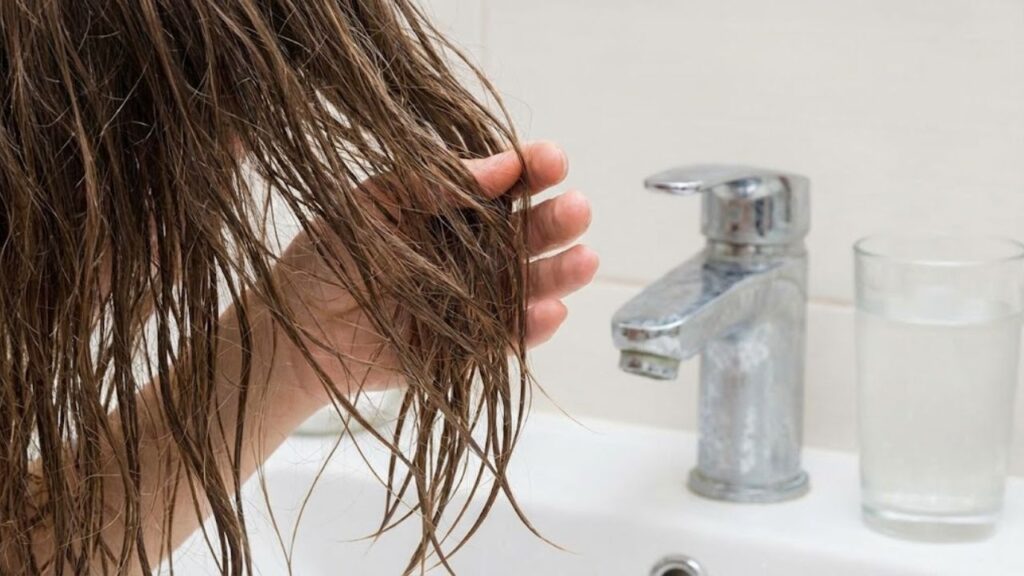
That strange heaviness appearing minutes after a shower usually has less to do with technique and more to do with what’s coming out of the tap. Hard water minerals like calcium and magnesium can leave a fine, invisible layer on each strand. On the scalp, these minerals mix with natural oils and shampoo residue, creating something that behaves like soap scum buildup. It’s subtle, but enough to make hair feel coated, limp, and frustratingly “dirty” again.
In many regions, this is a quiet but widespread issue. A woman switches cities for work and suddenly her hair feels lighter and silkier — using the same products, the same routine. Back home for the holidays, the heavy feeling returns within two washes. The only real change is the water. With more than millions of households living with hard water, countless people blame their shampoo while the real culprit keeps flowing.

How hard water quietly builds up on your hair
Hard water minerals cling to hair like microscopic dust, forming deposits that don’t care how expensive your shampoo is. These particles bind with styling residue and sebum, flattening volume at the roots and making lengths feel coated — especially on fine or porous hair. Over time, this layer can roughen the cuticle, the outer surface of the hair shaft.

When the cuticle becomes uneven, hair tangles more easily, looks duller, and holds onto less moisture. Many people respond by adding more conditioner, which then sticks to the mineral layer, creating an even heavier feel. It becomes a loop: more buildup, more product, more frustration. It feels like your hair is “getting worse,” when in reality, your water is stacking against you with every wash.
Breaking the waxy-hair cycle caused by hard water
The most effective first step is simple but often overlooked: treat your final rinse like a treatment. Chelating products or acid-based rinses help dissolve the mineral film regular shampoo can’t remove. Using a chelating shampoo once a week — often labeled clearly on the bottle — can reset the strands without changing your entire routine.

On non-clarifying days, a diluted rinse made with apple cider vinegar or citric acid can help. Applied after shampooing and rinsed out after a minute, the mild acidity lifts minerals and smooths the cuticle. Many people instinctively respond to waxy hair by scrubbing harder or washing more often, but over-washing can trigger extra oil production, which traps even more minerals. As one stylist puts it, once mineral buildup is handled, that “old” shampoo often starts working again.
Rethinking “dirty” hair when the tap is the real issue
There’s relief in realising your hair isn’t misbehaving — it’s reacting to its environment. That heavy feeling right after washing can feel like a personal failure, when it’s often just geography and plumbing winning a quiet battle. Seeing hard water as part of the story shifts the question from “What’s wrong with my hair?” to “What’s sticking to it?” That small mindset change replaces blame with curiosity.

Instead of chasing miracle bottles, you start noticing patterns over weeks, not just one wash. You might check your local water hardness, adjust your final rinse, or simplify your routine. These aren’t dramatic overhauls, just practical tweaks that work with the water you have. Sometimes, that shift in perspective is exactly what helps hair finally feel genuinely clean again — not just perfumed and wet.

- Hard water minerals — Calcium and magnesium cling to hair and scalp, explaining waxy heaviness after washing
- Chelating and acid rinses — Target mineral deposits more effectively than standard shampoo
- Small routine adjustments — Weekly clarifying, gentle daily care, and patience over a full month
