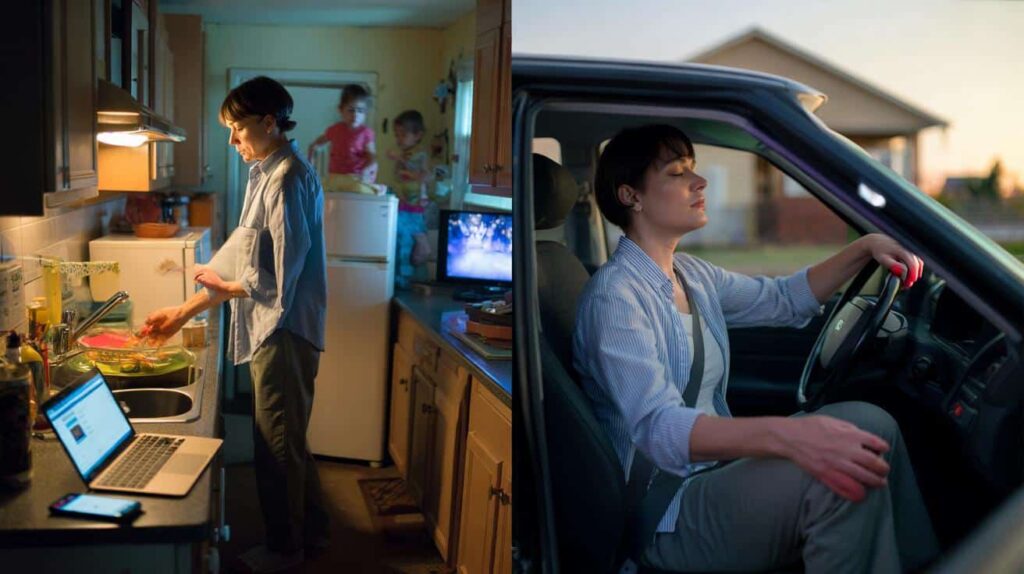
You shut your laptop at 6:59 p.m. and by 7:00 you’re already in the kitchen, half-answering a Slack message while staring into the fridge. Your brain is still at work, your body is at home, and somehow you’re in neither place. The kids are talking, your phone is buzzing, your mind is replaying that awkward meeting. You move fast, but you feel behind.
We treat life like one endless conveyor belt, jumping from task to task with no gap in between. No pause between waking and scrolling, between meeting and email, between video call and dinner.
Yet something strange happens when you slow the “in-between” moments, even just a little.

You start to feel… different.

We rush the “in-between” — and our stress soars
Watch people getting off a subway at 8:30 a.m. Doors open, and everyone surges forward like a single impatient animal. Headphones in, eyes down, fingers already unlocking phones. No one just walks. They stride, squeeze, weave, speed up at the escalator.
We live like that all day. We slam shut one context and instantly load another, like tabs in a browser. Meeting ends? Email opens. School drop-off done? Calls begin. Dinner dishes down? Netflix auto-plays.
The body doesn’t get the memo that the situation changed. It just stays in alert mode.
A therapist told me about a client who woke up already exhausted. She had a good job, loving partner, relatively healthy life. On paper, things were fine. Inside, she felt like a browser with twenty frozen tabs and a fan about to explode.
The therapist asked her to write down her day. Wake. Scroll. Shower while answering messages. Commute while listening to a productivity podcast. Back-to-back meetings. Quick lunch at her desk. More meetings. Gym with news on. Dinner while watching a series. Scroll in bed. Sleep.
The line that jumped out wasn’t any single activity. It was that there was no white space at all. No buffer between roles. No transition that wasn’t instantly filled.
Our nervous system loves clear signals. When we rush transitions, those signals get scrambled.
Your brain needs a tiny moment to understand: “Work is over. Now I’m home.” Or: “That argument ended. I’m safe again.” When you jump straight from one demand into the next, your stress response never fully powers down. It becomes a background hum.
Over time, that hum feels normal. You think you’re just “busy” or “not great at relaxing”. In reality, your body has forgotten what genuine off-duty feels like. *You’ve turned life into one long, continuous task — and your system is quietly paying the price.*
The 3-minute transition that changes your whole day
There’s a tiny habit that high-performing people quietly swear by: they ritualize transitions. Not in a mystical way. In a practical, three-minute way.
Pick the moments where your role clearly shifts. Waking. Starting work. Ending work. Entering home. Going to sleep. For just one of those, try this: pause, breathe slowly for ten breaths, and name out loud what just ended and what’s about to begin.
“Workday is ending. Now I’m going to be a partner and a parent.”
You’re giving your brain a clean page. A reset. A line between scenes.
A manager I interviewed started doing a “parking-lot pause”. She’d pull into her driveway after a hectic day and stay in the car for exactly three minutes. No phone. No music. Just one small question: “What do I want to leave in this car?”
Sometimes it was a frustrating email. Sometimes it was the unfinished to-do list. Sometimes it was a bad mood. She’d imagine literally dropping those things on the passenger seat. Then she’d take three slow breaths and say, “New shift now.”
Her kids didn’t know about this ritual. Yet a month later, her 7-year-old said at dinner, “Mum, you don’t shout when you come home now.” Same house, same stress at work. A slightly slower transition changed what her family felt.
Why does something this small work? Because transitions are where your identity shifts. Worker to parent. Partner to friend. Public self to private self.
If you rush through that doorway, the previous identity barges into the new room. You react to your kids like they’re your team. You treat your partner like a calendar reminder.

When you slow the shift, your nervous system gets to “reboot” its settings. Breathing slows. Muscles loosen. Your brain moves from survival mode towards curiosity and connection. Let’s be honest: nobody really does this every single day. Yet even doing it a few times a week can quietly drop your stress baseline.
Practical ways to slow down transitions (without becoming a monk)
Start with one transition: ending your workday. Not the dream version. The real one, where you’re tired and tempted to just slam the laptop and run.
Try this tiny sequence. First, close all tabs that aren’t essential. Second, write tomorrow’s top three tasks on a sticky note. Third, say out loud: “Workday closed.” Then stand up and walk away from your workspace, even if it’s a corner of the couch.
This whole thing can take under four minutes. Yet it tells your brain: the storm is over for today.
A common mistake is turning transitions into yet another performance. People hear “ritual” and imagine a 20-minute yoga flow with incense and journaling. Then, of course, they drop it after two days.
The point isn’t a perfect routine. The point is a consistent, tiny signal. Two deep breaths at the front door. A quick stretch when you leave a meeting. Putting your phone in another room for the first ten minutes after waking.
Be gentle with yourself when you forget. You will forget. That doesn’t mean it’s not working. It means you’re human, living in a world that constantly pulls you to the next thing.
The psychologist Fuschia Sirois, who studies procrastination and stress, said something that stuck with me: “People think they’re saving time by skipping the pause. What they’re really doing is borrowing calm from their future selves.”
- End-of-day “shutdown” sentence
Write one line about what you did and what can wait. Tell your brain the story that things are handled “for now”. - Doorway cue
Pick a door you walk through daily. Each time, feel your feet on the ground and take one slow breath as you pass. - Micro-move for your body
Roll your shoulders, stretch your neck, or shake out your hands between tasks. A physical reset helps your mind catch up. - Screenless first five minutes in the morning
Let your nervous system wake up before your notifications do. - Evening “landing” ritual
One simple repeated act — dim a light, make tea, or wash your face slowly — to tell your body the day is descending.
The quiet power of living in the gaps
Think about your day as a string of scenes from a film. Work scene. Commute scene. Home scene. Bedtime scene. Now imagine the editor removes all the cuts, all the fades, all the transitions. Just slams one shot into the next.
That’s what modern life often feels like. Jarring. Loud. No time to process what just happened. No time for your emotional subtitles to load.
Slowing transitions isn’t about becoming slower at life. It’s about becoming clearer inside it. You still send the email, make the dinner, answer the message. You just give yourself three breaths of humanity between roles.
You start to notice when you’re carrying the tension from that meeting into your phone call with your mother. Or when your 11 p.m. anxiety is actually leftover adrenaline from the day you never fully landed.
The small rebellion is this: treat the “in-between” moments as real parts of your life, not empty space to be crammed with more productivity.
You might find that the day doesn’t change on the outside, yet your experience of it softens. Conversations feel less rushed. Evenings feel more like evenings. Mornings lose their sharp edges.
And you may realise stress wasn’t only about how much you were doing. It was also about how hard you were slamming the doors between each part of your life.
| Key point | Detail | Value for the reader |
|---|---|---|
| Slow transitions calm the nervous system | Brief pauses signal “this task is over, a new one begins” | Reduces background stress and mental overload |
| Tiny rituals beat big routines | 3–5 minute habits like a shutdown sentence or doorway breath | Makes change realistic for busy people |
| One focused transition is enough to start | Choose waking, starting work, ending work, or arriving home | Creates visible change without overhauling your whole day |
FAQ:
- Question 1Why do I feel guilty when I pause between tasks?
- Answer 1
You’ve probably been trained to equate constant motion with worth. Pauses can feel “lazy” at first because your brain is used to being flooded with inputs. With repetition, you start to experience the pause as fuel, not a flaw.
- Question 2How long should a good transition take?
- Answer 2
Anywhere from 30 seconds to 5 minutes. The magic is in consistency and intention, not length. A single deep breath with a clear sentence (“meeting over, moving on”) is already a real transition.
- Question 3What if my job is nonstop and I can’t carve out time?
- Answer 3
Look for micro-gaps that already exist: walking to the bathroom, waiting for a call to start, switching tabs. Use those ten seconds to lower your shoulders, exhale slowly, and mentally mark the end of the last thing.
- Question 4Can slowing transitions really reduce long-term stress?
- Answer 4
You’re teaching your nervous system to cycle out of “on” mode multiple times a day instead of staying activated for hours. Over weeks, that can mean better sleep, fewer snap reactions, and a more stable mood.
- Question 5What if my family or coworkers don’t understand my new habits?
- Answer 5
You don’t have to make a big announcement. Keep your rituals small and personal. If someone asks, you can simply say, “I’m taking a moment to switch gears so I can be more present.” Most people secretly want the same for themselves.