
The first white hair usually arrives on a Tuesday you didn’t plan for. In the elevator mirror, under a strip of unforgiving neon, there it is: a silver thread catching the light like it owns the place. You smooth it down, you twist it, you wonder if anyone else can see it from this angle. That tiny strand suddenly weighs more than your laptop in your tote bag.
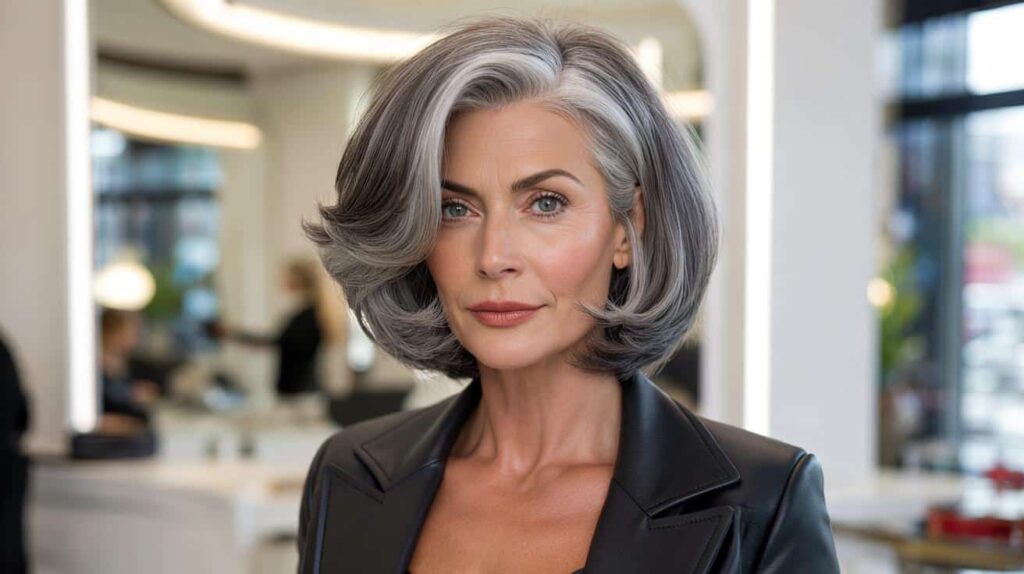
Fast forward a few years, and it’s no longer a rogue intruder. It’s a soft salt-and-pepper cloud around your face. On good days, it looks edgy and French. On bad days, you catch your reflection and think, “Since when did I start looking like my old primary school teacher?” You don’t want to look “young at all costs”. You just don’t want that automatic “granny” label every time a silver hair appears in the sun.
That tension is where the magic can actually happen.
 “A-line bob” haircut: this bob is perfect for fine hair and will be very trendy for back-to-school
1. Cut with intention: the anti-“granny” shortcut
“Gray doesn’t age you. The haircut does,” says Paris-based hairstylist Léa Moretti as she runs a comb through her client’s steel highlights. In her chair sits a 52‑year‑old lawyer with cheekbone-grazing salt and pepper hair and a leather biker jacket. Nobody in the salon is thinking “granny” as she scrolls through her emails. They’re thinking: who is this woman and what’s her story?

The truth is, long, shapeless hair plus gray can drag the face down and amplify tiredness. Sharp lines, airy layers, or a bold bob, on the other hand, turn every silver strand into a design choice. That’s what a good cut does: it transforms gray from “sign of age” into **deliberate style signal**.
Picture two scenes from the metro. On one bench: a woman with chest-length, thinned-out hair, yellowed at the ends, gray at the roots, parted in the middle because “that’s how it’s always been”. She looks like she’s apologizing to the world for taking up visual space.
On the next bench: someone the same age, hair cut into a blunt jawline bob, natural salt and pepper left to shine, a bit of movement at the tips. Same color palette, radically different energy. One blends into the background. The other has the quiet presence of a magazine street style photo. The difference is not age. It’s structure. The haircut frames the face, lifts the jaw, and makes the sparkle in the eyes match the sparkle in the hair.
From a technical point of view, gray and white hair reflect light differently. They’re slightly more porous, a bit coarser, and they show every line of a cut, for better or worse. A heavy, outdated shape will read ten times more “old-fashioned” on silver than on brown. That’s why stylists often recommend cleaner outlines, lifted crowns, and necklines that don’t sag into the shoulders.
A modern shape sends a clear visual message: this gray is intentional, not a sign you gave up. Layering around the face brings movement. A micro-fringe can suddenly make glasses look arty instead of “sensible”. When the cut is current, people read your hair as a fashion statement, not as a birthdate.
2. Shine and tone: turning “dull gray” into silver armor
If the cut is the frame, shine is the filter. Most of the “granny” effect comes from gray hair that looks dull, flat, or slightly yellow — the exact opposite of that glossy silver you admire on Instagram. The good news: gray loves light when you feed it properly.
Hairstylists swear by the same trio: hydration, protection, soft toning. Think sulfate-free shampoos, rich but light conditioners, and once-a-week purple or blue care to cool down brassiness. The aim is not to turn your hair violet, just to keep that crisp, icy dimension. *Healthy gray catches light like a silk scarf; neglected gray swallows it like a cotton sweatshirt.*
Léa tells the story of a client who walked in, 60 years old, ready to dye it all back to brown. “I’m tired of looking washed out,” she said. Her salt and pepper had a beige cast, the ends felt like straw, and her blow-dryer at home was on maximum heat “to go faster”.
They didn’t color her hair. They detoxed it. Clarifying shampoo to remove old deposits, a gentle gloss to add translucent shine, a cool toner to erase the yellow. At the end, the same gray looked like liquid chrome. The client put on red lipstick, pulled out her phone, and whispered: “I can’t believe this is still my hair.” No brown needed, just a smarter routine and less aggression.
There’s a simple reason this works. Gray hair has fewer natural oils, so the cuticle opens and frizzes more easily. Heat, sun, and pollution rough it up further, which makes light bounce off unevenly. Regular masks, heat protectant before styling, and a cooler blow-dry setting smooth the surface again. When the surface is smooth, light reflects. When light reflects, hair looks expensive.
Léa has a plain-truth line she repeats all day:
“Yellowed gray ages you. Shiny silver lifts you. It’s the same head, just a different care story.”
- Use a gentle hydrating shampoo and conditioner two to three times a week.
- Add a purple mask or conditioner once a week to cancel out yellow tones.
- Always apply heat protectant before blow-drying or straightening.
- Finish styling with a tiny drop of serum on lengths and ends for shine.
- Limit scorching settings: warm air is usually enough for smoothness.
3. Play with style: clothes, brows, and attitude that upgrade gray
The last frontier is not the hair itself. It’s everything around it. Salt and pepper instantly becomes editorial when it’s paired with crisp clothes, defined brows, and a touch of contrast on the face. That doesn’t mean full glam every morning, just a few deliberate choices.

Stylists often talk about “visual anchors”: elements that catch the eye and say “I’m here, present, awake”. For gray hair, that can be a bold frame of glasses, a structured blazer, white sneakers with clean lines, or a strong lip balm that brings life to the mouth. **Gray loves contrast**. A pop of color on a scarf, darker brows, or a navy sweater will prevent that faded, all‑over beige effect that screams “retirement home” even on a 40‑year‑old.
We’ve all been there, that moment when you suddenly notice you’ve been wearing the same shapeless cardigan for three winters, “because it’s comfy”. Next to new gray hair, that cardigan can read as giving up, even if you feel more alive than ever inside. Léa says one of the biggest shifts she sees is when clients allow themselves bolder, cleaner silhouettes: straight-leg jeans instead of saggy ones, a sharp shirt instead of a limp T-shirt, ankle boots instead of battered flats.
She also insists on brows. As hair lightens, brows often fade too, and the whole face loses structure. A bit of tint (or just a good pencil and brush) redraws the frame. The hair can be fully silver, but the expression stays vivid, focused, present.
There’s a mental component that no shampoo can replace. The women whose gray looks magnetic tend to speak about their hair in the present tense, not like a relic of their younger self. They say “my silver” or “my white streak”, not “what’s left of my color”. That subtle language shift changes how they carry their head in a room.
Léa sums it up with a sentence she repeats to clients doubting their transition:
“Gray hair tells your story. My job is to cut and style it so the story reads as power, not as permission to dismiss you.”
- Choose one strong element per outfit: glasses, shoes, jacket, or lipstick.
- Refresh brow shape and color to balance lighter hair.
- Favor clear, sharp lines in clothes instead of saggy, worn pieces.
- Experiment with colors that make your silver glow: navy, black, white, fuchsia, emerald.
- Speak of your gray as a feature, not a flaw. Your posture will follow.
4. Five daily habits to enhance gray hair without the “granny” effect
Behind every enviable salt and pepper mane, there’s less magic than you think. It’s mostly small habits, repeated quietly. Here are the five that hairstylists return to, day after day, for clients who want gray without the stereotype.
First: a regular, modern haircut every 6 to 10 weeks. Not a “trim if you have time”, a real appointment where the shape is refreshed, the neckline cleaned, the length re‑balanced. Overgrown gray quickly veers into “tired”. A crisp outline instantly reads as choice.
Second habit: a simple care ritual anchored in real life. One gentle wash, one conditioner, one weekly mask, one protective product before heat. Let’s be honest: nobody really does this every single day. The point is consistency over perfection. Skipping the aggressive shampoos and rough towel drying already changes the texture in a month.
Third: a quick toning step. That could be a purple conditioner in the shower while you shave your legs, or a salon gloss every couple of months. The goal is to keep your silver cool, not let it slide into nicotine yellow. That shift alone removes half the “granny” vibe.
Fourth habit: a 30‑second style upgrade in the mirror before you leave the house. It can be tucking hair behind one ear to expose earrings, flipping the parting for lift, or adding a pea‑sized volume mousse at the roots. Messy is fine. Intentional messy is chic.
Fifth: align your gray with one visible style choice off the head. That could be **a bright lipstick, a structured jacket, or a piece of jewelry you actually love**. Gray hair is a strong visual. It needs one ally somewhere else on your body to tell the world, “Yes, I did this on purpose.” Those micro‑rituals don’t take an hour. They just ask you to be present with the person in the mirror for a few beats.
Gray hair as a style choice, not a surrender
Gray hair used to mark a before and after: before, when you were allowed to be visible, and after, when you were gently told to tone everything down. That line is moving. You see silver buns in yoga classes, short white crops at concerts, salt and pepper pixies in boardrooms. The more we notice them, the more that old “granny” box starts to crack.

What changes everything is when you treat gray as a material, not as a problem. You cut it, gloss it, style it, frame it. You let it be contrasted, supported, sometimes even celebrated out loud. You’ll still have days where you miss your old color, the same way you miss a city you once lived in. You also gain mornings where your reflection looks strangely like the most honest version of you. And that’s where gray hair stops being a deadline and starts being a decision worth sharing.

| Key point | Detail | Value for the reader |
|---|---|---|
| Modern haircut | Structured bob, layers, or short cut that lifts the face | Makes gray look intentional and stylish, not neglected |
| Shine and toning | Hydrating care, heat protection, purple products | Transforms dull gray into luminous silver that catches light |
| Style balance | Defined brows, clean clothes, one bold accessory | Eliminates the “granny” effect and reinforces personal presence |
FAQ:
- Can gray hair really be flattering on everyone?Yes, if the cut, shine, and overall style are adapted to your face and lifestyle. Most people don’t suit neglected gray, but they do suit gray treated as a design choice.
- Do I have to cut my hair short to avoid the “granny” effect?No. Long gray can be stunning when the length is healthy, softly layered, and the ends are not see‑through. The key is shape, not length.
- How often should I use purple shampoo or mask?Usually once a week is enough for natural gray. If your hair gets very yellow, you can go up to twice weekly, balancing with hydrating care to avoid dryness.
- Will gray hair always feel rough?Not necessarily. With regular masks, gentle drying, and serums on the lengths, gray can feel smooth and soft, just with a slightly stronger texture than your old pigment-rich hair.
- What if I’m in the middle of growing out dye?Ask your stylist for soft blending: fine highlights, lowlights, or a transitional gloss to reduce the demarcation line. A modern cut and toning products will already make the “in‑between” phase look more intentional.
