The first time I witnessed a family dining without a traditional table, I thought it was a joke. It was a Tuesday night in a small apartment, kids in socks, and pasta bowls set on a low, wide coffee table. It looked more like a soft island than a piece of furniture. The parents were half-sitting, half-leaning on floor cushions, laptops closed, TV off. Everyone was gathered close, almost huddled together, like a picnic moved indoors.
No one asked, “Pass the salt at the end of the table,” because there was no “end” anymore. Just one expansive surface in the center of the living room, shared like a campfire.
The most surprising part? It didn’t feel messy or temporary. It felt like the dining room had simply… disappeared.
Why Dining Tables Are Quietly Vanishing
If you walk through modern apartments in major cities, you might notice something unusual. There’s no grand wooden table commanding the room, no set of matching chairs waiting for a Sunday roast. Instead, the space once occupied by a traditional dining room is now a hybrid: part living room, part office, part play area.
The once-dominant dining table is slowly being edged out. In its place? Low modular tables, oversized sofas with sideboards, kitchen islands doubling as workspaces. Our homes are shrinking, but the way we use them is expanding.
In cities like Tokyo, Berlin, and Copenhagen, real-estate agents admit that buyers now care more about plug sockets than where to place a formal dining table. One Danish interior designer shared that 70% of her clients prefer “a generous coffee table and a good island” instead of a formal dining setup.
She showed me photos of one of her projects: a family of four, with two kids and a dog. Their dinner spot? A large, low table on wheels in front of a corner sofa, with hidden storage underneath for placemats and board games. On Sundays, they slide the table aside to unroll a yoga mat. On weekdays, it doubles as a homework station. Only once a year do they borrow a folding table for Christmas.
The logic behind this trend is simple. We no longer live in our homes by “rooms.” Instead, we live by “moments”—work calls, quick snacks, dinners, online classes, movies, and stretching, all within the same space. A fixed, large dining table takes up valuable space while catering to fewer traditional meals.
The new approach views furniture as flexible tools, not fixed monuments to family life. With meals often lasting only 20 minutes and people eating at different times, a softer, adaptable surface feels like the honest answer to how we live today.
What’s Replacing the Dining Table: Functional New Setups
Surprisingly, one of the most common replacements abroad is a large, sturdy coffee table placed at the perfect eating height when seated on a sofa or cushions. These aren’t the tiny decorative pieces barely large enough for a magazine. Instead, they are broad surfaces, 100–120 cm long, sometimes adjustable in height, and with rounded edges for ease of movement.
Designers pair these tables with floor cushions, poufs, and deep sofas. Meals become more casual, with plates closer and bodies more relaxed. Some families even keep a small rolling cart nearby, stocked with cutlery, napkins, and condiments, which slides in and out like a mini sideboard on wheels.
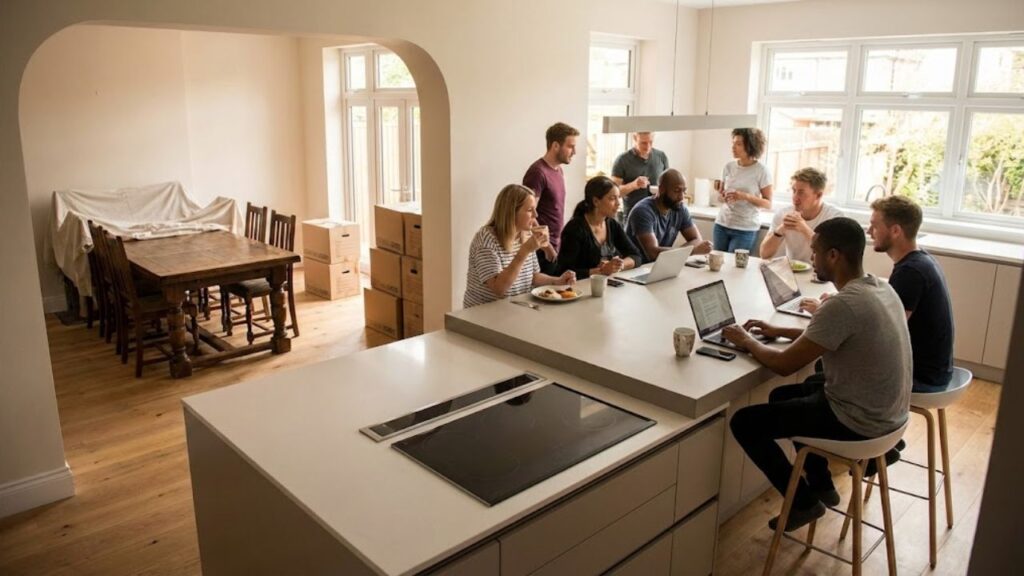
Another popular trend is the kitchen island revolution. In many Canadian and Dutch homes, the island has completely absorbed the role of the dining table. It’s where breakfast happens, laptops open, vegetables get chopped, homework is done, and wine is poured at night. One block, multiple uses.
A couple in Montreal shared how they sold their large dining table during a move and never replaced it. They extended their island by 40 cm with a wooden panel and added three stools. When they have guests, they simply bring in two foldable chairs from the balcony. “We eat better, we talk more,” they say. “There’s no formal ‘take your places,’ people just slide in.”
The deeper reason behind this shift isn’t laziness or lack of style; it’s a new hierarchy of needs. Storage is prioritized over ceremony. Comfort beats “proper posture.” Versatility beats tradition.
Many young families abroad prefer multifunctional furniture. They would rather invest in a sofa that hosts sleepovers, a coffee table that converts into a dining surface, or a bench that doubles as toy storage. The central dining table of their childhood memories now seems like an oversized relic.
There’s one simple truth no one likes to admit: **most families never sit together at the dining table on regular weekdays**. These new setups simply stop pretending.
How to Live Without a Dining Table (Without Chaos)
If you’re considering embracing this trend, start small. Instead of discarding your dining table right away, try creating a “low living” zone first. Bring a large tray to your coffee table or ottoman and have one meal there each week. Pay attention to how your body feels, how the conversation flows, and how the room feels afterward.
If the experience works for you, consider upgrading your furniture. Choose a coffee table large enough to hold four plates and a salad bowl. Look for rounded edges, easy-to-clean surfaces, and a height that allows you to eat comfortably without bending awkwardly. Think “informal but solid,” not “fragile design object.”
The biggest mistake is confusing “no dining table” with “eating anywhere, anyhow.” That’s when crumbs end up in the bed, sauce stains the laptop, and indigestion creeps in. Going table-free doesn’t mean losing all structure; it means creating a new structure that fits your rhythm.
Set a few simple rules: no plates on the couch cushions, always use a tray for snacks in front of the TV, and wipe down the central table after every meal like you would a regular dining surface. And be kind to yourself: **you don’t need a Pinterest-perfect setup to enjoy real moments around food**.
What This Trend Says About How We Want to Live
The disappearance of the dining table raises a larger question: what kind of life do we dream of inside our homes? Do we want a showroom-like space, or a flexible nest where the same square meter can transform three times a day?
Abroad, the answer is tilting toward fluidity. Families accept that dinner might happen in front of a series, that friends might eat on the balcony, and that kids might do homework on the same surface where tacos were served an hour earlier. Some people find this sad, others find it liberating. Both reactions are valid.
We’ve all had that moment when we realize our grand dining table mainly holds unopened mail or laundry waiting to be folded. Once you notice it, it’s hard to ignore. Letting go of the table isn’t just about losing a ritual—it’s about daring to rebuild one that better fits our real daily lives.
The question remains: if you were designing your home today from scratch, would you still dedicate an entire room to a piece of furniture you truly use only twice a month?
| Key point | Detail | Value for the reader |
|---|---|---|
| Flexible dining setups | Large coffee tables, islands, and modular furniture replace fixed tables | Gives ideas to adapt eating spaces to small or changing homes |
| Real-life usage | Most families don’t use formal dining tables daily for shared meals | Helps release guilt and design a home based on actual habits |
| Practical toolkit | Combination of low table, cushions, foldable table, and side cart | Offers a realistic method to live comfortably without a classic dining room |