Far from Shanghai and Beijing, France has built a surprisingly dense economic footprint in Sichuan, a huge inland province that has evolved from agricultural backwater to high-tech powerhouse, and the latest figures show the relationship is shifting into a much higher gear.
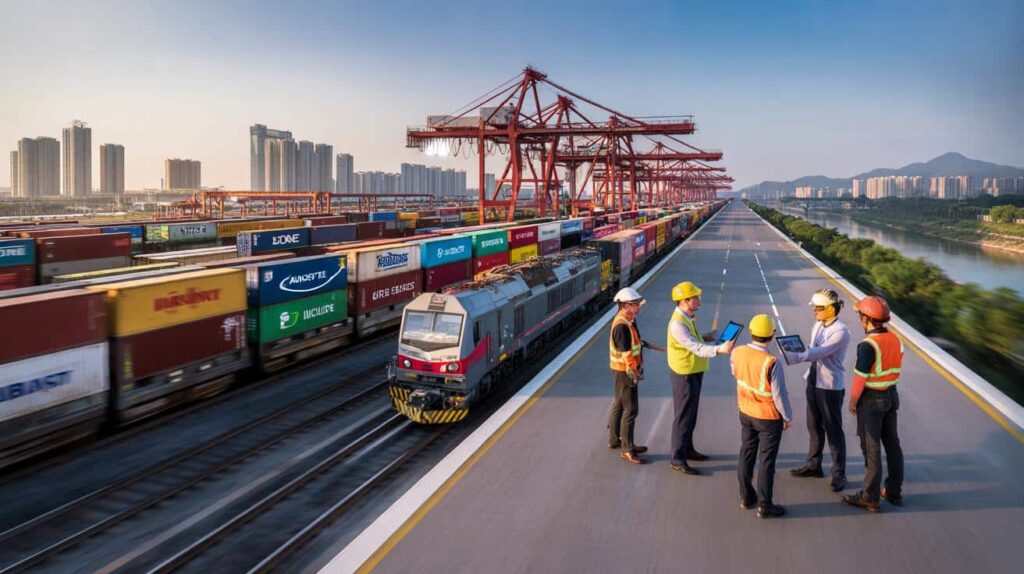
French exports to Sichuan surge on the back of deeper ties
Between January and October 2025, French exports to Sichuan province reached 3.51 billion yuan, or roughly €432 million at current rates.
Year on year, French exports to Sichuan jumped by 32.7%, turning the province into one of the fastest-growing regional partners for France in China.

The increase reflects long-term cooperation rather than a one-off spike.

French companies in aviation, food, insurance, digital entertainment and industrial gases have been building factories, service centres and joint ventures in the region for years.
For Beijing and Chengdu, the provincial capital, this French presence supports a broader push to rebalance China’s growth away from the coast and toward inland hubs.
Sichuan, a giant inland market France no longer ignores
Sichuan covers about 485,000 square kilometres, almost the size of Spain, and is home to more than 83 million people.
Its capital Chengdu has grown into a megacity of over 20 million residents in its wider metropolitan area, with a young urban middle class that buys smartphones, cosmetics and European-style dairy products.
The province now hosts major aerospace, electronics, automotive, chemical and agri-food industries, supported by a dense network of universities and research centres.
Hydropower dams on its rivers power tens of millions of households and factories, giving the region a strategic role in China’s energy system.
Economically, Sichuan’s gross domestic product exceeds €700 billion, which puts it roughly on par with some of Europe’s larger national economies.
For French business strategists, Sichuan looks less like a distant province and more like a stand‑alone market the size of a mid‑tier G20 country.
Trains from Lyon to Chengdu: rail becomes a trade artery
The China-Europe Railway Express shortens distances
A key reason behind the export surge lies in logistics.
French goods now reach Chengdu by the China-Europe Railway Express, part of Beijing’s Belt and Road initiative.
Trains depart from hubs such as Lyon and cross Central Asia and Eastern Europe before unloading containers directly in Sichuan.
Transit times between Chengdu and Poland have dropped to around 15 to 18 days, compared with 40 to 50 days by sea.
For many exporters, the rail option sits between costly air freight and slower shipping, offering a balance of speed and price.
- Rail: 15–18 days, mid-cost, reliable schedules
- Sea: 40–50 days, cheaper but slower and more exposed to port congestion
- Air: 1–3 days, fastest but often too expensive for bulk or mid-value goods
This shift directly benefits sectors such as French cosmetics, which already account for over €75 million of exports to Sichuan.
Faster journeys protect product freshness, reduce stock levels and allow brands to react more quickly to changing Chinese consumer trends.
Flagship French players betting big on Sichuan
Airbus: giving planes a second life in Chengdu
In Chengdu, Airbus runs its Airbus Lifecycle Services Centre, focused not on building new jets but on maintaining and dismantling aircraft at the end of their commercial career.
Technicians strip each aircraft, salvage components, recycle metals and refurbish parts that can re‑enter the global supply chain.
Each plane processed represents dozens of tonnes of material recovered and a complex orchestration of inspections, certifications and safety checks.
For France, the site acts as an industrial showroom, highlighting expertise in sustainable aviation and circular economy practices.
For Sichuan and China’s aerospace sector, it brings advanced know‑how, high‑skilled jobs and exposure to international maintenance standards.
Air Liquide: invisible infrastructure behind high tech
In factories across Sichuan and neighbouring Chongqing, Air Liquide supplies oxygen, nitrogen and high-purity hydrogen to electronics makers, chemical plants and advanced materials producers.
These industrial gases are rarely visible to the public, yet they underpin much of the region’s upgrade into higher-value manufacturing.
Microchip production needs ultra-clean gases to maintain stable conditions in fabrication plants.
Modern steelmaking relies on oxygen to reach the temperatures and quality demanded by carmakers and infrastructure projects.
By installing production units and pipelines in southwest China, Air Liquide signals that the area is no longer seen as a low-cost assembly base but as a mature high-tech cluster.
Danone: localising “French taste” for Chinese shoppers
In Qionglai, near Chengdu, Danone operates a major production and logistics hub that serves much of southwest China.
The site handles everything from milk processing to packaging and regional distribution.
 French foreign trade surges in Chinese Sichuan province with 32.7% export jump to €432 million
Product ranges include dairy goods and specialised nutrition, adjusted to local preferences and Chinese food safety standards.
Instead of simply shipping finished yoghurts from Europe, Danone sources from regional suppliers, works with local regulators and shortens supply chains to a radius of a few hundred kilometres.
This strategy reduces transport emissions, keeps prices competitive and anchors economic value inside Sichuan, something Chinese authorities welcome.
Groupama: insurance as a real-time barometer
Groupama SDIG Property Insurance has chosen Chengdu as a base for a network of 263 agencies across 12 Chinese provinces.
The company has recorded five consecutive years of profit growth in China.
Rising demand for insurance tends to signal more investment, higher household consumption and a growing stock of assets that need protection.
For a French insurer, succeeding in this environment requires a firm grip on local regulations, climate and industrial risks, and consumer habits that differ sharply from those in Europe.
Chengdu offers a vantage point to serve both fast-growing inland provinces and more established coastal markets.
Ubisoft: video games as a cultural bridge
Ubisoft’s Chengdu studio plays a full role in major global franchises rather than acting as a simple outsourcing centre.
Teams there design in‑game environments, narrative elements and gameplay systems targeting international audiences.
Gamers in London or Los Angeles often roam through virtual worlds imagined and coded in Sichuan, without realising it.
This two‑way flow of creativity turns the studio into a cultural bridge, where Chinese developers work on European stories and global players engage with ideas shaped in Chengdu.
Beyond trade: a maturing strategic partnership
From goods to skills, technology and education
Beneath the trade figures, a wider form of cooperation is emerging.
Authorities in Sichuan and France have pushed partnerships not only in aviation and automotive technology but also in environmental services, engineering education and public transport.
Some French universities and business schools cooperate with Sichuan institutions to run joint programmes, student exchanges and research projects.
City planners from Chengdu have drawn on French experience in metro systems and sustainable urban development.
France contributes brands and advanced technologies, while Sichuan brings scale, rapid adoption and a vast consumer base.
For French firms, the risk of intellectual property leakage or political tension remains real, yet the opportunity to anchor themselves in China’s inland rebalancing is hard to ignore.
Key concepts and future scenarios
What “export growth” really means for French jobs
When exports from France to Sichuan rise by 32.7%, the impact does not stop at customs statistics.
Higher demand for French cosmetics or aircraft components can support jobs in factories in Lyon, Toulouse or Normandy.
At the same time, local production in Sichuan, like Danone’s plant or Airbus’s service centre, shifts part of the value-add to China.
The result is a more complex map of who benefits:
- Design, branding and high-end engineering often stay in France.
- Manufacturing and customer service increasingly sit closer to Chinese consumers.
- Logistics, rail hubs and port services in Europe gain volume from the trade flow.
A sharp slowdown in Chinese growth or a regulatory clampdown could quickly hit these intertwined value chains.
Risks and resilience in a tense geopolitical climate
Growing dependence on a single foreign market brings vulnerabilities.
French exporters to Sichuan face currency swings, sudden changes in Chinese rules, and the broader chill in EU–China relations.
Companies now tend to build “China‑for‑China” strategies: plants, supply chains and financing structures that can operate relatively independently from their European bases.
This approach cushions the shock of policy shifts on either side, but it also increases the complexity of managing global operations.

For policymakers in Paris, the Sichuan case illustrates a wider question: how to balance strategic autonomy with the lure of one of the largest, fastest‑changing markets on the planet.