In test bays outside Reims and on government desks in Paris, a different kind of space strategy is taking shape: smaller rockets, faster development, and private companies leading the charge. At the centre of this shift sits Latitude, a young launcher firm betting that France can claw back influence in orbital access by 2026.
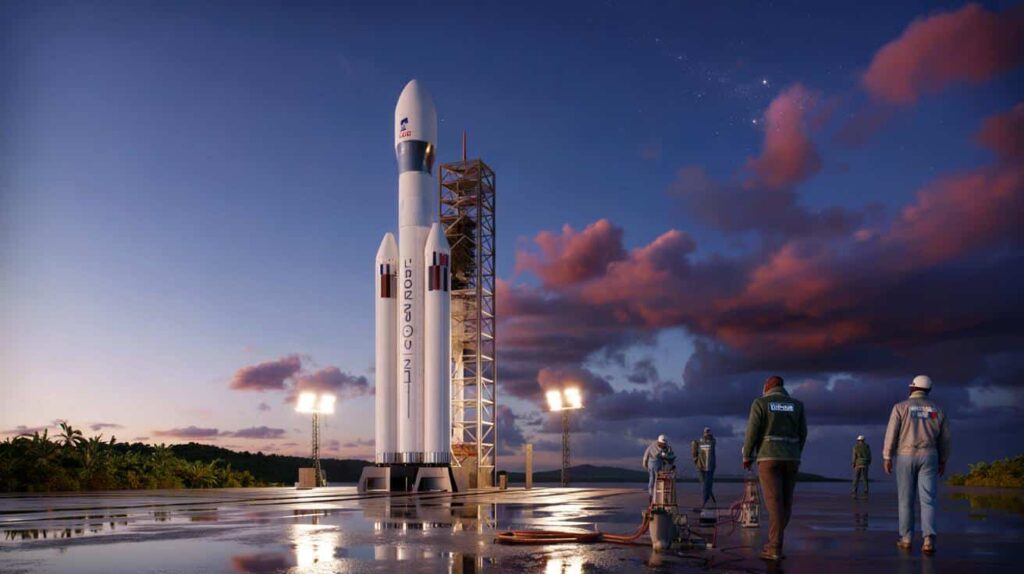
Latitude’s Zephyr launcher puts France back in the small-rocket race
Latitude’s main project, the Zephyr Launcher, aims to give France an independent way to send small satellites into orbit, without relying on foreign rockets or waiting for space on big launchers.
Zephyr is a two-stage, 20‑metre-tall rocket powered by kerosene and liquid oxygen. It targets a payload of about 200 kg to low Earth orbit, or around 80 kg to sun-synchronous orbit, a sweet spot for Earth-observation constellations and CubeSats.

Zephyr’s first orbital flight is currently targeted for 2026 from Europe’s Guiana Space Centre in Kourou, placing a French-built micro-launcher on the global stage.

This places Latitude in direct competition with a wave of European and international micro-launchers from Germany, the UK, Italy and the US. The business logic is clear: satellite operators want dedicated, flexible launches rather than waiting months for a rideshare slot on a larger rocket.
The company says Zephyr is designed for fast turnaround and simplified operations, with almost all critical hardware — including engines and turbopumps — developed and manufactured in-house. That approach demands higher upfront effort but promises tighter control over costs and reliability later.
Inside the “heart of fire and ice”: the turbopump challenge
Behind every dramatic launch video sits a brutal piece of machinery that most people never see: the turbopump. For Latitude, mastering this component has become a strategic milestone.
Why the turbopump decides whether a rocket lives or dies
The turbopump on Zephyr’s Navier engine sucks propellants from the tanks, compresses them, and forces them into the combustion chamber at extremely precise pressures and flow rates.
Any instability in that chain — a pressure oscillation, a gas bubble, a vibration — can kill performance or even shut down the engine. For a micro-launcher that has to be cost-efficient and reliable, the margin for error is thin.
Engineers often describe the turbopump as the mechanical heart of a liquid-fuel rocket: if it skips a beat, the mission is over.
In December 2025, Latitude pushed its turbopump into one of the toughest test phases so far: running with liquid oxygen, a cryogenic propellant stored at around −183 °C. The component must work while being battered by extreme cold on one side and mechanical stress on the other.
Liquid oxygen: the make-or-break test
Early tests used non-cryogenic fluids to prove the overall design. Switching to liquid oxygen (often called LOX or LOx) raises the difficulty dramatically.
At such low temperatures, any tiny thermal imbalance can create vapour bubbles inside the fluid. Those bubbles can implode violently inside the pump, a phenomenon known as cavitation. It reduces performance, damages internal parts and can quickly destroy the turbopump.
During LOX runs, Latitude’s teams track several parameters in real time:
- stability of propellant flow rates
- pressure delivered to the combustion chamber inlet
- mechanical resistance of rotating parts under thermal shock
- perfect sealing between liquid oxygen and lubricants
For now, Latitude keeps things deliberately simple. The kerosene fuel (RP‑1) used in flight is not yet injected in these tests. That choice removes one variable from the equation and lets engineers concentrate on mastering LOX behaviour.
Testing, breaking, tweaking: the iterative loop
Each turbopump test produces a flood of data: temperature curves, vibration spectra, transient regimes, pressure drops, and more. Latitude’s Fluid & Propulsion Systems teams feed this into an iterative design loop that looks closer to software development than classical aerospace engineering.
The strategy is clear: test early, learn quickly, modify aggressively, then test again — even if that means burning through hardware.
This approach has already produced a “flight-ready” version of the turbopump, now being integrated directly with the Navier engine’s combustion chamber for dedicated bench tests. That step edges Zephyr towards full-scale stage-level trials and, ultimately, a launch campaign.
Who is Latitude, and why is Paris betting on it?
From Reims start-up to strategic asset
Latitude was founded in 2019 in Reims by Stanislas Maximin, Kevin Monvoisin and Ilan Saidi‑Bekerman, originally under the name Venture Orbital Systems. Their pitch: bring back a sovereign French capability for small satellite launches at a time when Ariane was focused on heavy payloads.

In less than six years, the company has grown from a small incubated project to one of the flagships of French “NewSpace”. By 2026, it employs close to 180 people, has raised around €50 million, and operates an 8‑hectare test centre at Vatry.
Latitude plans a 25,000 m² factory south of Reims designed to produce up to 50 Zephyr launchers per year by 2030. The vision is industrial rather than artisanal: a production line for rockets that looks more like an automotive plant than a traditional space workshop.
Public money, private risk
The French state has stepped in as a crucial accelerator. Through the France 2030 investment programme, Latitude receives targeted funding to internalise production of critical systems such as turbopumps. Those are exactly the components now under cryogenic testing.
The CNES, France’s space agency, supports the company with technical expertise built over decades of cryogenic propulsion work on Ariane rockets. That support ranges from reviewing design choices to sharing software tools and test methodologies.
| Key Latitude milestones | Details |
| 2019 | Company founded in Reims, France (as Venture Orbital Systems) |
| 2021–2023 | First Navier engine tests and early turbopump development |
| 2024–2025 | Opening of Vatry test centre, ramp-up of Zephyr industrial planning |
| December 2025 | Start of turbopump liquid-oxygen test campaign |
| 2026 (target) | First Zephyr orbital flight from Kourou or SaxaVord (Scotland) |
A French NewSpace ecosystem no longer orbiting big primes
Latitude is not alone. France’s space sector, once dominated by a few heavyweights and long, state-led programmes, now includes a dense network of private firms covering everything from launchers to in-orbit services.
By 2023, around 150 private companies were active in “NewSpace” in France, representing more than 2,000 jobs. Over 300 employees already work on micro-launcher projects alone, a number that would have sounded ambitious a decade earlier.
The new landscape looks more like a tech cluster than a classic defence-industrial complex: start-ups, SMEs and scale-ups sharing patents, data and test facilities.
This ecosystem relies heavily on public support, but not in the old “top-down programme” style. Instead, CNES and other institutions act as catalysts. They fund risky stages, buy early services and open access to a library of around 400 space-related patents and software components.
An incubator called TechTheMoon even targets lunar activities, from resource extraction to microgravity agriculture, hinting at how far private players might go once orbital access becomes cheaper and more flexible.
Other French NewSpace players to watch
- MaiaSpace, a spin-off linked to ArianeGroup, developing a reusable mini-launcher.
- HyPrSpace, building a hybrid-propulsion rocket aimed at small satellites.
- Exotrail and ThrustMe, offering electric propulsion systems for satellites, which can pair naturally with micro-launcher missions.
- Kinéis, Unseenlabs and Prométhée, deploying constellations for IoT and maritime or Earth-observation data.
Latitude’s Zephyr fits into this puzzle as a missing link: a domestic ride to orbit for many of those future French-built satellites.
Why turbopumps and cryogenics matter beyond Latitude
For non-specialists, terms like “cryogenic turbopump” can feel abstract, but they sit at the core of modern rocketry. A simpler, low-pressure feed system would make engines larger, heavier and less efficient. Turbopumps let engineers shrink tanks, raise pressure and boost performance within tight weight limits.
Mastering cryogenic propellants such as liquid oxygen also opens doors to more advanced systems, including stages that use liquid hydrogen or in-space refuelling concepts. Each successful test at Vatry inches European know-how closer to those future architectures.
The flip side is risk. Turbopump failures have destroyed rockets from multiple countries over the last 60 years. Tiny cracks, manufacturing defects or misjudged operating margins can trigger catastrophic disintegration within seconds of ignition.
In practice, that means Latitude and its peers must juggle competing pressures: investors and customers demanding rapid progress, regulators insisting on safety, and engineers chasing margins of just a few percentage points in efficiency or reliability. Each extra point can decide which launcher survives in a crowded global market.
For satellite operators, a functioning Zephyr in 2026 would bring tangible benefits. They could, for instance, book a dedicated flight for a small constellation refresh instead of hitching a ride on a large rocket that prioritises someone else’s schedule. Earth-observation start-ups could launch on specific orbital planes or revisit times, securing sharper business cases.

At the same time, a growing number of micro-launchers raises questions: more rockets mean more debris risk, more emissions and tighter ranges for safe launches. Regulators in Europe and abroad are already wrestling with flight cadence limits, environmental assessments and space-traffic management. Any “French counterattack” in space thus intertwines with global conversations about how crowded low Earth orbit should become.