
The physio room smells faintly of disinfectant and coffee. On one table, a woman in her fifties rolls up her leggings, wincing as she bends her knee. On the other, a young runner thumps a frustrated fist into the pillow as his therapist shakes her head. Both of them have heard the same advice for months: “Swim more, try Pilates, avoid impact.” Both of them did. Their knees still hurt.
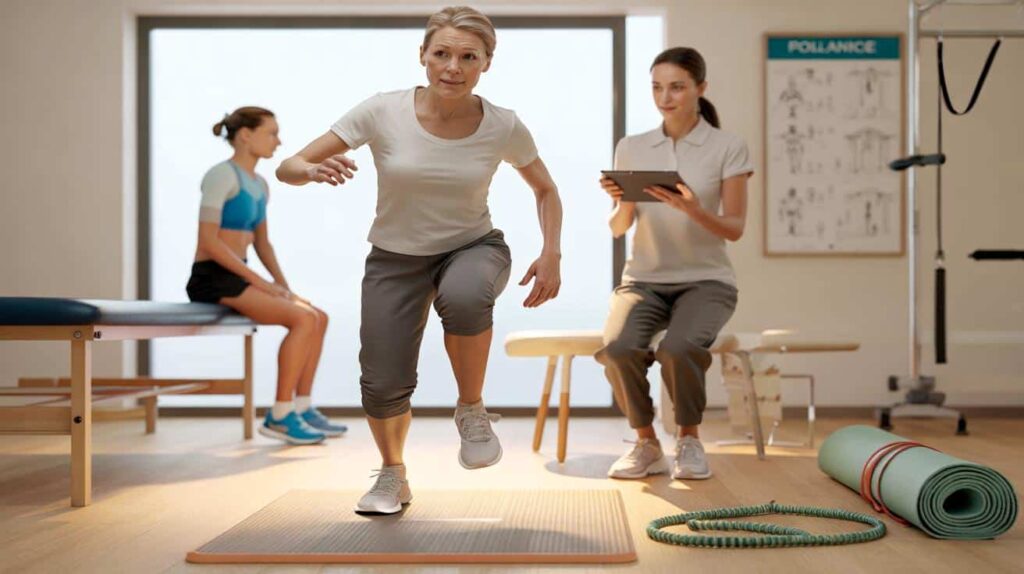
Then the physio pulls out something they don’t expect at all.
Not a pool schedule. Not a mat with gentle stretches.

A small jump platform. A skipping rope. A plan that sounds like a bad idea for someone whose knees are already angry.

Yet she swears this controversial thing is what actually turned her own knee pain around.
Why some physios are telling knee-pain patients to jump more, not less
The idea lands like a slap: treat knee pain with jumping. Little hops. Mini-squats that pop off the ground. Low-level plyometrics that every online article used to file under “avoid if you have bad knees.”
One London-based therapist calls it “teaching the knee to be brave again.” The concept is simple enough. Instead of endlessly protecting the joint with soft, slow movements, you gradually reintroduce tiny bursts of impact so the tissues stop overreacting to every step.
This goes completely against the “wrap it in bubble wrap” reflex many of us have when a joint starts screaming. Which is exactly why people click away from it or swear by it.
Take Marie, 47, office manager, three years of nagging knee pain. She tried everything she was told was “safe”: swimming three times a week, then gentle Pilates, then a raft of stretchy resistance-band exercises that bored her stiff.
Her scans showed early osteoarthritis. Every new professional repeated the same menu: low impact, low load, low risk. Her pain… stayed medium. She could walk. She could function. She also missed dancing at weddings and running for the bus without bracing.
A new physio tested her strength, then watched her climb a step. He saw more fear than damage. Within six weeks of a graded “micro-jump” program, she was landing soft hops in her living room, startled to find her knee feeling more solid, not less.
The logic is brutal and strangely reassuring. Cartilage, tendons, and muscles adapt to what you repeatedly ask of them. Spend months only moving in slow motion, and the body gets very good at… slow motion. Ask it to take a small jump after that, and the system panics. Pain, stiffness, swelling.
So a camp of modern physiotherapists has flipped the script. They still use strength work and controlled movements, but they mix in progressive impact: minuscule hops, step drops, light skipping. The goal is not to smash the joint. The goal is to teach it that impact can be normal and survivable again.
Not all colleagues agree. Some see it as genius. Others as playing with fire. That clash is exactly where the controversy lives.
How this “micro-jump” approach actually works day-to-day
The method almost never starts with big, Instagram-style box jumps. Think boring. Think small.

Session one might be standing on two legs and doing 10 very tiny hops on a soft mat, barely leaving the floor. You land like you’re hiding from the neighbors downstairs. Next, you might step off a low step, drop just a few centimeters, and “ride” the landing by bending knees and hips together.
Only when that feels as dull as brushing your teeth does the therapist turn up the dial. They track pain on a simple scale: if discomfort spikes above a 3 out of 10 and lingers more than 24 hours, the jump dose was too high. It’s impact, but it’s calculated impact.
This is where most people trip up. They hear “jumping helps knees” and go straight from couch to HIIT class. Then they flame out, ice pack in hand, muttering that all physios are liars.
The controversial protocols are the opposite of macho. They’re almost embarrassingly gentle at first. Ten hops twice a day. A few slow step drops. Maybe some light skipping with shoes that actually support you. The boring stuff you can do in your hallway while the kettle boils.
Let’s be honest: nobody really does this every single day. Life gets in the way. Which is why good therapists build forgiving plans, not perfection projects, and accept inconsistency as part of the picture.
The other major pitfall lies in fear. If you’ve been told for years that any impact will “destroy your knees,” your brain reacts long before your cartilage does.
One physio in Paris told me she spends more time reframing beliefs than teaching exercises.
“We were so focused on protecting joints that we sometimes forgot to rebuild their courage,” she said. “Impact is a language the body understands. If you remove it completely, the system becomes hypersensitive to the slightest noise.”
She shares a simple checklist with her patients:
- Start with two-legged jumps before anything on one leg.
- Always land softer than you took off.
- Keep pain during the exercise at “discomfort” level, not “alarm” level.
- Leave at least one rest day between heavier sessions.
- Stop increasing difficulty if sleep, swelling, or mood goes downhill.
Those tiny rules are the guardrails between helpful stress and pure folly.
Why experts still argue — and where that leaves your knees
Behind the fight over jumping lies a deeper split in how we think about pain. Some therapists still see the knee like a worn-out hinge: too many impacts equals more wear, end of story. Others see it more like a sensitive ecosystem, where zero impact can be just as destabilizing as too much.
Studies on tendinopathy and joint pain back both sides at times, which doesn’t help. Some research shows graded plyometrics improving function in people with knee issues. Other trials warn against early impact in certain post-surgical cases. The nuance easily gets flattened into clicky headlines: “Never run again” versus “Running cures arthritis.”

*Most real-life rehabs sit in the messy grey between those extremes.* That’s exactly why physiotherapists argue in conference halls, on Instagram reels, and quietly in clinic kitchens where patients never hear.

| Key point | Detail | Value for the reader |
|---|---|---|
| Graded impact can help | Micro-jumps and soft landings retrain tissues and brain to tolerate load | Gives a pathway back to walking, running, or stairs with more confidence |
| Progression matters more than perfection | Slow increases in difficulty, with pain and recovery as guides | Reduces flare-ups and fear while still moving forward |
| Physios will disagree | Different training, beliefs, and reading of the same data | Helps you understand why advice clashes and how to ask better questions |
FAQ:
- Is jumping really safe if I already have knee pain?
Sometimes, in tiny doses. The key is graded impact, soft landings, and pain that stays in a low “this is new” zone, not “something is wrong” panic.- Should I stop swimming and Pilates completely?
Not necessarily. They’re still useful for general fitness and gentle strength. The debate is about adding smart impact, not throwing out the pool or the mat.- How do I know if the load is too much?
If pain spikes above a 3–4/10 during exercise, or stays worse for more than 24 hours, your step was probably too big. Pull back, don’t quit.- What if my doctor told me to avoid impact forever?
That advice may be right for specific conditions or surgeries. You can still ask, calmly, what level of impact is acceptable and whether a graded program could be possible later.- Can I try this alone without a physio?
You can start with very small two-leg hops on a soft surface and watch how your knee responds. For long-term change, especially with arthritis or past injuries, a professional eye is worth seeking out.
