
At 9:15 on a Tuesday morning, the salon is still waking up. Coffee cups on the counter, the soft buzz of hairdryers in the back, a low playlist of 80s hits. On chair three, Claire, 56, pulls her cardigan a little tighter and lifts a limp strand of hair between two fingers. “It’s like… it just gave up,” she sighs, half laughing, half mortified. Her hair is clean, well-cut, technically “fine but healthy”. Yet it lies flat against her scalp, refusing to hold volume for more than ten minutes.
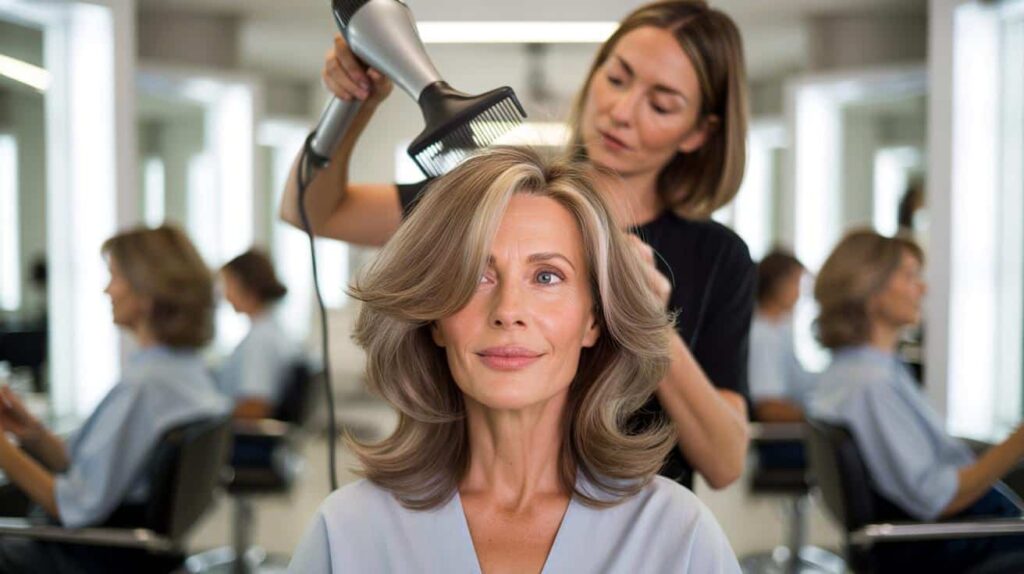
Around her, other women in their 50s and 60s nod in silent solidarity. They’ve swapped colorists, tried supplements, bought the expensive volumizing shampoo “that influencer” recommended. Still, by late afternoon, their hair seems to slide down their head as if someone pressed a slow-motion “deflate” button.
That’s when the hairstylist leans in and says, in a quiet conspiratorial tone: “There are a few tricks that really work. The kind nobody tells you on the box.”

Why fine hair changes after 50 — and what your stylist really sees
Ask any seasoned hairstylist and they’ll tell you: something shifts around 50. Not from one day to the next, but gradually, like the brightness being turned down a notch. Estrogen drops, follicles miniaturise, and the hair that grows back is a little thinner, a little softer, a little more “floaty”. On dark hair, the silver strands seem wiry. On blondes, everything starts to look see-through at the parting. You wake up one morning and the ponytail that once felt solid now feels like a shoelace.

In the salon mirror, it’s not just hair that changes. It’s posture. Women start touching their roots, angling their head to check the crown, asking questions they never asked at 35: “Is it thinning?”, “Can you see my scalp?”, “Am I too old to wear it long?” Stylists say they hear the same story again and again. “I didn’t touch my hair for years, then suddenly, overnight, nothing works the way it used to.” The truth is, the hair changed slowly. The routine didn’t.
That gap between new hair and old habits is where disappointment settles. For years, the industry sold us the myth that one magic product would “fix” fine hair. Your stylist sees something different: hair that needs less weight, smarter structure, and gentler handling. Not a miracle cure. A strategy. When they look at a head of 50+ fine hair, they’re not only checking density. They’re reading the growth patterns, the cowlicks, the hairline recession, the way the hair collapses around the temples. That’s where real results start.
Take Marie, 62, who walked into the salon insisting she “needed extensions” because her hair was “too far gone”. Her hair was indeed fine, but not dramatically thin. The real issue sat at the crown and around the parting: long layers that dragged everything down, a heavy fringe that split in the middle, and a color that was too flat, too uniform. “It looks like a curtain,” she whispered, watching her reflection closely. She wasn’t wrong. Her hair fell in one straight, heavy sheet.
Instead of gluing in more hair, the stylist did the opposite: she removed weight. A slightly shorter cut, soft internal layering only where the hair could handle it, and a micro-shift of the parting to a “messier” position. Then came the blow-dry: roots lifted in the opposite direction of growth, crown supported with a round brush, ends turned under just enough to frame the jawline. The transformation wasn’t theatrical. It was believable. Suddenly, Marie’s hair didn’t look like “more”. It looked like hers, but awake.
This is what most clients don’t see: *the illusion of fullness often comes from subtraction, not addition*. Shortening hair by two or three centimeters can make the ends look denser. Shifting the parting half a centimeter can hide a thinning line. Breaking up a block colour with whisper-light highlights or lowlights can give the impression of texture. The science is simple: light, shadow, and weight distribution. Once you understand that, “fine after 50” stops sounding like a curse and starts sounding like a technical brief. One that a good stylist loves to solve.
The techniques that “really work” on fine hair after 50
Ask the stylist what actually works, the stuff she repeats on real clients all week long, and she’ll start with this: cut for lift, not for length. Shoulder-grazing or just above, with a soft outline, is her go-to for most fine-haired women over 50. Not a choppy, over-layered crop that frays the ends, but a structured, almost invisible layering that lives inside the cut. She often leaves the outline slightly blunt to keep the perimeter looking thicker, then removes tiny pockets of bulk closer to the scalp so the hair can rise instead of cling.
Then comes the blow-dry method that clients rarely reproduce at home. She works in vertical sections, lifting each one straight up, drying the roots first with the nozzle pointing down the shaft, not blasting directly at the scalp. The hair is cooled in place to “lock” the shape. Roots are flipped in the opposite direction for a minute, then gently placed back. That ritual is small, but it’s the difference between flat hair by noon and a shape that survives a full day of movement.

The second thing she talks about isn’t glamorous: product discipline. **Most women with fine hair after 50 are simply using too much, or the wrong kind**. Thick creams, heavy oils on the roots, “nourishing” masks used every wash — they all add microscopic weight that fine hair can’t carry. The stylist recommends a three-step baseline on wash days: a light volumizing shampoo, a pea-sized amount of conditioner on mid-lengths and ends only, and a root-lifting spray or foam that feels almost like nothing. That’s it. Let’s be honest: nobody really does this every single day.
She also warns against the common panic reaction: growing hair longer to “prove” it’s still there. Past a certain length, fine hair starts to show its cards. The ends taper, the shape collapses, and the face looks dragged down. It’s not about age rules, it’s about physics. Long, fragile strands without internal support break more easily and split sooner. The woman who “can’t” get volume often just has too much length. When she finally agrees to lose a few centimeters and add a fringe or face-framing pieces, her cheekbones reappear, and suddenly people comment: “You look rested.”
Color is the other landmine. Dense, one-tone dark color makes any scalp contrast sharper, especially at the parting. Warm, scattered highlights around the face and through the top, on the other hand, give movement and help “blur” thinner areas. **The sweet spot is soft dimension, not stripes**. The stylist often adds a slightly deeper tone at the nape and underneath, so the top looks lighter and airier. It’s a quiet optical trick that gives the feeling of depth where there isn’t much hair to play with.
There’s also the emotional piece: the tiredness of feeling like your hair is a daily battle. The stylist sees women come in almost apologising for their hair, blaming themselves for “not taking care of it right” or “waiting too long”. She gently untangles that shame. Fine hair after 50 isn’t a failure; it’s a new manual. Once you stop comparing it to your 30-year-old mane, you can work with what’s on your head today, not with the ghost of your old ponytail.
“Women over 50 come in convinced they’ve ‘lost’ their hair,” says Sophie, a hairstylist with 20 years of experience. “Most of the time, they haven’t. They’ve lost density in a few key areas, and they’re still styling it like they did ten, fifteen years ago. When we adjust the cut, the blow-dry, and the products to what their hair is now, not what it used to be, they suddenly see themselves again. That moment is magic. They sit up straighter.”
- Lift from the roots, not at the ends
Use a light root spray or foam, and focus your brush or blow-dryer at the first 3–4 cm of hair. That’s where volume lives. - Wash a little smarter, not necessarily more often
Alternate a gentle volumizing shampoo with a soothing one if your scalp feels dry or sensitive. - Change your parting by a few millimetres
A micro-shift can hide a thinning line and instantly create lift where the hair usually lies flat. - Say yes to regular, small trims
Every 6–8 weeks, just to keep the perimeter dense and stop the ends from going wispy and see-through. - *Sleep with your hair loosely clipped up high*
A soft scrunchie at the crown can help preserve root lift overnight without breaking fragile lengths.
Rethinking “good hair” after 50
Somewhere between the salon chair and your bathroom mirror, the definition of “good hair” tends to get stuck. For decades, we were sold strong, thick, swingy hair as the gold standard. Then menopause, stress, medication or genetics walk in, and suddenly fine hair after 50 feels like a downgrade, a problem to be fixed. The stylist, watching wave after wave of women in their 50s, 60s, 70s, quietly sees it differently. She sees a moment where hair stops being about pure decoration and starts being about alignment: does this cut match the life you actually live?
That might mean a soft, low-maintenance bob that you can rough-dry in ten minutes and still feel polished. Or a short crop that shows off a beautiful neck and makes glasses look intentional. Or long-ish, layered hair that’s lighter but supported, with a softer color that shows the silver instead of fighting it to the death. Fine hair can’t play every role, but the roles it can play, it plays beautifully. Airy, light, close to the face, it highlights eyes and cheekbones like a frame around a painting.

We’ve all been there, that moment when you catch your reflection in bad lighting and decide your hair is “over”. Maybe the real turning point is smaller: booking a consultation just to talk, bringing photos of hair that feels honest for your age and texture, letting a professional touch your hair and tell you what they actually see. Not the filters, not the old photos, not the fear. Just the hair you have today, and the possibilities it still holds.

| Key point | Detail | Value for the reader |
|---|---|---|
| Cut for lift, not length | Shoulder-grazing, subtle internal layers, blunt-ish outline | Instant visual thickness and volume without drastic change |
| Light, targeted products | Volumizing shampoo, minimal conditioner, root-focused styling | Longer-lasting lift and less “collapse” during the day |
| Color and parting as optical tools | Soft dimension and micro-shifts in parting position | Camouflages thinner areas and creates the illusion of density |
FAQ:
- Does cutting my hair shorter really make fine hair look thicker after 50?Often, yes. Removing a few centimetres stops the ends from looking see-through and gives the whole shape more structure, so the hair appears fuller, even if the actual amount of hair hasn’t changed.
- How often should I wash fine hair at this age?Every 2–3 days works for most people, adjusting to your scalp’s comfort. Focus on lightweight products and a thorough rinse so nothing weighs the roots down.
- Are layers bad for fine hair over 50?Not if they’re subtle and internal. Over-layering can make the ends stringy, but soft, invisible layers inside the cut can help the roots lift and stop the hair from collapsing.
- Can I still wear long hair if it’s fine and I’m over 50?You can, as long as the perimeter doesn’t go wispy and the internal structure supports the length. Many women look great with mid-back hair that’s regularly trimmed and slightly layered around the face.
- Which styling tool is safest for fine, mature hair?A quality hairdryer with temperature control and a nozzle, used with a heat protectant, is usually safer than daily straighteners or curling irons, which can over-dry already fragile strands.
