
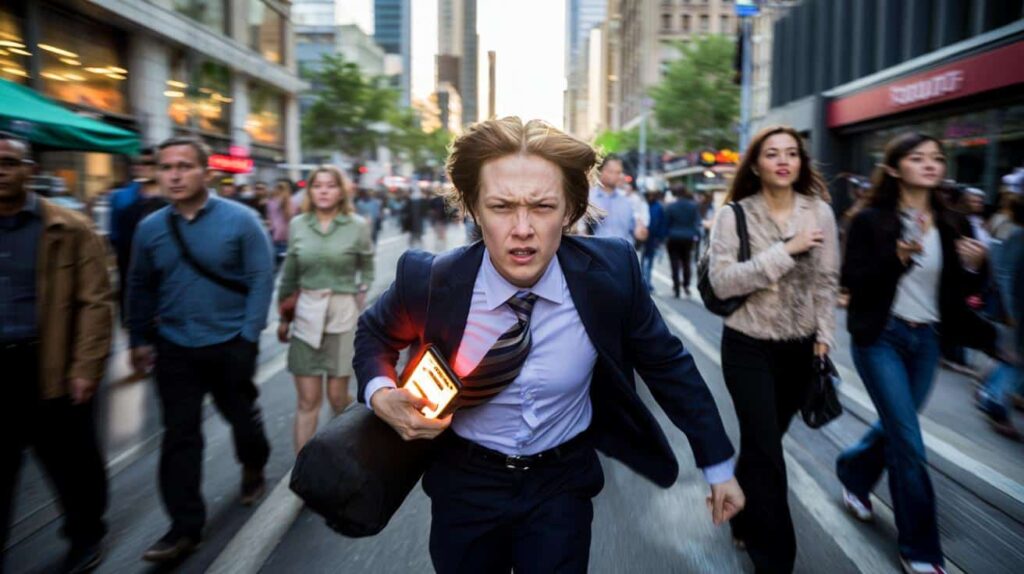
You spot them from a distance. The people who slice through the sidewalk like they’re late for the rest of their life. Bags clutched tight, jaw locked, eyes already three streets ahead. You step aside as they rush past, swept up in a private storm no one else seems to see.
On social media, we praise them. “Look how fast they walk, so fit, so productive, such hustle.” We turn their frantic pace into a form of virtue.
But watch closely. Their shoulders are tense. Their breathing is shallow. They don’t look free.

What if fast walkers aren’t healthier at all.
What if they’re just more anxious — and a little bit unstable.

Why that fast walker might be running from their own thoughts
The myth sounds comforting: fast walkers live longer, are more resilient, more athletic, more successful. We like this shortcut. Walk quickly, win at life. Done.
On the street though, the story looks different. The rushed walker doesn’t glide, they clatter. Their phone vibrates, their eyes flick down, their steps quicken again, as if the message behind the screen had pushed them physically forward.
Speed becomes a shield. A way of never having to slow down long enough to feel what’s really going on.
One therapist I spoke to described a client who couldn’t walk slowly even on vacation. Tropical island, no meetings, no deadlines, and still she was weaving around elderly tourists like they were human traffic cones.
Her husband filmed her as a joke. Later, watching the video, she noticed something unbearable: everyone around her looked relaxed, **soft**, present. She looked like someone trying to escape an invisible threat.
She realized the fast walking had started during a chaotic year at work. New boss, constant restructures, fear of losing her job. Her body had learned to be “on” all the time. The job changed. The pace stayed.
Psychologists sometimes call this “hyperarousal”: the nervous system stuck on high alert. It doesn’t only show up at night in racing thoughts. It leaks into the way you eat, scroll, even cross the street.
Walking fast can be a quiet panic response. Your brain whispers: keep moving or something bad will catch up. So your legs obey. You don’t plan it. You just suddenly notice you’ve arrived ten minutes early and don’t remember half the journey.
The world applauds the result – “Wow, you’re so energetic!” – and almost no one sees that the engine under the hood is pure anxiety.
How anxiety hijacks your walking speed (and your day)
There’s a detail people overlook when they quote studies about brisk walking and longevity. Those studies usually talk about intentional pace, not chronic rushing.
A 20‑minute purposeful walk in the park, with your shoulders relaxed and your breath steady, is not the same as power‑charging through a crowded station, sweating through your shirt, mentally checking emails you haven’t even received yet.
The first is movement. The second is fight‑or‑flight on two legs.
Think back to the last time you were really late. Maybe your train was delayed, your boss was waiting, your phone was at 3% battery. Your walk wasn’t just fast, it was frantic. Your feet hit the ground harder. You bumped into people. You overreacted to every red light.
Now imagine living in a body that feels like that almost every day, without a clear external reason. Many chronic “fast walkers” describe exactly that. They don’t even feel especially sporty. They just feel hunted by time.
One woman told me she started measuring her commute like a competition. If she shaved off 30 seconds, she felt oddly proud. If a crowd slowed her down, she went home angry without knowing why. That’s not fitness. That’s a nervous system in survival mode.
From a mental health point of view, this makes sense. Anxiety pushes your body to anticipate threats and move quickly. People with high baseline anxiety or unstable moods often report they “can’t stand dawdling” or “lose it” when someone in front of them walks slowly.

Underneath the irritation sits a primitive fear: if I slow down, I’ll lose control. I’ll be swallowed by my thoughts. Or by my sadness. Or by everything I’ve been avoiding.
So the legs keep moving faster than the rest of the self can process. It looks productive. It feels like a chase.
How to test your own pace — and gently let your body calm down
Here’s a simple experiment that tells you more about your stress than any smart watch. Tomorrow, on a route you know by heart, decide to walk 20% slower than usual. No headphones, no call, just you and the pavement.
Notice how quickly discomfort shows up. Not in your legs, but in your mind. Do you feel exposed. Impatient. Embarrassed to “take up space” at a calmer speed.
If slowing your walk by a tiny margin instantly makes you irritated or restless, your pace might be less about health and more about self‑defense.
The next step isn’t to swing to the opposite extreme and float around like a cartoon monk. That’s just another form of pressure. Instead, try adding “slow zones” to your day. One corridor at work. One street on your commute. One supermarket aisle.
In those zones, you consciously loosen your shoulders, drop your gaze from the horizon to the middle distance, and let others overtake you. Your goal is not elegance. Your goal is to *survive the slowness without panicking*.
Let’s be honest: nobody really does this every single day. But once or twice a week is enough to send a signal to your nervous system that the world doesn’t collapse when you stop rushing.
Over time, you might notice something subtle. Your thoughts get a little less sticky. The day feels a tiny bit wider. You don’t snap as quickly when someone blocks your path.
A psychiatrist I interviewed told me:
“Fast walkers aren’t bad people, and they’re not doomed. They’re often just scared, overstimulated, and running on emotional fumes. When they learn to walk five percent slower, their whole life starts to feel ten percent less catastrophic.”
Then the doctor scribbled three things on a notepad for her patient, and they read almost like a small, quiet rebellion:
- Choose one daily route where you slow your pace on purpose.
- Breathe out fully every ten steps, like you’re letting air out of a balloon.
- Notice one color, one smell, and one sound before you reach your destination.
Maybe the healthiest walkers are the ones who can choose their speed
If fast walking automatically meant health, half the people racing through city centers would be glowing with inner peace. You only need to sit on a bench at rush hour to see that’s not the case. Their bodies are quick. Their faces look exhausted.
The real skill might not be speed at all, but flexibility. The person who can walk briskly when they need to catch a bus, then saunter slowly through the park without feeling guilty, is probably in a better place than the one who only has one gear: fast.
We rarely talk about this, because slowness doesn’t photograph well. It doesn’t scream productivity. Yet it’s in those seemingly “wasted” minutes that your nervous system repairs, your brain digests the day, your mood finds its balance again.
Next time you notice you’ve overtaken ten people in a row, you could try something tiny: drop your pace for half a block and see what feelings bubble up. Annoyance. Fear. Relief. Curiosity. That reaction is worth more than any step counter.

Because beneath your walking speed, there’s a hidden question: are you moving toward your life, or just running away from yourself.
 A solar belt around the Moon by 2035?
| Key point | Detail | Value for the reader |
|---|---|---|
| Fast walking can signal anxiety | Chronic rushing often reflects a nervous system stuck on high alert, not superior fitness. | Helps readers reinterpret their habits and spot hidden stress. |
| Slowing down is a diagnostic tool | Deliberately reducing walking speed reveals how comfortable you are with calm and stillness. | Gives a simple, real‑life way to check emotional balance. |
| Small “slow zones” recalibrate the body | Designated routes or moments of slower walking can teach the brain that safety exists without rushing. | Offers a practical method to lower anxiety and regain control. |
FAQ:
- Question 1Does walking fast always mean I’m anxious or unstable?Not always. Some people naturally have a quicker stride or train for fitness. The question is whether you can slow down without feeling distressed. If slowing even a little makes you tense or angry, there might be more going on than simple habit.
- Question 2But aren’t there studies saying brisk walkers live longer?Yes, research links intentional brisk walking with better health outcomes. Those studies usually describe controlled, moderate exercise, not constant, frantic rushing through daily life driven by stress or fear.
- Question 3How do I know if my fast walking is a problem?Look at the context. Do you often arrive places wired instead of refreshed. Do slow walkers trigger disproportionate irritation. Do you struggle to stroll even on weekends. If the answer is yes, your pace might be tied to anxiety.
- Question 4Can changing my walking speed really affect my mental health?It’s not a magic cure, but your body and mind are deeply connected. Calming your pace, breathing, and posture sends a “not in danger” signal to your brain, which over time can reduce baseline stress and emotional volatility.
- Question 5What if my job forces me to rush all the time?You might not control your whole schedule, yet you can still carve out micro‑moments: one hallway, the walk to the bathroom, the trip from the station to your door. Those tiny pockets of chosen slowness can act like pressure valves in an otherwise fast day.
