
On a quiet Sunday morning in a suburban kitchen, a woman in an old college sweatshirt leans over her sink. In one hand, a yellowed toothbrush. In the other, a mug of white, foaming paste she found on TikTok: baking soda and hydrogen peroxide. She stirs it with the care of someone mixing pancake batter, then starts scrubbing the tile grout with unexpected satisfaction.
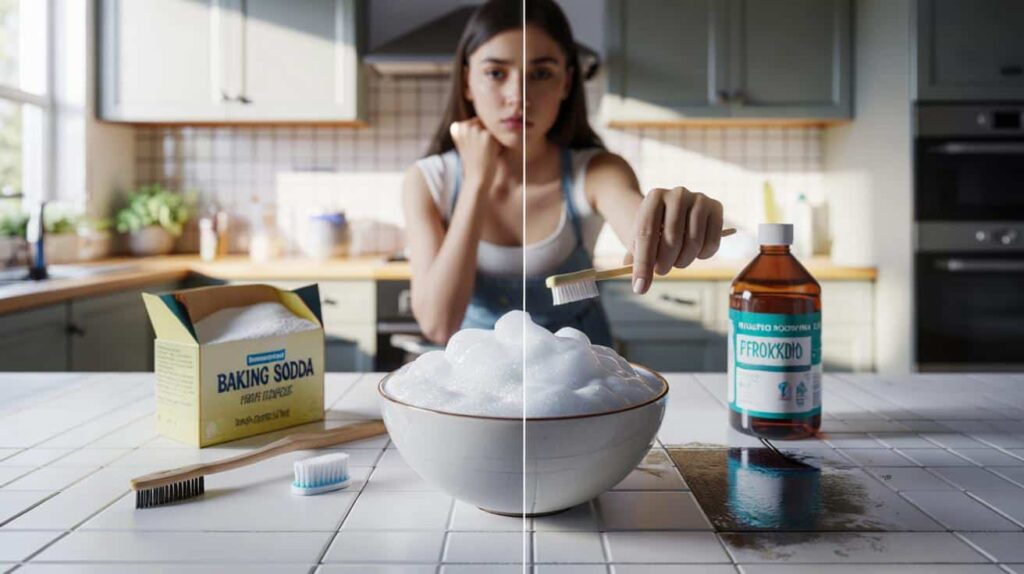
Two doors down, her neighbor is doing something similar… for his teeth. A quick swirl of the same mixture, a flash of a smile in the mirror, a mental note: “Whiter already.” No lab coat, no warning labels, just the feeling of a small life-hack victory.
Across town, a dentist scrolling through social media sees the same trick and winces.

Something about this duo is making people a little too confident.

Why this “power couple” of the pantry is freaking experts out
The mix looks harmless enough. Baking soda on its own feels almost friendly, powdery, familiar from fridges and cookies. Hydrogen peroxide arrives in a brown bottle, a staple of childhood scraped knees. Together, though, they form a bubbly, reactive blend that can cut through stains, odors, and grime with an almost alarming ease.
That easy power is exactly why chemists and doctors are starting to sound the alarm. They’re watching a wave of DIY recipes go viral under the promise of “non-toxic,” “natural,” and “safer than chemicals,” while quietly knowing that this combo is very much a chemical reaction. One that doesn’t always stay under control.
Scroll through Instagram or YouTube and the pattern jumps out. A home influencer swears by her paste of baking soda and 3% hydrogen peroxide for grout so bright it “looks like new construction.” Another creator uses the same mix for stained cutting boards, oven doors, even the rubber seals of a washing machine. The before-and-after shots are dramatic, almost addictive.
Then you land on dental hacks. People brushing with a gritty white paste, claiming it lifts yellow stains in a single week. One viral clip has a teen bragging she ditched professional whitening strips to “just use what’s in the bathroom cabinet.” No mention of enamel erosion. No mention of gum burns. Just likes and views pouring in.
Experts see a different picture forming. Baking soda is alkaline and mildly abrasive. Hydrogen peroxide is a strong oxidizer that breaks down into water and oxygen, releasing free radicals that attack stains…and, if overused, healthy tissue. Combined, the mix can temporarily spike pH levels on surfaces or skin, boost penetration into pores, and stress materials not designed for that intensity.
On grout or ceramic, that might mean micro-damage and faster wear over time, especially if used daily. On skin or teeth, it can mean irritated gums, increased sensitivity, and a slow thinning of protective layers. The danger isn’t the occasional careful use, they say. It’s the enthusiastic, daily, “if a little is good, more is better” mentality that quietly creeps in.
The hidden science behind all those “wow” cleaning hacks
Used with restraint and a bit of knowledge, this duo can actually shine. Literally. For many households, a small bowl of baking soda and diluted hydrogen peroxide has become the go-to for grout, stained mugs, and discolored sinks. The basic method is simple: sprinkle baking soda on a damp surface, then mist or spoon a small amount of peroxide on top. Let it foam for a minute or two, then scrub gently and rinse.
That fizzing reaction you see is oxygen being released. It helps lift stains and organic matter, while the mild abrasion of the baking soda boosts the mechanical cleaning. The trick is contact time and gentleness, not brute force.
This is where reality and viral culture part ways. Many people leave the paste on for twenty or thirty minutes “for extra power,” or they attack the surface with a stiff brush, feeling productive as the foam builds. Some even mix huge batches and store them in closed containers, not realizing gas build-up can warp or burst lids.

On porous stone, natural wood, or delicate finishes, that extended contact can cause subtle etching, dull spots, or patches that never look quite right again. Dermatologists share quiet stories of patients who tried the mix on underarms for odor, on acne spots, or even on toenail fungus, then showed up with raw, angry skin. The irony is hard to miss: chasing a “cleaner,” “greener” fix, and ending up with a different kind of problem.
Here’s the uncomfortable truth professionals keep repeating: *the line between smart hack and slow damage is thinner than most people think.* Baking soda shifts pH and gently sands. Hydrogen peroxide bleaches and oxidizes. Both effects can be brilliant in small doses, or harsh in the wrong context.
Chemists point out that concentration matters desperately. That brown-bottle 3% peroxide from the pharmacy is one thing. Salon-grade or industrial-strength peroxide is on another planet entirely. Mix that with baking soda in a closed bathroom with poor ventilation, and you’re not just doing a cute DIY project anymore. You’re running a tiny, uncontrolled lab experiment over your sink.
How to use baking soda and hydrogen peroxide without trashing your home (or body)
The safest way to approach this combo is to behave less like a magician and more like a cautious tester. Start very small, both in quantity and surface area. For tile grout, for example, try a teaspoon of baking soda and just a few drops of 3% hydrogen peroxide to form a loose paste, no thicker than toothpaste. Apply with an old, soft toothbrush to a single, hidden line of grout.
Let it sit for 2–3 minutes at most, then scrub lightly and rinse thoroughly with warm water. Wait until everything dries to see the real effect. If the color looks even, the finish intact, and there’s no chalky residue, you can gradually expand. If anything looks off, stop right there and go back to milder cleaners.
When it comes to teeth and skin, dentists and dermatologists are almost begging people to slow down. For oral care, many say that using this mix more than once a week is pushing your luck, and brushing with plain baking soda alone too often can still erode enamel over time. That sharp, squeaky-clean feeling? Not always a compliment.
Let’s be honest: nobody really does this every single day, but social media makes it look like everyone else is. That pressure to “optimize” every habit can lead people to ignore nagging sensitivity or redness until it becomes a bigger issue. The safest route is to treat this duo as an occasional tool, not a lifestyle.
“People treat baking soda and hydrogen peroxide like they’re innocent because they’re cheap and familiar,” says Dr. Elina Morris, a cosmetic chemist who consults for household brands. “What I see are two strong functional ingredients that deserve the same respect as anything under a lab hood. The product doesn’t need a skull-and-crossbones label to cause harm if misused.”
- Never mix baking soda with high-strength (above 3%) hydrogen peroxide at home.
- Test any cleaning paste on a tiny, hidden area before going all-in on a visible surface.
- Limit oral use to very occasional “emergency” whitening, and stop if teeth or gums feel sensitive.
- Avoid using the mix on bare skin, kids’ toys, or fabrics without professional guidance.
- Store hydrogen peroxide away from heat and light, and never tightly seal a fresh mix that’s still fizzing.
The quiet divide: clean-freaks, cautious experts, and everyone stuck in the middle
Look closely, and this isn’t just a story about a fizzy cleaning paste. It’s a snapshot of how we live now, caught between a craving for low-cost, “natural” fixes and a nagging worry that our shortcuts might bite back. On one side, households thrilled by the way a simple mix restores their bathrooms, brightens stained cups, and gives them a sense of control in a world that feels anything but tidy. On the other, professionals stepping into comment sections, repeating the same warnings, often drowned out by an algorithm chasing engagement.

Somewhere between these two camps sits the rest of us. We read the labels, then watch the hacks. We trust the neighbor who swears by a trick more than the abstract expert we’ll never meet. *We’ve all been there, that moment when one clever shortcut feels more persuasive than a dozen cautious footnotes.*

| Key point | Detail | Value for the reader |
|---|---|---|
| Potent reaction | Mixing baking soda with 3% hydrogen peroxide creates a strong cleaning and bleaching effect | Understand why the hack works and where the real risk starts |
| Context matters | Safe on some hard surfaces in short bursts, risky for teeth, skin, and delicate materials | Decide when to use it and when to walk away |
| Use sparingly | Small quantities, short contact time, and rare use reduce long-term damage | Get benefits without quietly destroying enamel, grout, or finishes |
FAQ:
- Question 1Is it safe to brush my teeth with baking soda and hydrogen peroxide?
- Answer 1
- Occasionally, a weak mix can remove surface stains, but dentists warn that regular use erodes enamel and irritates gums. If you feel sensitivity or burning, stop immediately and switch to products designed for teeth.
- Question 2Can I use this mix to clean all my grout and tiles?
- Answer 2
- You can test it on small areas of ceramic tile grout with 3% peroxide, short contact time, and gentle scrubbing. Avoid natural stone, colored grout, or sealed surfaces unless a professional confirms it’s safe.
- Question 3Is the mixture toxic or dangerous to breathe?
- Answer 3
- Low-strength mixes in a ventilated room are usually not a big inhalation risk, but high concentrations or large amounts in closed spaces can irritate eyes and airways. If you smell sharp fumes, step away and air out the room.
- Question 4Can I store leftover baking soda and peroxide paste?
- Answer 4
- Better not. The reaction releases gas and can build pressure in closed containers. Mix only what you need, use it right away, and rinse everything thoroughly when you’re done.
- Question 5Isn’t this safer than commercial cleaners full of “chemicals”?
- Answer 5
- “Natural” doesn’t always mean gentle. Many commercial products are precisely formulated and tested. A homebrew mix can be less predictable, especially on skin, teeth, and delicate surfaces, even if the ingredients seem familiar.
