
On a rainy Tuesday evening, the kind where the sky looks like a used dishcloth, I watched a neighbor crouch in her driveway with two battered bottles: baking soda and hydrogen peroxide. No fancy labels, no eco-chic branding. Just supermarket basics, poured into an old yogurt pot.
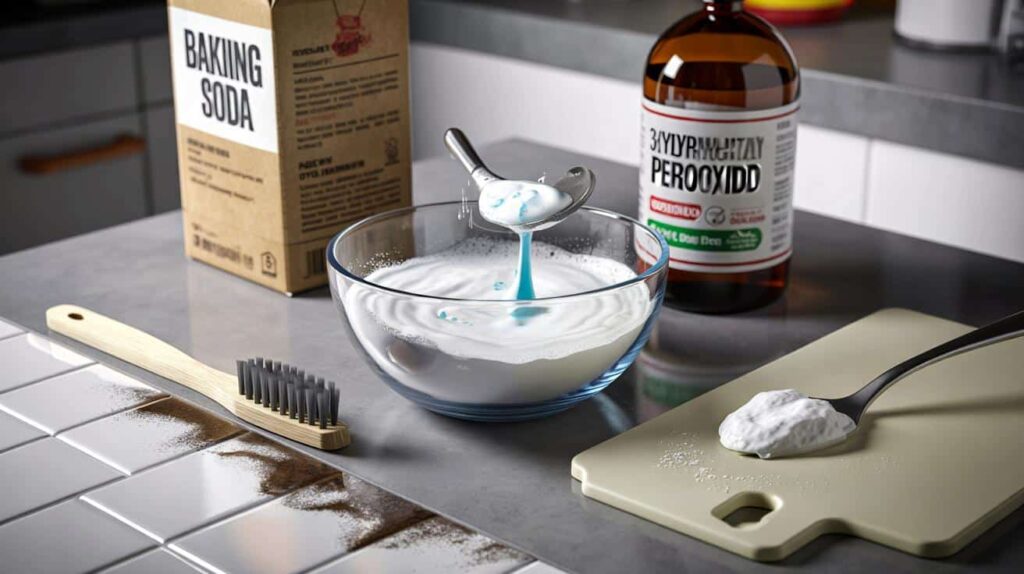
She stirred them with a spoon, spread the paste over a greasy barbecue grate, and went back inside as if nothing had happened. Fifteen minutes later, she rinsed it with the garden hose. The metal shone like it had skipped five summers of smoke and burnt fat.
That small scene felt oddly revealing. Two quiet ingredients, one almost-forgotten trick.

Something people are starting to talk about again.

Why experts are quietly obsessed with this low-cost combo
Walk into any lab, dental office, or serious cleaning aisle, and these two names pop up again and again: sodium bicarbonate and hydrogen peroxide. Separately, they’re already workhorses. Together, specialists say they create a kind of “everyday powerhouse” that’s getting renewed attention as people hunt for cheap, effective, less-toxic solutions.
Chemists point out that each plays a different role. Baking soda is mildly abrasive and alkaline, great for loosening grime. Hydrogen peroxide brings oxygen-based bleaching and disinfecting. When you mix them, a gentle fizz starts working in the background, lifting stains and breaking down organic gunk.
Not flashy. Just quietly efficient.
You see this pairing most clearly in dentistry. Some dentists still mix a simple paste of baking soda and low-volume hydrogen peroxide to polish surface stains on teeth before a check-up. The American Dental Association has long noted that hydrogen peroxide is a standard whitening agent, while baking soda has a long track record as a tooth-cleaning mild abrasive.
At home, people copy the method with DIY pastes to brighten coffee or tea stains on enamel. Others use diluted peroxide with a sprinkle of baking soda as a short contact mouth rinse against bad breath from bacteria. Dentists warn against going overboard, but they acknowledge one thing: **this duo has stuck around for a reason**.
It’s cheap, it works, and people actually use it.
What’s happening on a microscopic level is simple enough. Hydrogen peroxide breaks down into water and active oxygen—those tiny bubbles that fizz on contact. That oxygen helps decompose organic residues: stains, blood, food particles, plaque biofilm. Baking soda, slightly alkaline, shifts pH and makes some soils easier to break apart, while its fine particles offer a soft scrubbing effect.
Together, they create a short-lived reaction that’s strong enough to lift dirt yet gentle enough for many surfaces if used correctly. Experts see it as a kind of “smart brute force”: targeted, not toxic, and over quickly.
The trick is knowing where that sweet spot begins—and where it ends.
From grout lines to cutting boards: how people are actually using it
The most shared tip from cleaning pros is almost ridiculously simple. For stained tile grout, sprinkle baking soda along the lines, then drizzle or spray 3% hydrogen peroxide over it. Let it foam for 5–10 minutes, then scrub with an old toothbrush and rinse. The fizzing action helps lift the grime, so the mechanical effort drops.
The same basic recipe works on yellowed plastic chopping boards or stained sinks. Spread a paste, wait, scrub, rinse. It’s not magic, but when friends swap before/after photos, the difference can look pretty close.
On social media, those quiet bathroom corners—grout, silicone seams, old soap scum—are where this mix gets its small fame.
One young couple in a tiny city apartment told me they stopped buying three different “specialized” cleaners when they realized their grandparents had managed kitchens with far less. They now keep a glass jar of baking soda near the sink, a brown bottle of 3% hydrogen peroxide in a dark cupboard, and a single spray bottle where they mix them right before use.
They use the combo to refresh their white sneakers, lift red wine from a cotton tablecloth, and clean the inside of a stained mug that’s seen too many reheated coffees. They still keep a heavy-duty disinfectant for rare, serious jobs—but reach for the soda-peroxide mix weekly. *That shift didn’t come from a trend; it came from fatigue with crowded cupboards and harsh smells.*
Once you see one product doing five jobs, the others start to look unnecessary.

There’s a logic behind this “one duo, many uses” approach. Baking soda is food-grade, cheap, and non-corrosive on most household surfaces. Hydrogen peroxide at 3% is a familiar antiseptic that decomposes into water and oxygen. Put together, they can handle light disinfection on cutting boards, deodorizing trash cans, lifting organic stains from fabrics, and even cleaning some cookware—without leaving behind mystery residues.
Let’s be honest: nobody really scrubs grout with a toothbrush every single day. So people look for something that gives a big visible payoff in short bursts. This mix tends to deliver that, which explains the loyalty. Experts still repeat the same note of caution, though: respect contact time, rinse thoroughly, and don’t expect industrial-level sterilization from pantry chemistry.
It’s a helper, not a miracle cure.
The hidden rules: when this duo shines…and when it’s risky
If you want to actually try this, the rule starts with concentration and timing. Use standard 3% hydrogen peroxide—the kind sold for household first aid—and plain baking soda. For a paste: mix roughly one part peroxide to two parts baking soda in a small cup until it looks like thick frosting. Spread it on the target area, let it sit a few minutes, then scrub and rinse.
For a light cleaning spray, some experts suggest filling a dark spray bottle with 3% peroxide, spraying the area, then sprinkling baking soda on top rather than pre-mixing large amounts. The reaction is short-lived, so fresh is always better.
A common mistake is thinking “if a little works, a lot must be amazing.” That’s where trouble starts. Stronger peroxide (like 6%, 10%, or hair developer strengths) can irritate skin, damage fabrics, and is not meant for casual kitchen experiments. The same goes for leaving peroxide-baking soda paste on metal surfaces for hours—it can dull finishes, pit aluminum, or fade delicate materials.
Experts also warn against storing the mixed paste in a closed container. The slow breakdown of peroxide produces oxygen gas, which can build pressure and pop lids, especially in warm rooms. So mix small, use it, and toss the leftovers.
Cleaning hacks are fun until they blow a cap across the room.
Professionals tend to sound like cautious fans of this duo, not cheerleaders. Many will say, in almost the same words:
“Used with common sense, baking soda and hydrogen peroxide are incredibly useful around the house. The problems come when people see them as ‘natural,’ assume that means ‘harmless,’ and forget that chemistry is still chemistry.”
Then they repeat the basics, over and over:
- Use only 3% hydrogen peroxide for household mixes.
- Test on a hidden area before scrubbing visible surfaces or fabrics.
- Don’t use on wool, silk, or very dark, unstable dyes.
- Avoid mixing with vinegar, bleach, or other strong cleaners.
- Keep all products away from kids’ reach, even the “gentle” ones.
Those sound like buzzkill lines, yet they’re what keep a clever trick from becoming a regretted story.
A modest mixture with surprisingly big questions behind it
The renewed attention to baking soda and hydrogen peroxide says something about the moment we’re living in. Many households are quietly tired of neon-colored gels and long ingredient lists they can’t pronounce. They want things that work, cost little, and don’t feel like opening a chemical plant under the kitchen sink.
This duo fits that mood. It isn’t perfectly “natural.” It isn’t zero-risk. It just sits in that pragmatic middle ground where science and common sense shake hands. You can use it to whiten a mug, freshen a bathroom, clean a cutting board, or brighten tile, then watch it literally bubble away into something simple.
That small fizzing sound, if you pay attention to it, can feel oddly reassuring. It means something is happening, right there on the surface. A stain is lifting, bacteria are losing ground, old grime is getting its eviction notice. You do a little, chemistry does a little, and the job gets done.
Where you take that—toward a more minimalist cupboard, toward more thoughtful cleaning habits, or just toward one rescued pair of sneakers—is your call. The mix is just a tool.
 Meteorologists warn early February signals suggest the Arctic is entering uncharted territory
What people build with it is the interesting part.

| Key point | Detail | Value for the reader |
|---|---|---|
| Versatile cleaning power | Combines mild abrasion from baking soda with oxygen-based action from 3% hydrogen peroxide | Replaces multiple specialized cleaners with one flexible duo |
| Low cost, high payoff | Both ingredients are inexpensive, widely available, and long-lasting when stored properly | Saves money while still delivering visible before/after results |
| Safety with limits | Safe for many household uses when diluted, tested, and not stored once mixed | Helps readers clean confidently without unnecessary risks |
FAQ:
- Can I use baking soda and hydrogen peroxide on my teeth every day?Most dentists suggest using such a paste only occasionally, not daily. The mild abrasion and peroxide can irritate gums or enamel if overused, so treat it as a short-term brightening boost, not a full-time replacement for regular toothpaste.
- Is it safe to clean cutting boards with this mixture?Yes, many experts accept a 3% hydrogen peroxide and baking soda paste for deodorizing and light disinfecting plastic or light-colored wooden cutting boards. Scrub, let sit a few minutes, then rinse very thoroughly and let the board dry upright.
- Can I use it on colored clothes or fabrics?Hydrogen peroxide can act like a mild bleach on some dyes, especially darker or unstable colors. Always test on an inside hem first. For white cottons or towels, this combo can help lift organic stains like sweat or food.
- Is it dangerous to mix baking soda and hydrogen peroxide in a closed bottle?Storing the active mix sealed is a bad idea. As peroxide breaks down, it releases oxygen gas that can build pressure and pop the container. Mix in small amounts, use immediately, and discard the rest.
- Can I combine this duo with vinegar or bleach for “extra power”?No. Mixing different strong cleaners quickly increases risk. Vinegar and peroxide together can create peracetic acid vapors, and anything near bleach can release hazardous gases. Stick to one system at a time, with plenty of rinsing in between.
