
The street in North Jakarta smells faintly of salt and gasoline. At the edge of a battered concrete seawall, fisherman Arif squints at a new crack that wasn’t there last month. Behind him, a skyline of towers leans a fraction closer to the sea each year, like a city caught mid-sigh. His house has flooded three times this season, and the water is coming faster, higher, stranger.
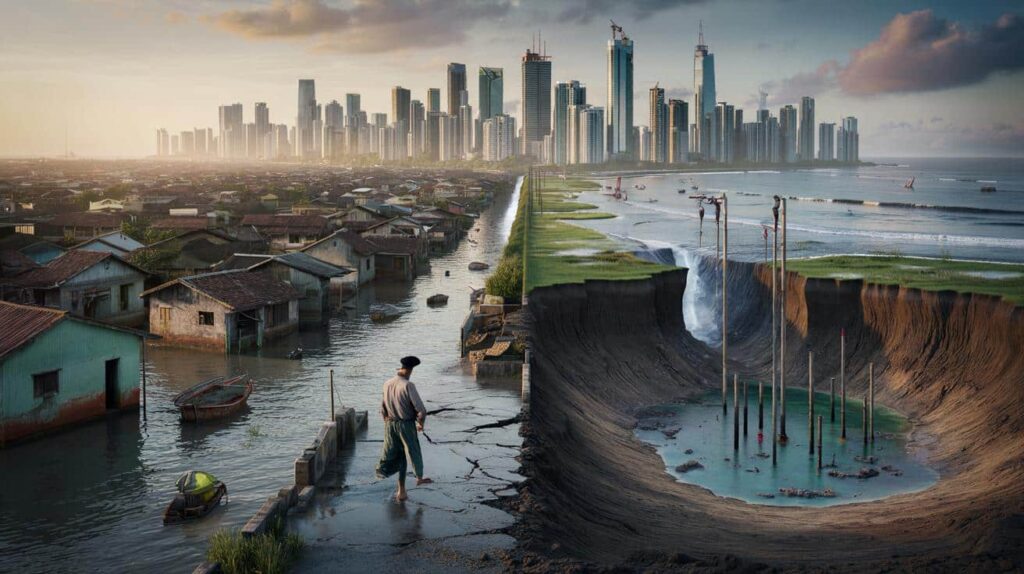
Far away, in air-conditioned conference rooms, engineers project colorful 3D models on big screens. Their pitch sounds almost magical: refill the emptied oil fields beneath our feet with water, “re‑inflating” the ground and slowing the sinking. Save the megacities, they say.
Arif just wants to know if his front door will still open in ten years.

The people in the room promise they can move the earth itself.

Can pumping water really hold up a falling city?
Walk around any low-lying megacity at high tide and you feel it in your body. The curb disappears under dirty water, shopkeepers build little steps out of bricks, motorbikes weave through puddles that are more like ponds. Locals don’t talk about “subsidence” or “groundwater extraction”. They talk about another neighbor who had to raise their house again.
Behind that everyday chaos sits a brutal fact: huge cities like Jakarta, Mexico City, Bangkok and Lagos are literally sinking. Not metaphorically, not as a journalistic flourish. Measured, centimeter by centimeter, year by year.
And that’s where the new engineering dream comes in. If pulling fluids out of the ground helped collapse the sponge, maybe pushing fluids back down can plump it up.
The most striking example on every presentation slide is usually the Groningen gas field in the Netherlands. There, decades of gas extraction led to tiny quakes and a slow sagging of the land. People saw hairline fractures creep across living room walls. Some had to leave their homes entirely.
After fierce protests, gas production was sharply cut and **pressure management** became the new mantra. Engineers started looking at how controlled reinjection of fluids could stabilize the rock layers. To many, Groningen became a warning and a laboratory at the same time.
Now, big oil companies are quietly marketing an evolution of this idea to flood-threatened cities: use depleted oil and gas reservoirs beneath or near urban areas as giant underground “cushions” by pumping in water, brine, or even captured CO₂.
From a mechanical point of view, the logic sounds almost neat. Oil and gas once filled the tiny pores of deep rock. When they were pumped out, the pressure dropped and the overlying layers began to compact under their own weight. That compaction translates, painfully slowly, to the surface.
By refilling those pores with another fluid, engineers hope to restore some of the lost pressure. Less compaction, less sinking. At least on paper.
Geologists warn that rocks are not empty soda bottles you can just refill and reseal. Underground layers have fractures, old faults, varying grain sizes. Push too hard in one place and you might wake something up in another.
The “playing god” problem beneath our feet
In test projects in California and the Middle East, reinjection wells are drilled like acupuncture needles into the earth’s crust. Operators start with low pressures, then gradually increase, tracking the response with a forest of sensors. Seismic monitors listen for tiny tremors. Satellite radar measures millimeters of uplift or continued sinking at the surface.
The method has a textbook name: “managed aquifer recharge” for shallow layers, or “reservoir pressure support” for deeper ones. In practice, it can look like a mix of science and gambling. One wrong calculation and you don’t get a graceful lift. You get a sudden jolt, or a new pathway for water to leak where nobody wants it to go.
Still, for city officials staring down flood maps that turn whole districts blue, the gamble has a certain desperate appeal.
Urban planners in Jakarta are already spending billions on sea walls and a new capital city inland. Mexico City has raised its cathedral foundations, its streets buckling and warping as the historic center sinks unevenly. Lagos watches the Atlantic chew away at luxury towers and tin shacks alike.
In those meeting rooms, the conversation has shifted from “if” to “what else”. Reinjection into dead oil fields is pitched as another layer of defense. Not a silver bullet. More like an underground insurance policy.

Critics point to places like Oklahoma, where wastewater disposal linked to oil production coincided with a sharp rise in induced earthquakes. Different context, yes, but a hard reminder that messing with subsurface pressures has a track record that isn’t exactly comforting.
The ethics land heavy here because the whole scheme feels like a sequel to the first mistake. We over-pumped: oil, gas, groundwater. The land sank. Now the same industrial mindset wants to pump something else back in and “fix” it.
*This is geoengineering at city scale, just hidden under our shoes instead of in the sky.*
An Indonesian geophysicist I spoke to called it “trying to reverse a cake after you’ve already baked it”. You can moisten it, decorate it, slow the crumbling. You can’t un-bake. The risk is that political leaders hear the promise of salvation and relax on the harder choices: cutting groundwater use, controlling sprawl, accepting that some areas need to retreat from the sea.
What cities can actually do while engineers chase miracles
Strip away the futuristic graphics and there’s a more grounded story here: the easiest way to slow sinking is to stop sucking so much water and fuel out of the ground in the first place. In Bangkok, tighter controls on groundwater pumping helped cut subsidence rates significantly over the last two decades. That wasn’t magic. It was regulations, meter readings, and a lot of boring enforcement.
For megacities, the most practical “method” looks surprisingly simple on paper: diversify water sources, cap deep wells, restore wetlands to store floodwater, and put real money into maintaining leaky pipes so utilities don’t lose half their supply underground.
Only then does something like reinjection become a tool of last resort, not a get‑out‑of‑jail card for decades of neglect.
Residents are rarely told that every engineering choice comes with trade-offs. You protect one district, another floods. You lift pressure underground here, stress moves over there. People understandably latch on to any solution that promises to save both their home and their job.
Engineers admit privately that political pressure can be louder than scientific caution. Mayors want photo ops by gleaming new pump stations, not slow, invisible reforms like zoning rules or water tariffs. Let’s be honest: nobody really reads a 600-page environmental impact statement before re‑electing someone.
So the same pattern risks repeating: flashy megaprojects grab headlines, while the modest, unsexy steps that actually work – like closing illegal wells or limiting building weights on soft soils – are pushed to the margins.
“Calling this ‘playing god’ is not quite right,” says a hydrogeologist in Rotterdam. “God would probably have read the manual. We’re more like kids hammering at an old radio, surprised when the music changes pitch.”
- Focus on demand first
Cities that invest in water recycling, leak reduction, and stricter groundwater rules tend to see subsidence slow before they ever touch deep geology. - Treat reinjection as experimental
Dead oil fields are not blank canvases. Each one needs years of mapping, small-scale tests, and real-time monitoring before anyone promises city-wide protection. - Insist on independent oversight
When the same companies that emptied a reservoir are paid to refill it, conflicts of interest are baked in. External audits and public data make it harder to hide early warning signs. - Plan for retreat, not just resistance
Some zones will be lost to the sea or become too risky to inhabit. Honest planning means helping people move with dignity, not just building walls higher. - Listen to the people on the waterline
Fishermen, street vendors, neighborhood leaders notice small changes long before satellite maps do. **Their reports** are often the first real-time monitoring system a city has.
A future built on moving ground
The eerie thing about subsidence is its quietness. No sirens, no live disaster footage. Just doorframes warping year by year, canals climbing the sides of houses, storm drains that suddenly sit uphill from the street. By the time a city fully feels it, decades of choices are baked underground.
Reinjecting water into dead oil fields offers a strange kind of hope: maybe we can gently push the earth back into a safer shape. Or at least stop it slumping quite so fast. The same technique could double as carbon storage, turning old fossil reservoirs into vaults for our emissions.
Yet that hope comes with a question that won’t go away. If our answer to one round of planetary overreach is simply a more sophisticated version of the same thing, who is really learning here – us, or the rocks?

We’ve all been there, that moment when a quick fix is so tempting you almost forget how you got into trouble. As the seas rise and the ground sinks, our cities are reaching exactly that moment, balancing between human ingenuity and the quiet, slow patience of geology.

| Key point | Detail | Value for the reader |
|---|---|---|
| Why cities are sinking | Combination of groundwater pumping, oil and gas extraction, and heavy construction on soft soils | Helps you understand why floods and cracked streets keep getting worse in many megacities |
| What reinjection can do | Pumping water or CO₂ into depleted reservoirs may stabilize pressures but can trigger quakes or new leaks | Gives a realistic sense of promise and limits behind the “save the city” headlines |
| What actually slows subsidence | Cutting groundwater use, fixing leaks, restoring wetlands, stricter zoning on fragile ground | Shows the quieter, proven steps that protect homes and livelihoods long before big geoengineering projects arrive |
FAQ:
- Question 1Is pumping water into dead oil fields a proven way to save cities from sinking?
Answer 1
Not yet. The basic physics of pressure support are well known from the oil industry, but using them at city scale to slow subsidence is still experimental. Some pilot projects show promise in stabilizing local ground levels, others reveal new risks like small quakes or unexpected fluid migration.- Question 2Could this strategy cause earthquakes where I live?
Answer 2
There is a real risk of induced seismicity when you change underground pressures. Most events linked to reinjection are tiny, but regions like Oklahoma have seen noticeable quakes tied to wastewater disposal. Any serious project needs dense seismic monitoring and strict limits on injection rates to reduce that risk.- Question 3Why don’t cities just stop pumping groundwater and fix the problem that way?
Answer 3
They should – and some do – but it’s politically tough. Industries rely on cheap water, utilities leak huge volumes, and many households tap illegal wells. Cutting groundwater use means raising prices, enforcing rules, and sometimes confronting powerful local interests. It works, but it’s slow and rarely makes for big headlines.- Question 4Is this the same as carbon capture and storage (CCS)?
Answer 4
The technique overlaps. Both involve injecting fluids into deep rock formations, often old oil and gas fields. The goals differ – one aims to store CO₂, the other to manage ground stability – but some projects hope to combine them: sequester carbon while also easing subsidence. Each added goal makes the geology more complex to manage.- Question 5What can ordinary residents in sinking cities actually do?
Answer 5
On your own, you can support politicians who invest in water infrastructure instead of just shiny sea walls, report new cracks or persistent floods in your area, and join local groups pushing for transparent data on subsidence and wells. No single gesture fixes a sinking megacity, yet public pressure often decides whether leaders back slow, real solutions or chase risky miracles.
