The class is filled, but there’s no talk about the real reason everyone is there. It’s 9:15 a.m., the music is low, mats are aligned, and a few silver ponytails bob as people settle in. In the back, a man in his early 60s pulls at his T-shirt, trying to hide the soft curve of his belly. He walks every day. He eats “pretty healthy,” yet his belt size keeps growing.
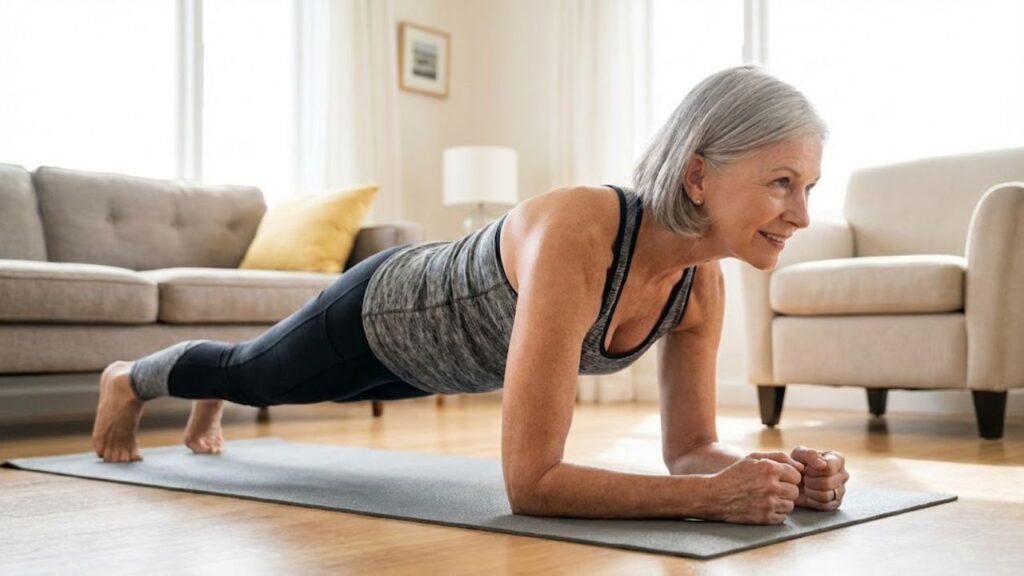
The instructor asks everyone to lie down. “Today we’re focusing on deep core strength,” she says. The room sighs collectively… then falls into a quiet that feels more like curiosity.
Because this is where the real secret starts.
The Hidden Challenge of Belly Fat After 60
Abdominal fat changes after 60. It’s not just about how your jeans fit or that stubborn roll that appears when you sit down. Inside the belly, around the organs, a quieter story unfolds, one that many don’t see coming.
Doctors call it visceral fat. It acts like a tiny factory of inflammation, pushing up blood pressure, raising blood sugar, and straining the heart. The frustrating part? You could walk for hours and still see that soft, tight ring around your waist.
We’ve all had that moment when you catch your sideways reflection and think, “When did that happen?” Marta, a 67-year-old woman I interviewed, gained just three kilos during menopause. Years later, her weight barely shifted, but her waistline expanded by 8 cm.
Her doctor shared something shocking: Even at a “normal” weight, the extra abdominal fat doubled her risk of metabolic issues—not due to laziness, but because her muscles—especially the ones you can’t see—had slowly weakened over time.
As we age, we naturally lose muscle mass, especially around the core and hips. Less muscle means a slower metabolism, less support for the spine, and more pressure on joints. The body adapts by storing fat around the middle.
That’s why so many over 60 feel stuck. They walk, cycle, avoid sweets, and the scale barely budges. The truth? Without activating deep abdominal muscles, the body has no reason to change that belly fat.
The Most Effective Exercise You’re Not Doing
Ask five experts what to do for abdominal fat after 60, and you’ll hear the usual: brisk walking, light strength training, maybe Pilates. But when I spoke to physiotherapists and geriatric trainers, one exercise kept coming up like a hidden gem: the “deep belly hold” or transverse abdominis contraction.
This exercise doesn’t require a mat or fancy gear. You can do it sitting at the kitchen table, on the bed’s edge, or while waiting for the kettle to boil. Picture zipping up tight pants and gently pulling your belly button toward your spine while breathing normally. It’s small, invisible, and deceptively simple.
Most over-60s focus on the “showy” muscles—crunches, sit-ups, or oblique twists. These mostly target surface muscles. The deep belly hold works deeper muscles, like an internal corset from your spine to the front of your abdomen.
Alain, a 64-year-old retired nurse I met, started with just five deep belly holds three times a day. After six weeks, he hadn’t lost much weight, but his belt tightened a notch, his lower back hurt less, and he joked, “My belly doesn’t spill over my trousers the same way.” He hadn’t done a single crunch.
The Benefits of Deep Belly Holds
Regularly engaging these deep muscles does two things: it stabilizes the spine, which improves posture, and it activates the core. Standing taller can change how the waist looks, but there’s more.
A stronger core improves movement—how you walk, how your hips move, and how other muscles fire. Everyday activities, like climbing stairs or getting up from a chair, burn more calories and reduce joint stress. Over time, this creates a shift: less strain, better alignment, a calmer appetite, and a belly that finally starts to soften.
How to Do the Deep Belly Hold
Sit or stand tall, but relaxed. Place one hand on your lower belly, just below your navel. Inhale naturally, letting your belly rise under your hand. Exhale slowly, imagining a zipper from your pubic bone up to your ribs.
Gently draw your belly button toward your spine, but only to about 30–40% of your maximum effort. You should still be able to talk. Hold for 5–10 seconds while breathing softly, then release completely. That’s one repetition. Start with 5–8 reps, once or twice a day.
Avoid bracing too hard. Don’t suck in your stomach like posing for a photo or hold your breath. The goal is subtle engagement, not tension—like quietly turning on a light, not slamming a door.
Another common mistake: doing it for two days, then forgetting for weeks. To build consistency, link the exercise to daily habits. Every time the kettle boils, do three holds. During TV ads, do five holds. Tiny rituals make it easier than relying on willpower alone.
Experts’ Take on the Deep Belly Hold
Physiotherapists emphasize that while the deep belly hold isn’t “magic,” it’s a foundation for everything else. One expert told me: “Give me eight weeks of consistent core activation, and I’ll give you less back pain, a steadier walk, and a smaller waistline—even if the scale barely moves. The core is the quiet boss of the body.”
Practical Tips
- Start slow: 5–10 seconds per hold, 1–2 sets daily, then gradually build up.
- Pair with light walking or gentle resistance training for better fat-burning results over time.
- Relax your shoulders and face so the effort stays in the abs, not the neck or jaw.
- If you experience pain or dizziness, pause and consult a professional if you have hernias or recent abdominal surgery.
- Consistency beats intensity after 60—“little and often” works better than “all out and exhausted.”
Rewriting Your Relationship with Your Belly After 60
There’s quiet dignity in choosing a better stage of life than elastic waistbands and joking about a “grandpa belly.” You don’t need to chase a flat stomach like you had in your 20s, and most experts agree that shouldn’t be the goal.
What you can aim for is a stronger, more responsive core that lets you get up from the floor with ease, carry groceries without effort, and walk into a room without adjusting your shirt. A belly that works for you, not against you.
The deep belly hold is nearly invisible, which is perhaps why so few people talk about it. No sweat, no drama—just a quiet, daily engagement with the muscles that support you. Over time, it shows in your waistband, posture, and energy.
This isn’t a quick fix, and it won’t reverse all signs of aging. What it does offer is control over a changing body, a practical tool to combat abdominal fat, and a way to feel at home in your own middle again. And that’s a story worth rewriting, one small contraction at a time.
Quick Takeaways
- Activate deep core muscles: Perform gentle “belly button to spine” holds while breathing normally to target abdominal fat and support the spine.
- Integrate into daily life: Add short sets while waiting for the kettle, TV ads, or public transport, making it part of existing habits.
- Combine with light movement: Add walking and basic strength moves for better metabolism and waistline results after 60.