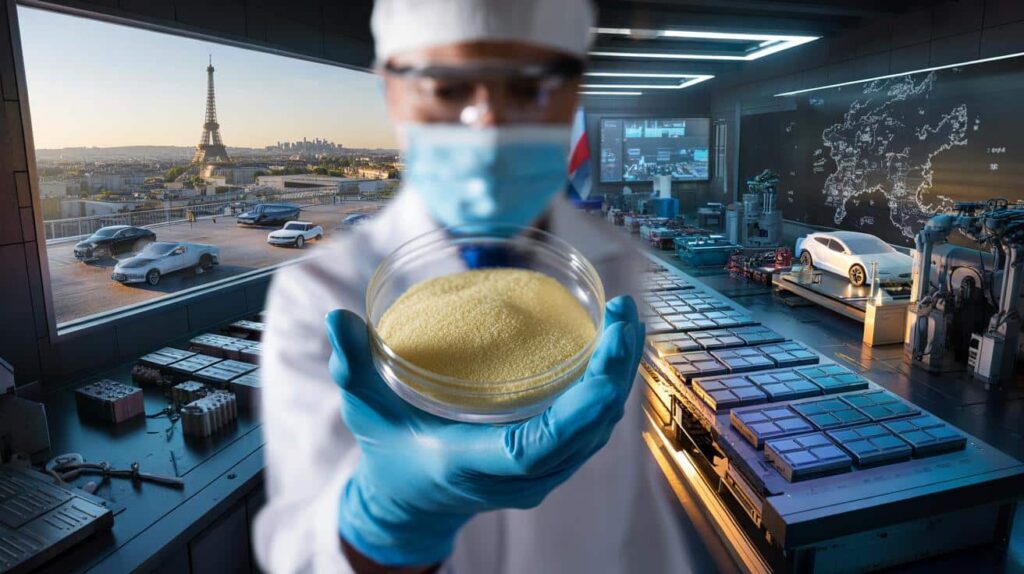
While most drivers are still debating range and charging points, France is quietly laying the groundwork for dominance over a hidden but decisive ingredient for next‑generation electric vehicles: sulfur-based solid electrolytes, the core of tomorrow’s all-solid-state batteries.
France’s stealth bid for Europe’s battery crown
At Rueil-Malmaison, just west of Paris, a new player called Argylium has moved from the lab to industrial reality with an unapologetically bold goal: to become Europe’s leading producer of sulfide solid electrolytes for all-solid-state batteries.
This is not a classic early-stage start‑up story. Argylium is backed by an industrial alliance knitting together two French heavyweights, Axens and IFP Énergies nouvelles, and Belgian chemical group Syensqo. Together they bring a decade of research, a stack of patents and teams of specialists who have already spent years working on battery materials.

Argylium is positioning France as the only European country currently able to produce sulfide solid electrolytes at ton-scale, a critical capability for future car batteries.

In practical terms, that means one country is attempting to secure the bottleneck material for all-solid-state batteries just as the technology approaches commercial maturity. For Europe’s carmakers, the timing could hardly be more sensitive.
Why this obscure powder could decide the future of electric cars
From flammable liquids to solid power blocks
Conventional lithium-ion batteries use a liquid electrolyte. It sits between the anode and cathode and acts as a highway for lithium ions during charging and discharging.
The liquid works, but it comes with headaches: it is flammable, reacts badly to shocks and overheating, and demands complex safety systems. Those constraints limit how fast you can charge and how aggressively you can push performance.
All-solid-state batteries ditch the liquid and replace it with a solid electrolyte. That change may sound technical, but for engineers it unlocks a different design space.
Argylium focuses on a family of sulfur-based compounds known as argyrodites. These materials offer high ionic conductivity, which means lithium ions can move quickly through a solid instead of a liquid.
- Less flammable solvent, cutting the risk of fires linked to the electrolyte
- Better heat resistance and tolerance to extreme operating conditions
- New cell architectures that can push energy density far beyond current lithium-ion designs
The company is targeting cells with around 500 Wh/kg by 2028–2030. Many of today’s EV batteries sit between roughly 200 and 300 Wh/kg, depending on chemistry and use case. Doubling that number reshapes how far a car can go on a single charge, or how light it can be for the same range.
Argylium also claims its technology should allow charging in under 10 minutes, a threshold that would push EVs much closer to the refuelling experience drivers are used to with petrol.
Energy density, explained in plain terms
Energy density, measured in watt‑hours per kilogram (Wh/kg), tells you how much energy a battery can store for each kilogram of weight.
- At 250 Wh/kg, an EV pack might weigh around 400–500 kg for decent range.
- At 500 Wh/kg, that same usable energy could be packed into roughly half the weight, or the same weight could give you significantly more range.
That extra freedom can be “spent” on longer range, smaller batteries, more interior space, or weight savings that extend tyre life and improve handling.
The industrial machine behind France’s push
Two leaders, one mission
Argylium is run by a duo designed to blend business clout with scientific continuity.
- Alessandro Chiovato, the CEO, is an organic chemist by training with more than 25 years at Solvay and then Syensqo. He has moved across strategy, innovation and market development in battery materials.
- Valérie Buissette, the CTO, brings deep technical roots. A materials scientist with a doctorate and training from leading French engineering schools, she has spent a decade working specifically on solid-state batteries.
The pairing signals that Argylium is not treating this simply as a speculative bet, but as a long-term industrial project that connects lab-scale breakthroughs to factory floor realities.
A four-step roadmap from lab to monopoly-level scale
The company has sketched out a stepwise path to something approaching European dominance in this niche, but crucial market:
| Phase | Main goal | Key milestones |
|---|---|---|
| 1. Product & validation | Finalise electrolyte range and prove performance | Use pilot units in Paris and La Rochelle to supply battery makers for testing; assemble financing consortium |
| 2. Raw material security | Lock in access to lithium sulfide and other feedstocks | Build a dedicated pilot unit; scale output to several tonnes per year |
| 3. Industrial demonstration | Shift from pilot to pre‑commercial scale | Operate a demonstration plant producing several hundred tonnes annually; serve first automotive clients |
| 4. Mass industrialisation | Reach tens of thousands of tonnes per year | Deploy large plants and license technology to industrial partners |
The strategic bet is clear: whoever controls large-scale solid electrolyte production controls a choke point in the European EV supply chain.
Two French sites as a real-world testbed
Argylium operates with more than fifty experts split between two French locations that act like a relay race between science and manufacturing.
- Paris hosts the research centre, where chemists and engineers work in a “kilo‑lab”. That means they develop and fine‑tune materials at the kilogram scale, pushing beyond the gram-sized batches of academic labs.
- La Rochelle is the development hub, home to a pilot unit designed to prove that the same materials can be made reliably at industrial scale.
This Paris–La Rochelle tandem allows quick feedback loops. Formulations tested on the bench can be transferred to pilot production, then adjusted and sent back for further tweaking.

European uniqueness and geopolitical leverage
Only toner in a continent of lab samples
Argylium claims to be the only entity in Europe currently capable of producing sulfide solid electrolytes at the ton scale. That may sound modest, yet it is a major step beyond small‑scale academic research.
Automakers and gigafactories planning multi‑billion‑euro plants cannot make investment decisions based on milligrams shipped from university labs. They need tonnes, then hundreds of tonnes, of consistent material they can test in real cell formats and real pack architectures.
By being first across this threshold, France buys itself leverage. Any European manufacturer that wants to move quickly into sulfide-based solid-state batteries will, at least initially, find a French gatekeeper standing between concept and commercial rollout.
Battery materials as a sovereignty issue
The French and EU authorities have backed the project with a clear strategic lens. This is no longer just about greener cars or shiny new gadgets. It touches industrial independence and geopolitical risk.
Control over battery materials is becoming as politically sensitive as control over gas pipelines once was.
Europe’s current EV industry depends heavily on Asian suppliers and, increasingly, American technology players. Argylium’s plan covers the entire chain, from lithium hydroxide through to the final argyrodite powder used in the battery cell.
Owning that chain helps keep quality and costs in check, while reducing exposure to export restrictions, trade disputes or sudden price spikes in critical materials.
A market set to explode — and consolidate power
Market data are moving in Argylium’s favour. According to Global Market Insights, the global solid-state battery market is expected to leap from about $1.1 billion in 2024 to $17.7 billion in 2034. That implies it nearly doubles every three years.
Three concrete forces sit behind this surge:
- Electric vehicles, where carmakers chase longer range without ballooning battery weight.
- Consumer electronics, from phones to wearables, which need safer, slimmer batteries that last longer between charges.
- Stationary storage for solar and wind power, which calls for batteries able to survive thousands of charge cycles with minimal degradation.
Sulfide solid electrolytes tick the main boxes: high energy density, improved safety and charging times often presented in the 10–15 minute range. Europe already accounts for around 22% of the global solid-state market and has poured more than a billion euros of public money into the sector in recent years.
At industrial scale, one rule tends to hold: the few players capable of producing specialised materials by the hundred‑tonne become unavoidable nodes in the supply chain. France is trying to make sure that, for this particular material, one of those nodes is on its soil.
What this means for drivers, manufacturers and investors
Possible scenarios for the next decade
If Argylium hits its targets by around 2030, European carmakers could roll out mass‑market EVs with:
- Similar battery weight but significantly more range, easing “range anxiety” for drivers
- Charging stops closer to a fuel station experience in time
- Simpler thermal management systems, potentially cutting costs at vehicle level
Conversely, if European sulfide electrolyte production stalls while competitors in Asia race ahead, the gap could force European OEMs to import critical materials once again, weakening the strategic autonomy goals talked up in Brussels and Paris.
Key technical risks behind the glossy promises
Several challenges still hang over sulfide‑based solid-state batteries.
- Interface stability: Maintaining clean, durable contact between solid electrolyte and electrodes is complex. Poor interfaces lead to resistance, heat and degradation.
- Dendrite growth: Lithium filaments can still form and pierce the solid electrolyte if design and operating conditions are not carefully controlled.
- Manufacturing cost: Moving from expensive pilot batches to cost‑effective mass production requires continuous process optimisation.
- Moisture sensitivity: Many sulfide electrolytes react with water, which demands tightly controlled production environments.
How Argylium handles those issues will determine whether France ends up with a true strategic asset, or a promising but niche technology.
Terms worth knowing before the next EV purchase
Three expressions are likely to crop up more and more over the next few years:

- All-solid-state battery (ASSB): A battery where both electrolyte and, in many designs, parts of the electrodes are solid, with no flammable liquid between them.
- Sulfide solid electrolyte (SSE): The sulfur‑based material replacing the liquid electrolyte; Argylium’s main speciality.
- Energy density: The amount of energy stored per unit of weight or volume; a core metric for range and design flexibility in EVs.
As these terms shift from specialist conferences into dealership brochures, the industrial decisions taken now in places like Rueil‑Malmaison and La Rochelle will shape which brands still build cars in Europe in ten years’ time — and which countries quietly hold the keys.