
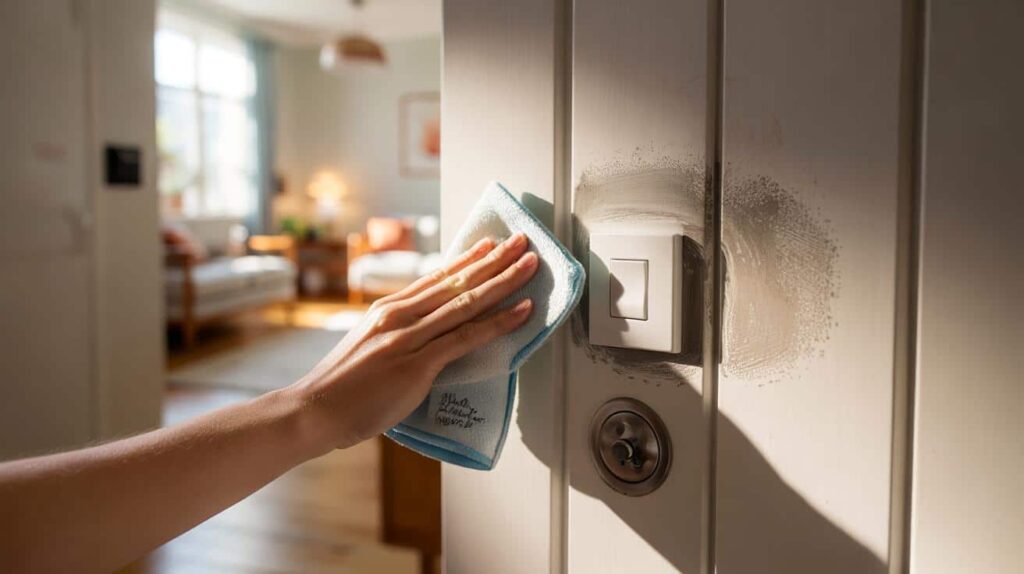
You notice it on a Tuesday, of all days. The light outside is grey, the sink is full, you’re half listening to a podcast and half scrolling your phone. You reach for the hallway switch and, under that dull winter light, you see it: a faint dark halo around the button, fingerprints layered like tree rings. The door handle nearby looks tired too, slightly sticky, a bit greasy. Not filthy enough to shock you. Just… off. You wipe it with the sleeve of your sweatshirt and the contrast is almost rude. One patch of clean plastic against a wall that suddenly looks older than you remember. Something shifts quietly in the room.
You start wondering what else you’ve stopped seeing.
Why these tiny, grubby details bother us more than we admit
Walk into any home as a guest and watch where your eyes land first. Not on the ceiling, not on the bookshelf, but on the objects you’re about to touch: the door handle, the light switch, sometimes the fridge handle if you’re close enough to the kitchen. These things are like a silent handshake from the house. When they’re slightly yellowed, smudged or sticky, the whole place feels a notch less welcoming, even if the rest is spotless.
Our brains are wired to judge a space in seconds. Small, high-contact points act like shorthand for “How cared for is this place?”
A professional home stager once told me she can walk through a property and guess, almost to the month, when someone last did a proper deep clean. She doesn’t look at the floors first. She looks at the switches. At the bathroom door handle. At the tiny screws around the handle plate where dust and grime settle into a dark outline.
Real estate agents say buyers often can’t explain why a house “feels off”, even when it looks fine in photos. Often it’s the micro-details. One woman I interviewed decided against an otherwise perfect flat because, she said, “Every light switch felt sticky. If they didn’t care about that, what else did they skip?”

There’s a psychological trick at work. Light switches and door handles live at hand height, under our fingertips. You don’t just see the dirt, you feel it. That physical contact turns a vague impression into a clear message: this space is looked after, or it isn’t.
Sensory researchers talk about “disgust triggers” that operate below conscious thought. High-touch grime is one of them. *A clean switch sends the opposite signal: quiet safety, quiet order.* It tells your nervous system that someone is paying attention, even when you’re not.

The tiny cleaning habit that changes the whole atmosphere
There’s a reason professional cleaners move fast but never skip handles and switches. The method is almost boring in its simplicity. Take a soft cloth, lightly dampen it with warm water and a small drop of gentle dish soap or an all-purpose cleaner. Wring it out hard. You want barely any moisture.
Wipe the switch plate, the button, the edges, then the nearby wall where fingers land when people miss the target. Same with the handle: top, underside, backplate. One pass to lift the grime. A second, dry cloth to remove residue. That’s it. Thirty seconds per point, tops.
The mistake most of us make is going months without touching them, then attacking with aggressive sprays or harsh scrubbing pads in a guilty panic. That’s how you strip paint, cloud plastic or push dirty water into the gaps. There’s another, quieter mistake too. We treat this task like a punishment. Something we “should” have done last weekend, or last year.
Let’s be honest: nobody really does this every single day.
When you approach it as a small reset instead of a moral failing, it stops feeling heavy. One hallway today. Just the bathroom tomorrow. You’re not catching up on years of neglect. You’re rewriting the feel of your home in tiny strokes.

“The quickest way to make a tired home feel looked after is to clean what people touch, not just what they see,” says Marie, who’s cleaned houses for 18 years. “If I’ve only got ten minutes, I go for handles, switches, remote controls and the kettle handle. People feel the difference as soon as they walk in.”
- Start where you enter
Front door handle, hallway switches, intercom buttons. These set the tone every time you come home. - Hit the “germ magnets”
Bathroom door handles, flush levers, bedroom switches near the bed. These carry both bacteria and emotional weight. - Pair it with something you already do
While the kettle boils or the bath runs, grab a cloth and do three switches. Habit grows from tiny anchors. - Use gentle products
Microfiber cloth, mild soap, or a light disinfectant. Harsh bleach can yellow white plastic and irritate skin. - Look from a guest’s perspective
Stand at your front door, then at the bathroom door. Anything you’d hesitate to touch? That’s your next target.
When a clean switch becomes a quiet act of self-respect
Once you start noticing these little contact points, it becomes hard to unsee them. Not in a stressful way. More like spotting spelling mistakes on a street sign. They jump out. One reader told me she began wiping the kitchen light switch every evening as a tiny ritual before bed. “The room just feels calmer,” she said. “Like I’ve closed the day properly.”
What surprised her most wasn’t the cleanliness. It was the emotional ripple. She began washing her mugs more quickly. Clearing the table sooner. The switch clean became a cue: this is a space I’m choosing to care for.
We’ve all been there, that moment when life is messy and the house feels like visual noise. Dishes stacked, laundry half folded, receipts on the counter. Deep cleaning is out of reach, both in time and in energy. Yet wiping one handle, one switch, is oddly doable. Not heroic, not Instagram-worthy. Just a single, human-sized gesture.
That’s the plain truth of it: tiny actions are often the only ones we can take on a bad day. And they count. They tell a quieter story about how you see yourself inside your own four walls.
 Goodbye Hair Dye for Grey Hair: The Simple Conditioner Add-In That Restores Natural Colour Gradually
A clean switch doesn’t impress your guests as much as it steadies you. Every time you reach for the light, your fingers meet smooth plastic, not tackiness. Every time you open the bathroom door, it doesn’t whisper “later” in that accusing tone clutter tends to use.
You start to feel that your home is not something happening to you, but something you’re gently shaping. High-touch points become more than hygiene. They’re small, stubborn proofs that you’re still here, still trying, still capable of transforming a room with nothing but a cloth and five spare minutes.
 Not once a week, not on alternate days : dermatologist explains how often we should wash our hair
| Key point | Detail | Value for the reader |
|---|---|---|
| Focus on high-touch areas | Light switches, door handles, appliance handles shape first impressions | Maximum impact for minimal time and effort |
| Use a simple, gentle method | Damp microfiber, mild soap, quick wipe then dry | Protects surfaces while still cutting germs and grime |
| Turn it into a micro-ritual | Pair with daily tasks like boiling the kettle or brushing teeth | Builds a sustainable habit that quietly upgrades your home mood |
FAQ:
- How often should I clean light switches and door handles?Once a week is a good rhythm for most homes. In busy households or during illness, every couple of days helps keep germs and stickiness in check.
- Can I use disinfectant wipes on switches?Yes, but squeeze out excess liquid first and avoid soaking the switch. Too much moisture can seep inside and damage the electrics over time.
- What’s the best product for door handles?A mild all-purpose cleaner on a cloth works for most materials. For brass or special finishes, use a cleaner designed for that surface to avoid dulling or staining.
- Why do my white switches look yellow even after cleaning?Plastic can discolor from age, smoke, cooking fumes or strong chemicals. If yellowing doesn’t lift with gentle cleaning, the material itself has changed and may need replacing.
- Is this really worth it if the rest of my house is a mess?Yes. Tackling small, high-contact points can shift how you feel in your space and give you a sense of control, even when bigger jobs have to wait.
