At 7:15 every morning, Maria steps into the chilly air of her small garden. She wears a faded wool cardigan, which no longer buttons properly, and a pair of pristine white trainers that her granddaughter insisted she buy. At 102, Maria moves slowly, but she moves on her own terms—no walking frame, no need for assistance. Just determined, deliberate steps as she walks between the rosebush and the washing line.
She pauses, stretching her arms to the sky, and laughs softly to herself.
“I refuse to end up in care,” she says, almost as if it’s a daily affirmation.
A Life of Purposeful Movement
Maria lives alone in a cozy semi-detached house on a quiet street. The wallpaper is peeling, the kettle’s older than some of her neighbors, and the TV remote has been taped together more times than she can count. Yet, despite the aged appearance of her home, everything is designed to encourage movement. The sugar sits on a high shelf, the bins are far from the door, and the armchair everyone suggests she sit in remains empty most of the day.
She doesn’t rush. She simply never stops fully.
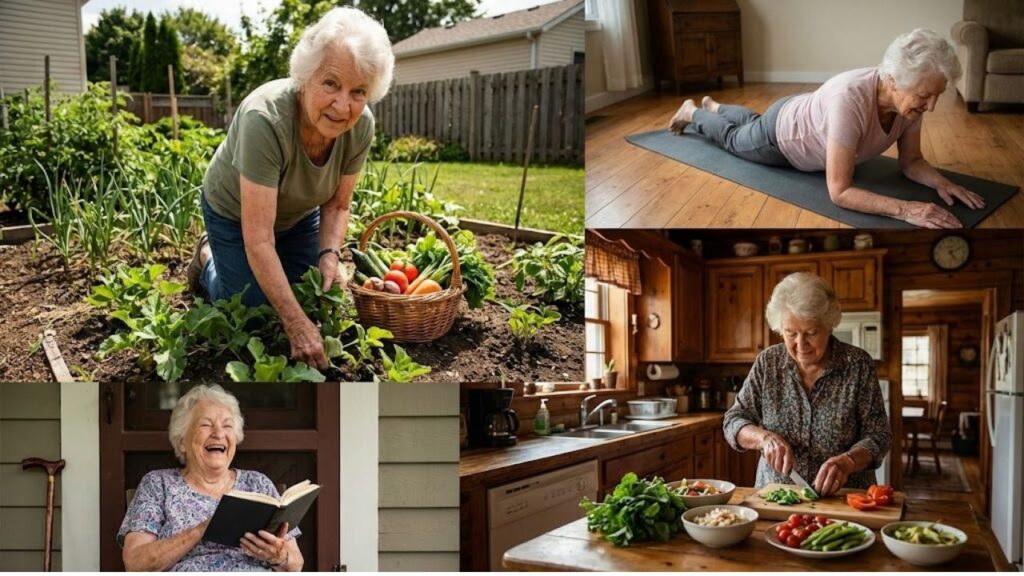
Her daily routine is filled with small, intentional rituals. She peels her own potatoes because, as she puts it, “the hands must remember.” She makes the trek to the corner shop, even though she could ask the neighbor’s son to bring milk. She waters her plants with a small jug instead of a larger watering can, forcing herself to go back and forth more often.
Her Strategy to Stay Independent
When her doctor suggested a walking frame, she politely agreed, but then stored it in the hallway behind the coats. “If I start leaning on it,” she tells me, “I’ll never stop.” It’s not denial. It’s a calculated strategy. Maria lives by the idea of “functional reserve,” even though she doesn’t know the term. Every small effort she makes is a deposit in her future self’s strength. She doesn’t rely on marathons or fancy supplements—just simple, daily actions to keep her body engaged.
Studies support this idea. People who keep moving with small daily tasks—like cleaning, cooking, and shopping—maintain their balance, muscle mass, and confidence far longer than those who “sit for safety.” What seems ordinary has a lasting impact.
The Power of Small Challenges
Maria has one non-negotiable rule: “I do something a little difficult every day.” Not dangerous. Just enough to challenge her. She still climbs the stairs twice a day, even though she could sleep downstairs. She handwashes clothes in the sink, feeling the weight of wet fabric. She opens jars herself, tapping the lid on the counter until it pops open.
These aren’t workouts—they are small, daily negotiations with gravity. Each task reminds her brain, “We’re still needed here.” These little efforts prevent her world from shrinking to a waiting room.
The Dangers of Overhelping
Maria is clear-eyed about the traps many of her friends fall into. It starts with the “just for now” chair in the living room—the one people sit in after lunch and then never quite get out of. Then there’s the family who does everything out of love and fear, until the person they’re helping forgets how to do anything for themselves.
Maria sees the love behind this help, but she also sees its consequences. “If they put the cup in my hand,” she says, “I forget the weight of it.” If someone ties her shoelaces, her back stops learning how to bend. These little actions, though seemingly insignificant, are critical to her continued independence.
Making Small, Empowering Choices
Maria’s daily choices aren’t magical. She knows luck plays a role, and she shrugs when talking about friends who were careful but still got sick. Yet, she refuses to accept that age is simply something that “happens to you.” Her days may seem small, but they are purposeful, and they keep her feeling alive.
Practical Tips to Keep Your Independence
- Move on purpose: Carry smaller shopping bags, take the stairs slowly, or stand while you peel vegetables. These small movements build strength and balance without feeling like exercise.
- Own one task: Whether it’s making your tea, folding laundry, or watering plants, keep at least one task yours. Protect it fiercely—even when others offer to help. It’s proof of your autonomy.
- Create small obstacles: Store items slightly higher or further away, use a smaller jug or lighter basket. These simple changes make you move more, without needing extra motivation.
- Accept slower, not “stopped”: Adapt how you do things instead of abandoning them altogether. A rest halfway up the stairs is a strategy, not a failure.
- Say it out loud: Maria’s phrase, “I don’t want to end up in care,” is her anchor. Find your own version. Naming what you fear can guide your daily actions.
What We Can Learn from Maria
Maria’s approach isn’t about doing everything perfectly or forcing yourself to “be strong” in a traditional sense. It’s about making daily choices that keep you engaged in your own life. When it’s easier to sit down, order takeout, or let someone else handle the task, a thousand small decisions redraw the boundaries of a life. The line between independence and care often comes down to unnoticed, everyday habits.
Her story doesn’t ask us to replicate her life. It simply invites us to ask ourselves, where, today, can we hold onto just a little more of our own power? It may be something small—like walking to the mailbox or standing up to take a phone call. No heroic actions, just small, persistent refusals to surrender the parts of life that still belong to us.
| Key point | Detail | Value for the reader |
|---|---|---|
| Daily “micro-efforts” | Using chores and small obstacles as natural exercise | Offers an accessible way to stay stronger without formal workouts |
| Guarding independence | Keeping certain tasks personal, even when help is available | Helps maintain dignity, confidence, and a sense of usefulness |
| Intentional mindset | Repeating a clear sentence: “I refuse to end up in care” | Gives a simple mental anchor for everyday decisions about ageing |