
You’re standing in the vegetable aisle, hesitating between a tight white cauliflower, a rugged green broccoli, and a heavy cabbage that smells faintly of earth. Three different shapes, three different colors, three different recipes in your head. The cauliflower is for gratin, the broccoli for a quick stir-fry, the cabbage for Grandma’s soup. You toss them into your cart as if you were choosing three unrelated strangers at a party.
Then someone tells you, casually, that all three are the same plant. Same species. Same origin. Just different “faces” of one stubborn vegetable that humans have pushed and pulled for centuries.
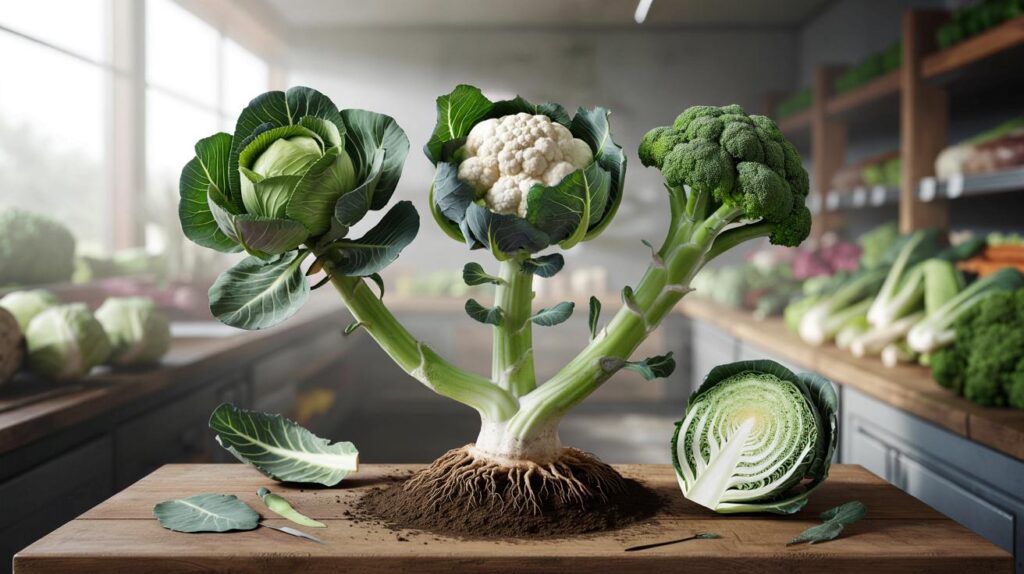
You look back at your cart and, for a second, the whole supermarket feels different.
What else are we getting wrong about what we eat every day?
One plant, three personalities in your shopping cart
Most people see cauliflower, broccoli and cabbage as cousins that barely talk to each other. They sit on the same shelf, they share a vaguely similar smell when cooking, and that’s usually where the story ends. Yet all three belong to a single species: Brassica oleracea. Different varieties, same botanical identity.

Broccoli is just a version where humans pushed the plant to develop big green flower buds. Cauliflower is another version, selected for dense white florets. Cabbage? A leaf-obsessed form, bred to pack its foliage into a compact head. Same DNA playground, different directions.
 A Pool Noodle Will Change Your Life in the Kitchen: Here’s Why It Will Revolutionize Everything
Picture a windy cliff on the Atlantic coast of Europe, centuries ago. A wild, scruffy plant clings to the rocks: thick leaves, salty air, no supermarket in sight. That’s the ancestor of your broccoli. Farmers noticed it was tough, resilient, and edible. They started saving seeds from the plants that had the fattest leaves, or the biggest buds, or the crunchiest stems.
Over generations, those tiny preferences turned into major shifts. In one place, people favored tight leaves, and cabbage was born. Elsewhere, they fell in love with swollen clusters of unopened flowers, accidentally creating broccoli and cauliflower. Nothing magical. Just human patience, selective seed saving, and many dinners later.
What’s happening here has a name: artificial selection. The same basic plant is subtly nudged in different directions by human choices. Botanically speaking, cauliflower, broccoli and cabbage are more like different dog breeds than separate species. Think of a Great Dane, a Dachshund, and a Border Collie. Different silhouettes, same species, same Latin name.
*The plain truth is: the supermarket looks diverse, but a lot of that diversity is just clever tweaking of a few base species.* This doesn’t make it less fascinating. It makes it more so. Because it means our tastes literally re-shaped the plants we rely on.
How to “read” your vegetables like a plant detective
Next time you cook, stop for ten seconds before chopping. Take a broccoli and a cauliflower and place them side by side on the cutting board. Look closely at their structure. Those rounded clusters? They’re immature flower buds, packed tight. Break them apart and you can see the same branching pattern, the same tiny stems, the same architecture.
Then grab a cabbage. Peel the outer leaves, slice it in half, and watch the internal spiral. Those layers are just leaves folded around a short, stubby stem. If you let that plant mature and bolt, it would also send up a tall stalk with yellow flowers that look suspiciously like… broccoli gone wild.
A simple “experiment” at home makes this story very real. Plant cabbage, broccoli, and cauliflower in the same corner of a garden or balcony. At first they look different enough. Then one day you’ll notice they all share the same yellow crucifer flowers, the same pods with seeds inside. That’s when the illusion breaks.
We’ve all been there, that moment when you realize something you thought was obvious isn’t so clear anymore. Suddenly, “broccoli vs. cauliflower” sounds like arguing about whether a poodle is more “real” than a labrador. You’re just looking at human choices expressed in stems and leaves.
What drives these changes is simple: selection for one part of the plant. For cabbage, humans exaggerated the leaves. For Brussels sprouts, they pushed that idea further and turned leaf buds along the stem into mini-cabbages. For broccoli, they zoomed in on swollen flower clusters. For cauliflower, they selected a mutation that keeps those flower buds dense and pale.

From a nutritional angle, this shared origin explains why they’re all rich in similar compounds: vitamin C, fiber, and those sulfur molecules that make your kitchen smell “brassy” after steaming. **Different recipes, same health toolkit.** Once you see them as one plant with multiple masks, your plate starts looking much smarter than you thought.
From field to plate: using this secret to cook smarter
Knowing these vegetables are variations of one plant can quietly change the way you cook. If a recipe calls for broccoli and you only have cauliflower, you’re much more relaxed about swapping. You start thinking in terms of structure instead of name. Need something that holds its shape in a stir-fry? Use broccoli stems or cabbage strips. Want a creamy mash? Steam cauliflower or the tender core of a white cabbage and blend it.
A simple method is to group them by “role”: florets for absorbing sauces, leaves for bulk and crunch, stems for texture. Once you see that, your fridge stops being a pile of strangers and becomes a toolbox.
A lot of us feel guilty when we let half a cabbage die in the crisper. The head seemed huge, you used two slices, then it quietly wilted at the back of the fridge. Let’s be honest: nobody really plans three different cabbage recipes in the same week. Knowing cabbage, cauliflower and broccoli are cousins helps reduce that waste. You can mix leftovers in the same pan, the same soup, the same roast tray.
One gentle tip: treat stems as ingredients, not trash. Peeling and slicing broccoli or cauliflower stems turns them into sweet, crunchy pieces that cook almost like kohlrabi. They’re from the same plant family, after all. **The more you see the link, the less you throw away.**
“Once people realize that cabbage, broccoli and cauliflower are the same species, something clicks,” says a market gardener I met outside a small French town. “They stop treating them as special, fragile things and start playing with them. That’s when cooking really gets fun.”
- Use cauliflower instead of potatoes for a lighter mash, keeping a few broccoli florets for color.
- Slice cabbage very thin and stir-fry it with garlic like you would broccoli, not just in soups.
- Roast mixed florets and cabbage wedges on the same tray: same family, same cooking time.
- Save outer cabbage leaves to wrap seasoned rice or leftovers, like quick plant-based “dumplings”.
- Try one “family meal” a week: any combination of these three goes into one big, comforting dish.
What happens when you never look at vegetables the same way again
Once you’ve seen the trick behind cauliflower, broccoli and cabbage, it’s hard to unsee it. The vegetable aisle stops being a neutral space and turns into a living museum of human choices. You start asking awkward little questions: how many other “different” foods are secretly the same species stretched in opposite directions? How many flavors are just tweaks of the same genetic story?
That curiosity can spread. You notice that kale is another form of the same plant, just leaves left loose and wild. Romanesco looks like a psychedelic cousin, yet it’s part of the same clan. Suddenly, your dinner is not just a plate. It’s a quiet conversation between history, farmers, and your own habits.
This perspective does something surprisingly tender: it reconnects you with the people behind your food. Someone, somewhere, kept seeds from one oddly big cabbage. Someone else decided a freakishly dense white head was worth replanting, and centuries later you call it cauliflower.

Next time you steam broccoli, you might feel a vague sense of continuity. From a salty European cliff to your table, the same plant adapted to our desires without saying a word. It bent, branched, thickened, folded. You season it with olive oil and salt, maybe a squeeze of lemon, and eat a story that started long before supermarkets and diet trends.
What if we treated our plates less like lists of nutrients and more like collections of living biographies?
 Meteorologists warn this country may face a historic winter as La Niña and the polar vortex align
| Key point | Detail | Value for the reader |
|---|---|---|
| Same species | Cauliflower, broccoli and cabbage are all Brassica oleracea varieties. | Changes how you see “variety” in the supermarket and on your plate. |
| Shared structure | They differ mainly in which part was selected: leaves, buds, stems. | Helps you swap ingredients and cook more flexibly. |
| Cooking freedom | Similar nutrition and behavior in the pan or oven. | Reduces food waste and opens up new, easy recipes. |
FAQ:
- Are cauliflower, broccoli and cabbage really the same plant?Yes. They’re all cultivated forms of the species Brassica oleracea, shaped by centuries of human selection.
- Do they have the same nutritional benefits?They’re not identical, but they share a similar base: fiber, vitamin C, vitamin K and sulfur compounds linked to protective effects.
- Can I swap one for another in recipes?Often yes. You may need to adjust cooking time and texture expectations, but most dishes tolerate a swap quite well.
- Is kale also related to them?Yes, kale is another variety of the same species, focused on loose, robust leaves instead of heads or florets.
- Why do they sometimes upset my stomach?The sulfur compounds and fiber that make them healthy can cause gas for some people. Cooking them well and eating smaller portions can ease that.
