
The party wasn’t even loud. Just a low hum of people talking over a soft playlist, someone laughing in the kitchen, the clink of glasses. You told yourself all day that you’d go, that you “needed to be social”, that you’d feel better once you got there. And yet, ten minutes in, your chest had that familiar tightness. Your smile felt stapled on. Your brain was already scanning for the nearest exit, rehearsing excuses about being tired, early meeting, not feeling well.
Later, walking home alone, the quiet felt like oxygen. A guilty kind of relief settled in. You wondered why you keep doing this: drifting away from group chats, cancelling dinners, disappearing from social media for weeks.
What if that urge to retreat wasn’t just “being weird”, but your brain pulling an emergency brake?

When your brain chooses silence over small talk
There are seasons when everything feels too loud, even when no one is shouting. A simple “How are you?” at the office lands like a test you haven’t revised for. Your phone lights up with messages and you feel a subtle pressure, not joy. That’s often when the first thought appears: “I just want to disappear for a while.”

Psychologists describe this as a protective reflex. When your emotional system is overwhelmed, the brain doesn’t ask for a better schedule or a different meeting. It asks for less. Less noise, fewer faces, fewer expectations to perform. Social withdrawal becomes the quickest, clumsiest way to get back to what feels safe.
Take Laura, 32, who went from organizing after-work drinks to letting her messages pile up unanswered. For months, she told friends she was “busy”. Behind the scenes, she was staring at her screen, feeling a wave of dread each time another notification popped up.
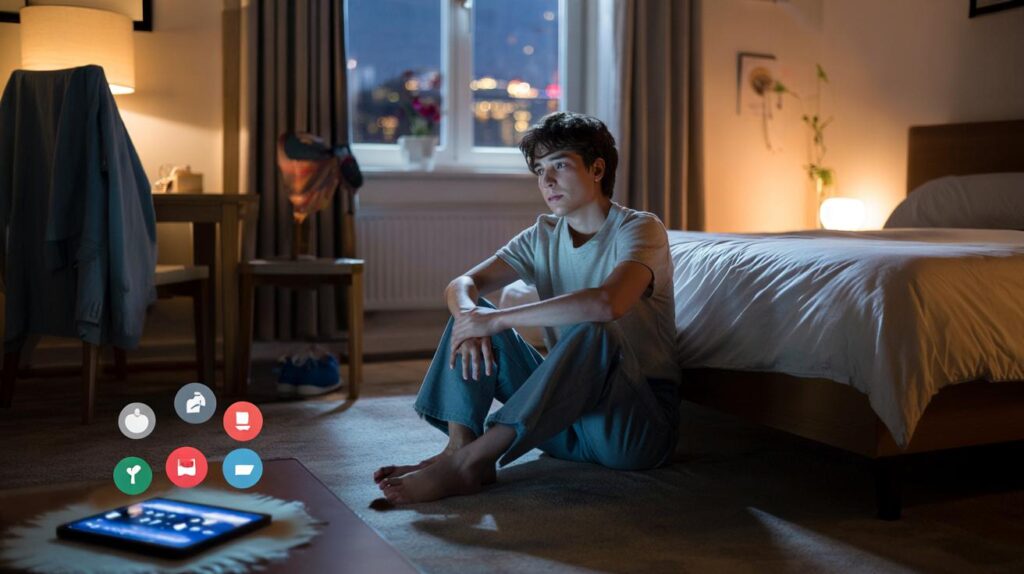
One night, instead of joining a video call with her friends, she shut off her phone and sat on the floor of her bedroom. She listened to the hum of the fridge, the traffic outside, her own breathing slowing down. That small, quiet moment felt more soothing than two hours of forced laughter. Months later, in therapy, she learned there was a name for that urge to cut contact: emotional self-protection.
From a psychological point of view, social connection is deeply rewarding, but also demanding. Every interaction asks your brain to read signals, adjust tone, manage tiny risks of rejection or misunderstanding. When your stress level is already high, this “social processing” becomes heavy work.
So your brain does something simple and very old: it chooses safety over risk. It pulls you back from the crowd, reduces exposure, and tries to stabilize your emotional world. *The problem isn’t that your brain wants safety; the problem starts when safety begins to mean “being alone all the time.”* That’s when protection quietly turns into isolation.
How to honor the need for safety without vanishing from your life
One practical approach is to negotiate with your nervous system instead of fighting it. Instead of forcing yourself to “be more social”, start by asking what kind of contact feels least threatening right now. Maybe texting one trusted friend feels doable, while a group dinner feels like a mountain.
You can also experiment with “time-boxed” connection: tell yourself you’ll stay at the gathering for 45 minutes, then decide again. That way, your brain knows there’s an exit. This reduces the internal alarm and makes showing up a little less daunting. Paradoxically, giving yourself permission to leave often makes it easier to stay.
A big trap is labeling yourself too quickly: “I’m antisocial”, “I’m broken”, “I’m bad at people.” Those labels stick and quietly shape your choices. Social withdrawal isn’t a personality flaw, it’s a signal. When you treat it as a signal, you get curious instead of judgmental.
Ask a simple question: “What part of connection feels unsafe right now?” Being judged? Being asked how you are? Not having energy to be “on”? Each answer opens a different path. And let’s be honest: nobody really does this every single day. Even mental health professionals skip calls and stay under blankets sometimes.
 Psychology explains that emotional numbness often develops as a short-term survival strategy
Psychologist and researcher Stephen Porges, known for the polyvagal theory, sums it up this way:
“When we feel unsafe, our social engagement system goes offline. We don’t lose our capacity to connect; we temporarily park it to survive.”
To work with that, you can build a small “emotional safety kit”:
- Choose one **anchor person** you can message without pretending you’re fine.
- Plan one low-stakes social ritual per week: a short walk, a coffee, a shared lunch break.
- Use a “soft exit line” in advance: a sentence you can say if you feel overwhelmed and need to leave.
- Limit your exposure to draining online spaces that spike your anxiety or comparison.
- Practice one grounding gesture (touching your wrist, breathing slowly) before you answer messages.
These are not about forcing yourself out of your shell. They’re about building **tiny bridges** between your need for safety and your need to belong.
Letting your need for emotional safety be seen
There’s a quiet shift that happens when you stop treating your social withdrawal as a personal failure and start seeing it as data. Your brain is telling you something: “Right now, connection feels risky. I’m trying to protect you.” Listen to that, but don’t hand it the steering wheel forever.
You can begin to talk about it with one person you trust: “Sometimes I disappear, not because I don’t care, but because I’m overwhelmed and my brain is looking for safety.” That kind of sentence can be clumsy, yet it opens space for real understanding.
And this is where a plain truth shows up: relationships don’t survive on good intentions alone, they survive on tiny, imperfect signals that you’re still here. A quick voice note. A “thinking of you, no need to reply”. A “today is not a social day for me, maybe next week?” Each little message tells your people: I haven’t vanished, I’m just recalibrating.
Over time, you might notice patterns: you pull away after conflict, after long workdays, during family stress. Those patterns are maps. They don’t accuse you. They show you where your emotional safety gets shaky and where you might need more support, more rest, or more honest conversations.
The urge to withdraw won’t disappear forever, and maybe it shouldn’t. There will always be evenings when your nervous system votes for solitude. The question is no longer “Why am I like this?” but “What is my brain protecting me from right now, and is there a kinder way to respond?”
 Psychology explains that hypervigilance can persist long after the original stressor has disappeared
Some readers will recognize themselves in these lines and feel a bit less alone. Others might finally understand a friend who keeps ghosting and coming back. Either way, this is an invitation to treat social distance not only as a problem to fix, but as a message to decode. What would change if your first response to that urge to disappear was not shame, but gentle curiosity?

| Key point | Detail | Value for the reader |
|---|---|---|
| Social withdrawal is a safety reflex | The brain reduces social exposure when it perceives emotional risk or overload | Helps reframe “pulling away” as protection, not laziness or defect |
| Small, safe connections matter | One-on-one contact, time-limited plans, and low-stakes rituals keep bonds alive | Offers realistic ways to stay connected without overwhelming yourself |
| Curiosity beats self-judgment | Noticing patterns and talking about them builds understanding and support | Encourages self-compassion and healthier relationships during hard phases |
FAQ:
- Question 1When does normal social fatigue turn into something I should worry about?If your urge to withdraw lasts for weeks, affects work or studies, or you lose interest in people you usually care about, it may be more than simple tiredness. That’s often a sign to talk to a professional and check for anxiety, depression, or burnout.
- Question 2Is wanting to be alone a sign that I’m an introvert?Not always. Introverts recharge alone, but intense withdrawal can also be a reaction to stress, trauma, or social fear. Personality and emotional safety needs overlap, but they are not the same thing.
- Question 3How can I explain this to friends without sounding dramatic?You can keep it simple: “When I disappear, it’s usually because I’m overwhelmed, not because I don’t care. I’m working on it, but if I’m quiet, that’s the reason.” That level of honesty is usually enough for people who truly want you in their life.
- Question 4What if social media makes my withdrawal worse?That’s common. Constant comparison and noise can spike your nervous system. You can mute accounts that drain you, set specific “online windows”, or delete apps from your phone for a while and only use them on a computer.
- Question 5Do I have to push myself into big gatherings to “get better”?No. You can start with the smallest steps that feel challenging but not terrifying: a short call, a coffee with one person, a hobby group where you can mostly listen. Progress in this area is usually slow, gentle, and very personal.
