
On a gray February morning in Tromsø, Norway, the harbor looks wrong. Sea ice that should be locked solid is broken into slushy plates, rocking gently like a puddle in the wind. A gull fights a sudden warm gust, wings tilting as if this were late April, not deep winter above the Arctic Circle. Along the quay, a biologist named Lise points to the open water and shakes her head. “We used to count on winter,” she says quietly. “Now it feels like waiting for something to snap.”
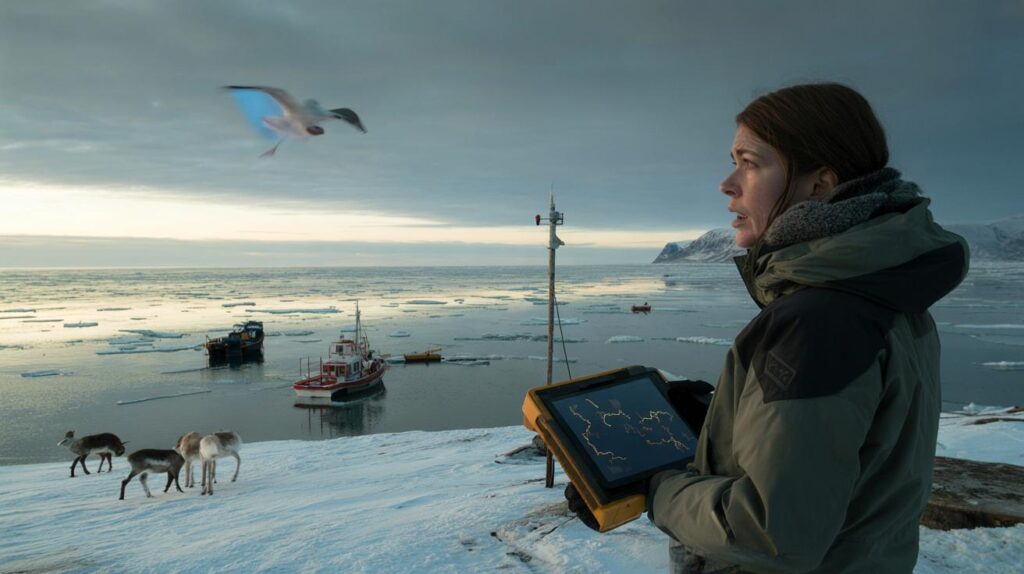
Out on the horizon, where the polar night still hangs low and blue, the air is strangely mild. Sensors on weather buoys send back numbers that make meteorologists double‑check their screens. Something in the Arctic system, the one we all grew up thinking of as frozen and distant, is starting to come undone.
And this time, the alarm isn’t just about ice.

Early February, and the Arctic already feels like late spring
In early February, Arctic forecasters are used to talking about blizzards, not rain. This year, many are staring at maps filled with red temperature anomalies instead of blue. Oceanic heat is pushing north, and the polar vortex — that swirling crown of cold air — looks dented and off-kilter. Patterns that once stayed locked over the pole are wobbling like a spinning top about to lose balance.

Across Greenland, Svalbard and the Russian Arctic coast, weather stations are logging days that feel more like thaw than freeze. A few degrees on a screen might sound abstract. On the tundra and sea ice, those small shifts are the difference between stable ground and a slushy trap.
You can see the consequences in places like Svalbard, where reindeer have been filmed slipping on sheets of ice that shouldn’t exist. A warm spell, followed by rain, then a flash freeze, seals their food — low‑lying plants and moss — under a rock‑hard crust. Locals describe starving animals standing on a shimmering glass floor, grass locked just a few centimeters below their hooves.
Satellite data backs up the anecdotes. Sea ice extent in late January and early February is hovering near record lows, while parts of the Barents and Kara Seas are as much as 8°C warmer than average. Meteorologists now talk about “Arctic breakdown” episodes, where the old rhythm of freeze, stay frozen, then melt, is replaced by a jittery on‑off pattern of thaw and refreeze.
For wildlife, that jumpy pattern is far more dangerous than a slow, steady warming. Animals and plants evolved over thousands of years to match a relatively reliable calendar: snow comes, sea ice forms, prey moves, predators follow. When February behaves like April for a week, then slams back into deep winter, that calendar tears.
Arctic ecologists describe this moment as a biological tipping point in slow motion. Not a single dramatic day when everything collapses, but a narrowing corridor beyond which many species’ life cycles simply no longer line up with the seasons. Once that mismatch crosses a certain threshold, no amount of adaptation can keep up.
When the timing breaks, the food chain breaks with it
The most crucial shift is not just how warm it gets, but when. Early February used to be a period of deep, stable cold that set the stage for spring. Now warm air intrusions are arriving weeks earlier, shaking that foundation. Meteorologists describe “atmospheric rivers” pushing moisture and heat into the high north, bringing rain instead of snow over sea ice and tundra.
This rain punches holes in winter. Snowpacks become heavier, wetter, then refreeze into hard layers. Sea ice turns porous and darker, absorbing more sunlight when the sun finally returns. Everything that depends on a clean, dry, layered winter suddenly has to operate in a half‑melted mess.
Take polar bears hunting seals. Their peak hunting period is late winter into early spring, when sea ice is still strong enough to carry them to breathing holes and pupping dens. With early breakdown, some ice platforms shatter or drift too far offshore before that feeding window. Bears end up burning more energy swimming, or they arrive at key seal nurseries too late.
On land, seabirds and migratory geese face a similar trap. They time their arrival to match insect blooms and plant growth that used to follow snowmelt like clockwork. As winter fractures earlier and in pulses — a thaw here, a freeze there — the spring “green wave” becomes patchy. Chicks hatch on schedule, but the buffet they expect can be days or weeks off. *A few mismatches are survivable; a whole decade of them isn’t.*
Scientists call this “phenological mismatch”: the breaking of synchrony between life cycles and the seasons. Early February breakdown amplifies that mismatch because it hits at a critical reset point in the Arctic’s annual cycle. If snow is too icy, herbivores can’t feed properly. If ice is too fragile, predators can’t hunt. If warm spikes trigger early blooms of plankton under thinning ice, then a later cold snap can wipe that food pulse out before fish, krill or seabirds are ready.
Once enough of these mismatches stack up, the system edges toward a biological tipping point where populations don’t just decline — they suddenly crash. And while models have warned about this for years, many researchers now say the real‑world data is arriving faster than their graphs predicted.

What scientists watch when they say “tipping point”
Behind the headlines, there is a surprisingly practical checklist that scientists quietly track each winter. They watch not only air temperatures, but also sea‑ice thickness, timing of first snow, first rain‑on‑snow events, and the dates when key species start breeding or migrating. One method gaining attention is the close pairing of satellite data with simple field notebooks kept by Arctic residents — reindeer herders, fishers, Indigenous hunters.
These observers note when caribou change routes, when seabirds arrive on cliffs, when the first cracks cut through lake ice that children once skated on. The goal is to catch the moment when variability turns into something new: a different baseline, rather than just another weird year.
If you follow this work long enough, you see that the mistake many of us make is treating each strange winter as a one‑off. A “freak” warm spell, a “record” low in sea ice, an “unusual” rainstorm. We sigh, shake our heads, and then move on to the next storm or heatwave. Yet Arctic researchers stress that tipping points are rarely about a single record being broken. They’re about patterns of broken records that don’t reset.
Let’s be honest: nobody really scrolls through climate bulletins every single day. We dip in and out, catching the biggest shocks. That’s precisely why so many scientists sound rattled this year. The shocks they’re seeing in early February used to belong to late March. The graph lines have shifted, and they’re not bouncing back.
“People think of tipping points as spectacular collapses,” says marine ecologist Javier López from his small office in Tromsø. “In reality, it’s often the year you stop seeing something that was always there. The year the ice doesn’t come back in time. The year the birds don’t arrive. You only notice it clearly when it’s already gone.”
To grasp what’s at stake, it helps to picture the Arctic not as a lonely ice desert, but as a tightly woven network. Some of the key threads scientists are watching right now are:
- Timing of sea‑ice formation and breakup
- Frequency of rain‑on‑snow events in mid‑winter
- Reproductive success of “keystone” species like Arctic cod and seabirds
- Shifts in migration routes of caribou, geese and whales
- Survival of juvenile animals after winters with repeated thaw‑freeze cycles
Each of these threads holds up a larger part of the web. When too many fray at once, the whole pattern re‑arranges — and not in ways that are easily reversed.
Why an Arctic cliff edge matters far beyond the polar circle
The phrase “early February Arctic breakdown” might sound remote if you’re reading this on a crowded subway or in a warm kitchen miles from the nearest snowbank. Yet the same disrupted polar vortex that’s letting warmth flood the high north is also sending strange winter weather further south. We’ve all been there, that moment when you step outside in what should be a cold, crisp week, only to be hit by damp, springlike air that feels out of place. That feeling of seasonal disorientation is now part of the same story.
When the Arctic loses its stable cold cap, the jet stream can twist and buckle more easily. That means flash freezes after balmy days, freak snowstorms in places not used to them, and stubborn stagnating heat domes in others. You might not see a starving reindeer outside your window, but you live downstream of the same altered system.
For wildlife, the timeline is even tighter. **Early February is supposed to be the safe, predictable heart of winter** — the moment when animals can lean on the old rules of ice and snow. With that certainty slipping, they enter the breeding season stressed and depleted. Lower fat reserves in a polar bear or a thinner snow cover for lemmings in one year might not cause collapse. Five or ten years of that, layered with chaotic weather, can.
The plain truth is that ecosystems do not negotiate; they break, then reorganize. **Once the Arctic tips into a new normal, “getting the old winter back” stops being an option and turns into a story we tell children.** The decisions that shape that future — on emissions, on fossil fuels, on protecting key habitats — are being made far from the ice edge, often in rooms with no windows at all.
So the question hanging over this strange early February is less about whether a single threshold has been crossed, and more about how we respond to the warning flares. Some readers will feel overwhelmed, others quietly numb, and that’s human. Yet one small, grounded step is to treat these Arctic signals not as distant trivia, but as a kind of global vital sign. Talk about them like you would a friend’s health scare. Share the story of rain on snow and starving reindeer alongside the headline about your own town’s weirdly warm winter.
If the Arctic really is edging toward a biological tipping point for wildlife, then this isn’t just a specialist’s problem. It’s a test of how quickly we can recognize that something fundamental in the background of our lives is changing, and decide that “far away” can’t be the reason we look away.
| Key point | Detail | Value for the reader |
|---|---|---|
| Early Arctic breakdown | Record‑warm air intrusions and rain‑on‑snow events hitting in early February | Helps explain why winters feel unstable and why scientists sound increasingly alarmed |
| Biological tipping point | Timing mismatches between ice, plants, prey and predators stacking over several years | Clarifies how gradual changes can suddenly trigger sharp wildlife declines |
| Global ripple effects | Weakened polar vortex and altered jet stream linked to extreme weather further south | Shows how distant Arctic shifts can influence everyday weather and local risks |
FAQ:
- Question 1What do scientists mean by an “early February Arctic breakdown”?
- Answer 1They’re talking about a cluster of unusual events — warm air surges, rain on snow, rapid ice thinning — arriving weeks earlier than they used to, disrupting the normal deep‑winter stability of the Arctic.
- Question 2What is a biological tipping point for Arctic wildlife?
- Answer 2It’s the moment when so many timing mismatches and stresses pile up that key animal populations stop just declining and instead crash or fail to recover, even if conditions improve a little later.
- Question 3Which species are most at risk right now?
- Answer 3Polar bears, reindeer and caribou, Arctic foxes, many seabirds, and species linked to sea ice like ringed seals and Arctic cod are among those facing the sharpest pressure.
- Question 4How does this affect people living far from the Arctic?
- Answer 4Changes in Arctic ice and temperature can weaken and distort the jet stream, increasing the odds of unusual winter swings, extreme cold snaps, heavy rainfall or long warm spells in mid‑latitudes.
- Question 5Is there anything individuals can realistically do about this?
- Answer 5Beyond cutting personal emissions, people can support policies that phase out fossil fuels, back science‑based Arctic conservation, amplify stories from northern communities, and vote with both their ballot and their wallet for a faster climate transition.
