
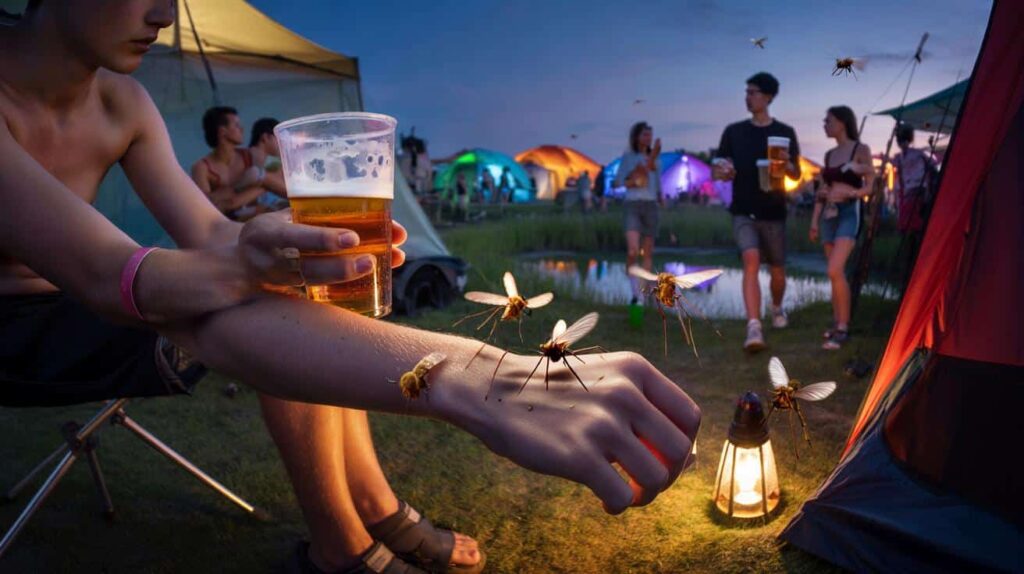
New research from the Netherlands suggests that your festival pint might be doing more than lifting your mood – it could be quietly turning you into a mosquito magnet.
Beer, bites and a Dutch field experiment
The study was carried out by a team at Radboud University in Nijmegen, who swapped their usual lab benches for a music festival in the Netherlands. They set up a temporary laboratory inside converted shipping containers during the annual Lowlands festival.
Nearly 500 volunteers took part. Each person answered questions about personal hygiene, diet and behaviour during the event. Then came the unnerving part: they were asked to place one arm into a cage filled with female Anopheles mosquitoes, a genus known for biting humans and transmitting malaria in some regions.

On the opposite side of the cage, researchers placed a sugar dispenser for the insects, providing an alternative to human blood. Cameras tracked how many mosquitoes landed on the exposed arm compared with those heading toward the sugar source.

People who had drunk beer in the previous 12 hours were 1.35 times more likely to attract mosquitoes than those who had not – about a 35% increase in risk.
The team published their findings on 26 August 2025 in the preprint repository bioRxiv, and the work has since drawn attention across the scientific community.
What beer does to your body that mosquitoes love
Alcohol already has a long list of effects on the body, from the brain and liver to the heart. The Dutch researchers argue that beer adds another, far itchier consequence, linked to changes in blood and skin.
The study suggests that regular beer consumption may make blood slightly richer in sugars and metabolites that can alter body odour. Those subtle changes are invisible to us, yet highly noticeable to mosquitoes.
Another key factor is heat and circulation. Alcohol causes blood vessels in the skin to dilate. That can make your skin feel warmer and sometimes look flushed.
Warmer skin and boosted blood flow can create a sharper “thermal signature”, making you stand out more clearly to a passing mosquito.
Australian mosquito specialist Nigel Beebe, from the University of Queensland, told reporters that alcohol can enhance both your heat profile and the chemical cues rising from your skin, making you an easier target for biting insects.
Why other alcoholic drinks might not have the same effect
The Dutch experiment focused on beer at a summer festival, not on wine, spirits or cocktails. While the researchers did not find a clear link between other alcoholic drinks and mosquito attraction in their data, they warn against over-reading that point.
Beer is often drunk in larger quantities, especially in hot outdoor settings, and usually contains more volume for a similar alcohol load. It might also interact differently with metabolism, gut bacteria and body odour compared with wine or spirits.
Researchers suspect a mix of factors:
- Greater volume of liquid consumed
- Changes in skin temperature and blood flow
- Altered scent compounds released through sweat
- Possibly sweeter blood chemistry after heavy beer drinking
All of this can add up to a more appealing target for a hungry mosquito searching for its next meal.
Not just beer: other habits that draw mosquitoes in
The festival study also looked at lifestyle behaviours alongside beer consumption. Using their custom-built experimental setup, the researchers noticed that certain patterns seemed to go hand in hand with more mosquito landings.
Mosquitoes showed a clear preference for people who skipped sunscreen, drank beer and shared a bed or tent.
People who did not use sunscreen appeared more attractive to the insects. One theory is that some sun creams might mask or interfere with human odours that mosquitoes use to locate us. Avoiding sunscreen could leave those chemical cues stronger and easier for insects to detect.
Sharing a bed or tent is another factor. Close sleeping quarters can trap carbon dioxide and body odours, creating a denser cloud of scent. Mosquitoes follow CO2 plumes like a trail. When multiple people are in one small space, that trail becomes more intense.

How mosquitoes choose their victims
Mosquitoes do not bite randomly. They use several signals to lock onto a host, including:
| Signal | What it is | How beer might affect it |
|---|---|---|
| Carbon dioxide | Gas we breathe out with every exhalation | Alcohol can alter breathing rate and patterns |
| Body heat | Warmth from skin and blood vessels | Vasodilation after drinking can raise skin temperature |
| Skin odours | Mix of chemicals from sweat and microbes | Metabolism of beer can change this chemical cocktail |
| Moisture | Humidity from sweat and breath | Alcohol may increase sweating in warm weather |
Different species respond to these cues in slightly different ways. The Anopheles mosquitoes used in the study rely heavily on odour and heat, which may explain why they responded so clearly to festival-goers who had been drinking beer.
Health stakes: it’s not just about itchy ankles
In northern Europe or the UK, mosquito bites are mostly an irritating side effect of summer. In parts of Africa, Asia and Latin America, they can carry malaria, dengue, Zika and other serious infections.
While this particular trial used an Anopheles species in a controlled setting, the findings raise broader questions about alcohol use, nightlife, and vector-borne disease in warmer regions.
In areas where malaria or dengue circulate, a night of heavy drinking could mean more bites and, potentially, a higher chance of infection.
Large gatherings such as festivals, beach parties or football celebrations often involve alcohol, crowded sleeping arrangements and limited attention to mosquito protection. That mix could make communities more vulnerable during peak mosquito seasons.
How to enjoy a drink without becoming a mosquito buffet
None of the researchers are calling for a blanket ban on beer. Their point is that certain behaviours can stack the odds against you. Putting a few extra measures in place can limit the damage.
Practical tips for beer fans in mosquito season
- Use a high-quality insect repellent on exposed skin, especially in the evening.
- Apply sunscreen during the day and reapply as directed, even if skies are cloudy.
- Wear long sleeves and trousers after sunset when possible.
- Limit the number of beers, particularly in hot, humid conditions.
- Sleep under a mosquito net if you are camping or staying in basic accommodation.
- Avoid leaving tents and cabin doors open with lights on, which draw insects in.
In regions with malaria or dengue, health agencies usually advise additional steps, including treated bed nets and, where available, vaccines against specific diseases like dengue.
Key terms and what they mean
A few scientific expressions in this story are worth unpacking.
Anopheles: A genus of mosquito containing many species, some of which transmit malaria. Only females bite, as they need blood to produce eggs.
Vasodilation: Widening of blood vessels. Alcohol often causes this in the skin, leading to warmth or redness in the face and limbs.
BioRxiv: An online platform where scientists share early versions of their studies before formal peer review. Findings on such servers are considered provisional until examined by other experts.
What this means for your next festival
Picture a typical summer festival: thousands of people, cramped tents, cheap beer and late nights. Add in ponds or fields nearby, and you have ideal mosquito breeding grounds plus plenty of warm, slightly tipsy targets.
If the Dutch study holds up in further research, organisers and public health teams might start treating mosquito control at large events more seriously. Simple changes – better drainage, insect screens around sleeping areas, awareness campaigns about repellent – could reduce both nuisance bites and any disease risk.
Your choice at the bar probably won’t define your fate, but that extra pint might be the difference between a peaceful night and a body full of red welts.

For now, the message is relatively straightforward: if you plan a night of beer in mosquito country, pack repellent alongside your reusable cup, and think twice before going bare-armed into the buzzing dark.
 It’s a real cancer nest”: doctor warns about hugely popular food that could endanger your health
