The man beside me on the subway is doing the usual: his phone at chest level, scrolling through TikTok, with headphones in, and a blue light illuminating his face. Across from him, a woman is tapping her iPhone to pay for coffee while responding to a Slack message with a quick thumb swipe. Nearby, a child plays Minecraft on a cracked screen, held together more with hope than glass. And then, there’s the bigger picture: Elon Musk, Bill Gates, and Mark Zuckerberg, three tech moguls who’ve likely looked at these moments and thought, “This is it. The smartphone era is coming to an end.”
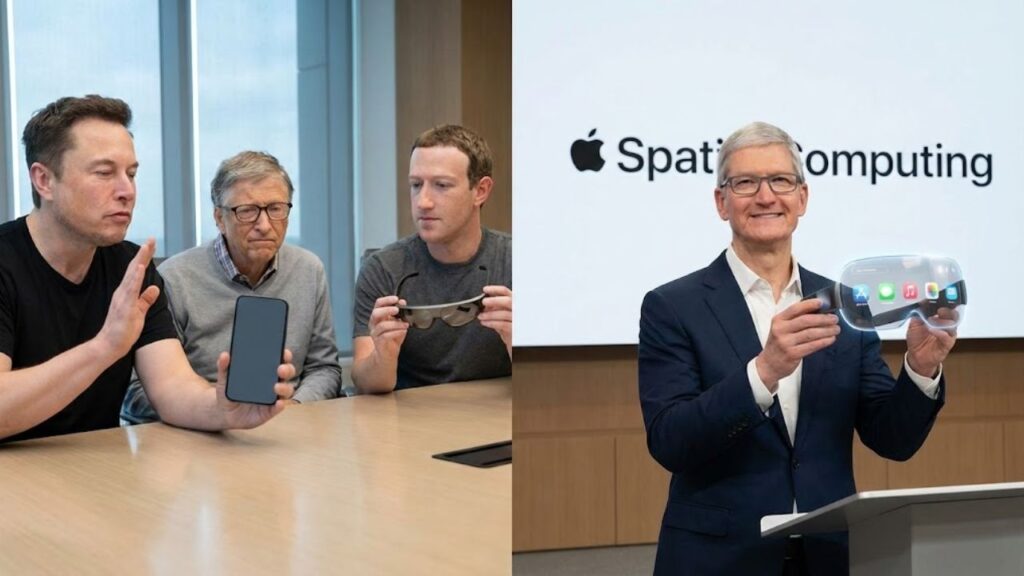
Meanwhile, in Cupertino, Tim Cook is observing the same scene, but instead of envisioning the phone’s demise, he’s reimagining its future.
The Tech Titans’ Vision of a Post-Smartphone World
Elon Musk has already moved on. He’s diving into neural interfaces, envisioning a world where typing with thoughts replaces typing with thumbs, and where screens become relics of the past. Bill Gates, meanwhile, predicts that the future lies not in another device, but in AI agents that accompany us everywhere, becoming as ubiquitous as smartphones once were.
Mark Zuckerberg is staking his claim on mixed reality, aiming to move beyond the smartphone screen into headsets and glasses, offering an experience that frees your eyes from the small, rectangular glass slab. Their message? The smartphone is already a nostalgic artifact of a bygone era.
What the Tech Giants Are Building vs. What They’re Saying
When you look at what these billionaires are investing in, it’s clear they are betting on a future beyond the phone. Musk’s Neuralink and his “everything app” vision signal a deeper integration of AI with technology, while Gates is backing ventures that focus on AI assistants managing our lives across different platforms. Zuckerberg’s shift towards Meta and virtual worlds further indicates that the smartphone is no longer the center of attention.
Their reasoning is simple. The smartphone market is saturated. Device upgrades are slowing, and every new launch feels like “a slightly better camera and a new color.” The focus is now on AI, wearables, cars with tablet-like interfaces, and ambient computing. The smartphone, they argue, is too limiting, too small, and too tied to the hands and eyes when Big Tech wants to immerse us in entire worlds. The real revolution is unfolding away from your pocket.
Tim Cook’s Quiet Revolution
In contrast, Tim Cook has a different strategy. While others proclaim the death of the smartphone, he’s busy turning the iPhone into the central hub of everything Apple creates. His keynotes make this clear. The iPhone is no longer just a phone — it’s the key to unlocking your Tesla, controlling your AirPods, managing your payments, storing your ID, and even connecting directly with AI models. Rather than letting the iPhone become obsolete, Cook is expanding its role into every aspect of daily life.
The iPhone: A Hub for Everything Apple
Take Apple Vision Pro, the new headset everyone compares to Meta’s goggles. On the surface, it seems like the “post-smartphone” device, but Apple’s message is clear in every demonstration: the Vision Pro works in tandem with your iPhone. Your photos, apps, messages, and passwords all sync through the familiar device.
Similarly, the Apple Watch started as a niche product but now serves as an extension of the iPhone, enhancing its capabilities. The more Apple introduces new gadgets, the more the iPhone remains the central, indispensable device that connects them all. Apple’s genius lies in this simplicity: they’re not reinventing the phone — they’re embedding it deeper into your life.
The Smartphone’s Resilience: Tim Cook’s Approach
From a business standpoint, Apple’s approach is straightforward. People are attached to their phones — they are the most personal gadgets we own. Apple understands that, even though we upgrade less frequently, we still rely on our phones for almost everything. They’ve built services, subscriptions, and accessories that enhance this essential device.
Apple also designs its technology to be invisible. We don’t think about our phone’s backups, password storage, or instant device pairings — they just work. This seamless integration makes the iPhone more indispensable, and Tim Cook’s goal is to ensure that it remains central to everything we do, even as new technologies emerge.
Adapting to the Future of Smartphones
So, where does this leave us? The smartphone isn’t going anywhere — at least not yet. But the devices we use alongside it are rapidly changing. Apple’s approach suggests that the future of tech will involve interconnected devices, all centered around the iPhone. The next time you purchase new tech, think about how it connects with your existing devices, particularly your phone. Make sure that your tech ecosystem is future-proof and can easily evolve with the times.
The “Dead Phone” Myth: What It Means for Consumers
Don’t fall for the hype of “the smartphone is dead.” Instead, focus on building a tech setup that will last. Choosing tech based on what you actually use and need, rather than jumping on the latest trends, will help you avoid clutter and unnecessary expenses. Stick with the phone you trust and invest in quality accessories that enhance its functionality. The smarter approach is to invest in tech that complements what you already use.
The Future of Phones: A Quiet Evolution
The smartphone is evolving, not dying. While tech giants race toward a post-phone world, Tim Cook is quietly embedding the phone deeper into our daily lives. The key takeaway is to design your digital life around your existing devices, ensuring they work together smoothly. No matter where technology goes, your phone will likely remain the centerpiece of your life for years to come.
Summary Table: Key Takeaways
| Key Point | Detail | Value for the Reader |
|---|---|---|
| Smartphone “death” is mostly about markets | Tech leaders seek a new platform, not because smartphones are useless, but because the next big boom lies elsewhere | Helps you understand the hype and the market trends driving these “end of the phone” proclamations |
| Apple treats the iPhone as a hub | Tim Cook’s strategy is to bind accessories, services, and apps around the iPhone as the central anchor | Guides your purchasing decisions towards devices and services that integrate well together |
| Your habits matter more than their roadmaps | Choosing technology based on your actual habits makes you more resilient to future shifts | Reduces digital clutter and the stress of chasing every new “post-phone” invention |