
The first time you watch a Martian sunset in real time, something feels off. The sky fades from butterscotch to blue, shadows stretch in strange ways, and your clock says one thing while your own sense of “a day” quietly disagrees. Engineers at mission control stare at their screens and realize their bodies are still on Earth time, but their workday has slipped into a 24-hour-and-39-minute loop.
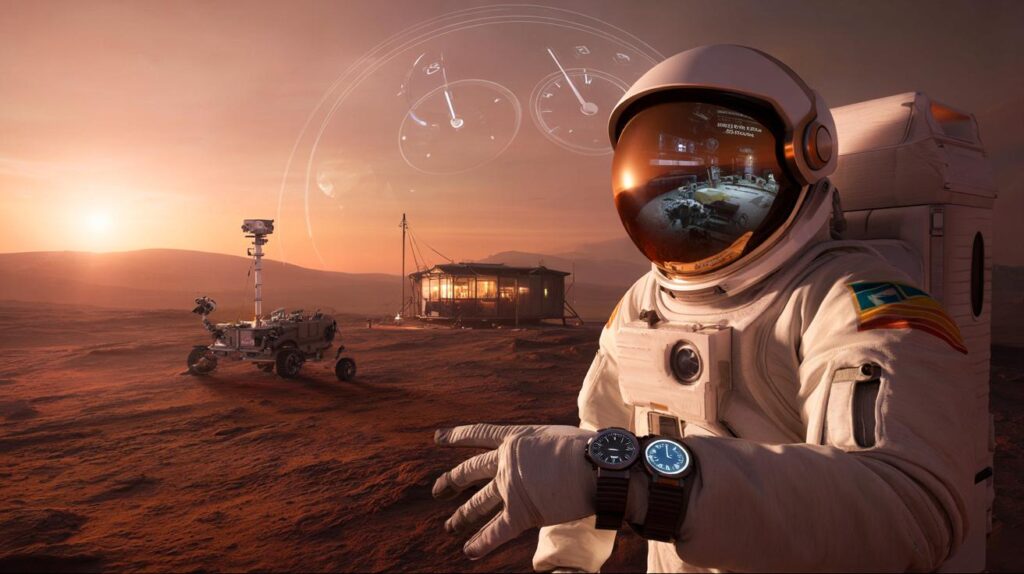
On Mars, the seconds tick almost the same. Yet the days refuse to line up.
Albert Einstein saw this coming on paper more than a century ago. Now the Red Planet is starting to prove it in the dust and data.

Einstein’s old thought experiment now lives on a cold red world
Einstein didn’t know what a SpaceX launch looked like or how a Mars rover would sound when its wheels first crunched alien soil. But he did know one thing: time is not a rigid, universal river. It bends with gravity, it stretches with speed, and it can run differently depending on where you stand in the cosmos.

For decades, this lived mostly in textbooks and lab demos. Atomic clocks flown on planes, GPS satellites that need constant adjustment to stay honest. Abstract stuff. Then NASA landed machines on Mars that had to work like clockwork, literally, and the numbers stopped being abstract.
Curiosity, Perseverance, InSight, the now-silent Opportunity and Spirit: each mission carried its own tiny laboratory of time. They tick through “sols”, Martian days longer than ours by 39 minutes. That tiny gap sounds trivial on paper. For human teams on Earth, it’s brutal.
During the early weeks of a rover mission, controllers switch to “Mars time”. Their workday shifts 40 minutes later every 24 hours. One week they start at 8 a.m., a few days later it’s midnight, then 3 a.m., then lunchtime again. People walk out of the control room into blinding sunlight with their brains screaming “3 a.m.”
Einstein’s relativity adds another twist. Mars has less gravity than Earth, and it orbits farther from the Sun. According to general relativity, clocks on Mars actually run a tiny bit faster than clocks on Earth, because they sit in a slightly weaker gravitational field. The effect is tiny, measured in fractions of microseconds. Yet for precision navigation and syncing spacecraft, that tiny lag or lead matters.
Time on Mars is like a watch that’s almost right, plus a day dial that doesn’t match your calendar. That double mismatch is why future missions must stop pretending “a day is a day” across planets.
Future Mars missions will have to bend their schedules, not the other way around
The most practical “method” for dealing with Martian time already exists, and it’s surprisingly low-tech. NASA teams have worn two watches: one set to local Earth time, another hacked to follow Mars time. Some used apps that stretched the 24 hours of a phone into 24 hours and 39 minutes. Alarm clocks went off when the rest of the city slept.
For future long-term crews, this can’t just be a quirky experiment. Habitats will likely run on a strict sol-based schedule, from power cycles to lab work to exercise. The trick will be syncing three worlds at once: Mars crew time, Mars base systems time, and Earth mission control time.

We’ve all been there, that moment when jet lag makes a normal day feel quietly impossible. Now imagine that, not for a week, but for years, on a world where stepping outside without a suit kills you. If planners ignore how time stretches between planets, fatigue and human error will creep in.
Early mission designers sometimes treated the 39 extra minutes like a harmless quirk. They learned fast. People burned out. Families couldn’t follow their loved ones’ schedules. Teams realized they needed shared calendars, blackout hours, nap rooms, and hard boundaries between “Mars time” tasks and Earth-time life. Let’s be honest: nobody really does this every single day without slipping.
One Mars architect I spoke with put it bluntly:
“Einstein gave us the warning label. We just assumed we could wing it. Now the data says: respect the clock, or the clock will break your mission.”
To turn that warning into practice, planners are starting to sketch simple tools:
- Dedicated “Mars clocks” in every control room, clearly separate from Earth time
- Rotating shifts that limit how long any person lives fully on Mars time
- Onboard AI assistants that auto-convert times between planets
- Communication windows planned around both planets’ circadian rhythms, not just radio delay
- Shared Mars/Earth calendars that visualize the slow drift between days
A planet where time itself becomes part of the adventure
If you zoom out, Mars is forcing us to admit something uncomfortable and beautiful at the same time. Our sense of a day, of a year, of “now”, is provincial. It belongs to this blue rock, to this gravity, to this spin. On the Red Planet, a sunset lasts longer, the stars rise slower, and a “workday” stretches into unfamiliar shapes. *Even our bodies will have to renegotiate what morning and night mean.*
Einstein predicted the math. Mars is delivering the human story. As samples come back from the Mars Sample Return campaign, they’ll carry not only rocks from another world but timestamps that never quite overlap with ours.

The question hanging in the air is simple, and also not simple at all: when humans finally live on Mars, will they feel like they live in the same century as us, or a slightly different one? That quiet, almost invisible drift in time might be the first true frontier we cross long before we plant a permanent city in the dust.

| Key point | Detail | Value for the reader |
|---|---|---|
| Einstein’s prediction on time | Time changes with gravity and speed; Mars’s weaker gravity and longer day twist our usual clocks | Gives a simple way to understand why time feels “off” on Mars |
| Mars missions already feel it | Rover teams live on 24h 39m “sols”, suffering shifting work hours and fatigue | Shows that this is not theory but a real challenge shaping space jobs |
| Future crews must adapt | Custom clocks, smarter schedules, and AI tools will sync Earth and Mars time | Helps imagine how everyday life in space will actually work for humans |
FAQ:
- Does time really flow faster on Mars than on Earth?
Very slightly, yes. Because Mars has weaker gravity and is farther from the Sun, relativity predicts that clocks there tick a tiny bit faster. The difference is incredibly small, but for precise navigation and long missions it has to be accounted for in the math.- Is the main problem the 39 extra minutes in a Martian day?
For humans, yes. That extra 39 minutes pushes crew schedules later each sol, causing “time drift” and something like rolling jet lag. For instruments and software, it’s mainly a matter of converting between Earth days and Martian sols without mixing them up.- Will future Mars colonies use Earth time or Mars time?
Most experts expect local Mars time to dominate daily life: wake up, work, and sleep cycles tied to the Martian sunrise and sunset. Earth time will still be used for coordination with mission control, international agreements, and maybe trade or communication windows.- Has any mission already used Einstein’s relativity for Mars operations?
Yes. Every deep-space mission, including those to Mars, uses relativity corrections when plotting trajectories and syncing clocks. Space agencies quietly fold Einstein’s equations into their software so spacecraft don’t drift off course over millions of kilometers.- Could people adapt permanently to a 24h 39m day?
Some studies suggest many humans might adapt reasonably well, since it’s not radically different from Earth’s day. The challenge is less the length itself and more the early years, when crews must also coordinate with Earth-based teams still locked to 24-hour days.
