Now a Canadian jet has done something few thought worthwhile after Concorde: race just below Mach 1, while still behaving like a practical, everyday business aircraft.
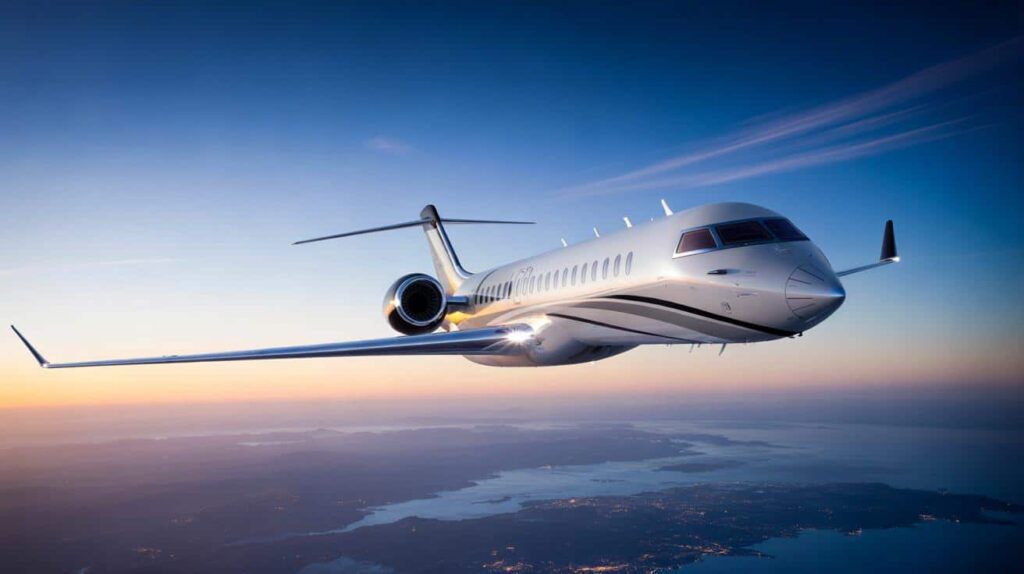
Bombardier’s Global 8000 flirts with the sound barrier
Bombardier’s new Global 8000 has officially become the fastest civil aircraft in service since Concorde, with a certified maximum speed of Mach 0.95. That is around 1,155 km/h at cruising altitude, or roughly 717 mph.
Mach 0.95 makes the Global 8000 the quickest certified civil aircraft of the post‑Concorde era, without crossing into supersonic flight.

Engineers have chased these numbers for decades. As an aircraft approaches Mach 1, it enters the tricky “transonic” regime. Local airflow over parts of the wing and fuselage can briefly turn supersonic, generating shock waves. Those shocks spike drag, disturb lift and demand far more power for tiny gains in speed.

The Global 8000’s pitch is simple: get as close as possible to that wall, without going through it. That choice neatly avoids today’s restrictions on supersonic flights over land and the punishing fuel burn that killed Concorde’s business case.
A triple certification that turns a prototype into a product
The Global 8000 is no experimental one‑off. It has cleared the three main regulatory hurdles that matter for global operations.
- Canada: Transport Canada certification in November 2025
- United States: FAA certification in December 2025
- Europe: EASA certification in early 2026
Each agency runs its own demanding safety assessments, covering structure, systems, engines, avionics, noise and performance. Together they form the backbone of global airworthiness standards.
Triple certification means the Global 8000 is not a tech demonstrator; it is a fully approved business jet that can operate almost worldwide.
That matters for the ultra‑wealthy and corporate operators who expect to fly from New York to Geneva one week and from Dubai to São Paulo the next, without paperwork headaches.
Who is Bombardier, the company behind the record
Bombardier is a Canadian aerospace manufacturer with deep, and sometimes turbulent, roots. The company entered aviation in earnest in the 1980s when it bought Canadair, later adding regional turboprop maker de Havilland and several other aviation assets.
By the 2000s Bombardier had become one of the world’s major aircraft builders, selling Dash 8 turboprops, CRJ regional jets and a growing range of business jets. Then the CSeries – a bold new small airliner – almost sank the group. Cost overruns, trade disputes and a harsh post‑9/11 market pushed Bombardier to the brink.
Between 2018 and 2020, the company sold its CRJ programme, its Q400 turboprops and, crucially, handed the CSeries to Airbus, which now sells it as the A220. That painful retreat left Bombardier focused entirely on high‑end business jets: the Challenger and Global families.
Today, Bombardier is smaller but much more specialised. The Global 8000 is, in many ways, the proof that the pivot to business aviation can still produce attention‑grabbing technology.
Range that rivals airliners, comfort that targets boardrooms
Paris–Singapore in one hop
The Global 8000’s party trick is not only speed. It also offers an advertised range of 8,000 nautical miles, about 14,800 kilometres, with a typical passenger load.
That range covers pairs such as Paris–Singapore, Los Angeles–Sydney or London–Buenos Aires without a refuelling stop.
Ultra long-haul capability gives operators flexibility: they can treat almost any two financial centres on the planet as a single‑leg trip. That saves fuel on take‑off and climb, saves airport fees and, above all, saves time.
A four‑zone cabin aimed at serious work and sleep
Inside, Bombardier leans heavily on the idea of a “true four‑zone” cabin. The aircraft’s interior can be divided into distinct areas for work, dining, relaxation and full‑flat sleeping.
On paper, that sounds like marketing jargon. In practice, it matters because ultra long‑haul missions can last 15 hours or more. Passengers want to hold confidential meetings, stream video conferences, eat at a normal table, then close a door and sleep in something that actually feels like a bedroom.
The cabin floor area is about 16.6 square metres, comparable to rivals, but Bombardier claims careful layout and low cabin altitude leave passengers feeling less jet‑lagged on arrival.
A wing that changes personality with speed
Smooth Flex Wing: lift at low speed, efficiency near Mach 1
The Global 8000’s wing is one of its quiet stars. Bombardier calls it Smooth Flex Wing: an aeroelastic design that subtly changes shape with speed and load.
At low speeds, such as take‑off and landing, the wing favours high lift and stability. That keeps runway requirements relatively short, letting the aircraft use smaller airports closer to city centres or remote industrial sites.
At high speeds in the transonic range, the wing shifts its behaviour. It aims to delay the onset of shock waves and reduce drag, protecting performance as the aircraft pushes towards Mach 0.95.
 France moves to lock in control of a crucial battery material Europe’s carmakers can’t live without
This wing technology helps the Global 8000 achieve near‑light jet take‑off and landing performance while running at near‑sonic cruise speeds.
Bombardier claims that, thanks partly to this wing, the jet can access roughly 30% more airports compared with some competitors in its class, widening the network of usable destinations.
Cockpit designed for marathon flights
Up front, the Vision Flight Deck is built around a full fly‑by‑wire architecture. Pilot inputs are interpreted by computers which then move the control surfaces, instead of direct mechanical linkages.
This allows the aircraft to filter out turbulence, harmonise responses and ease pilot workload, particularly during long, high‑altitude cruise segments. Design teams drew on thousands of hours of test flying and feedback from crews of previous Global models.
On ultra long missions, cognitive fatigue is a real safety concern. A tidy, intuitive cockpit and consistent handling characteristics can make the difference between a crew arriving merely tired and arriving exhausted.
Breathing easier at 40,000 feet
Cabin air as a selling point
Bombardier’s marketing leans on air quality, too. The Global 8000 uses a system called Pũr Air, which combines a hospital‑grade HEPA filter with an activated carbon filter.
- HEPA filtration traps 99.99% of particles such as dust and many microbes
- Carbon filtration helps remove odours and volatile organic compounds
- High air‑exchange rates refresh the cabin more often than on typical airline flights
On a 14‑hour flight, cleaner and drier air can genuinely influence how passengers feel at the other end. Fewer headaches, fewer sore throats, and marginally better hydration all add up, especially for people who do this every week.
A crowded race for ultra long‑range dominance
How the Global 8000 stacks up against rivals
The Global 8000 does not have the sky to itself. Gulfstream and Dassault are pushing hard in the same segment, with a focus on comfort and efficiency rather than raw speed.
| Aircraft | Range (km) | Max speed (Mach / km/h) | Cabin (m² / zones) | Price (M€) | Engines (kN ×2) |
| Global 8000 | 14,816 | 0.95 / 1,155 | 16.6 / 4 | 74 | GE Passport (84.2) |
| Gulfstream G700 | 13,890 | 0.935 / 1,135 | 17.1 / 4 | 72 | Rolls‑Royce Pearl 700 (81.2) |
| Falcon 10X | 13,890 | 0.925 / 1,125 | 16.1 / 4 | 69 | GE Passport (84.2) |
| Gulfstream G800 | 14,816 | 0.925 / 1,125 | 17.5 / 4 | 74 | Rolls‑Royce Pearl (81.2) |
| Global 7500 | 14,264 | 0.925 / 1,125 | 16.6 / 4 | 67 | GE Passport (84.2) |
The Global 8000 edges ahead on speed and matches the very best on range, but pays for it in complexity and price. For buyers, the decision often comes down to network, cabin feel, and trust in the support ecosystem as much as raw numbers on a spec sheet.
A different philosophy from supersonic icons
Why not just go supersonic again?
For nostalgic aviation fans, nothing will quite replace Concorde. Yet, the economic and regulatory landscape has changed. Sonic booms remain tightly restricted over land, and airlines are under pressure to curb emissions per passenger‑kilometre.
Supersonic cruise demands engines that guzzle fuel and airframes built with expensive materials to handle heat and stress. That can work for military jets or experimental projects, but it is a much harder sell for corporate fleets and charter operators whose clients expect predictable costs.
The Global 8000 trades the romance of supersonic flight for high‑subsonic practicality: fast enough to matter, still slow enough to be legal and commercially viable.
Several start‑ups still promise future supersonic business jets. For now, though, the aircraft actually being delivered to customers are the ones that work within current air traffic rules and airport infrastructure.
What Mach numbers mean in real life
How much time does Mach 0.95 really save?
On a flight of 10,000 kilometres, the difference between Mach 0.90 and Mach 0.95 may look small on paper, but it can trim up to 30–40 minutes from the journey, depending on winds and routing.
For an individual traveller, that is a slight perk. For a business that routinely shuttles executives across continents, those slices of time add up across a year. Faster aircraft also give more margin when delays stack up on the ground or in congested airspace.
There is a trade‑off: flying closer to Mach 1 often burns more fuel. Manufacturers claim improved aerodynamics and engine efficiency offset much of that penalty, but operators will watch real‑world data closely once a fleet of Global 8000s has accumulated thousands of hours.
Risks and future pressures
Jets like the Global 8000 sit in an uncomfortable spotlight as climate scrutiny rises. Even if they carry advanced engines and occasionally use sustainable aviation fuels, they move small numbers of people at high speeds with significant emissions per passenger.
Regulators may tighten noise and emissions limits over the next decade. That could push manufacturers to tweak designs or limit some of the speed advantage. On the other hand, business jets often act as early adopters for new technologies, from advanced composites to hybrid power systems, which later filter into commercial airliners.

For now, Bombardier has planted its flag: in the age after Concorde, the fastest way to cross continents without breaking the sound barrier is a €74‑million business jet aimed squarely at those for whom time is money in its purest form.