
What began as routine metal detecting in a ploughed field near Åndalsnes ended with a small bronze figure in the palm of a man’s hand — and a flurry of phone calls to archaeologists who now believe the site may rewrite part of Norway’s medieval story.
A long day in the field that changed course at the last minute
On the outskirts of Åndalsnes, in western Norway, hobby detectorist Kim Erik Fylling Dybvik was close to packing up. The field had already been swept for hours, the light was fading, and the finds so far were modest.
Then his detector gave a clear, insistent signal just a few centimetres below the freshly turned soil. Expecting yet another scrap of modern metal, he dug quickly. Instead, a slim silhouette began to form in the dark earth.

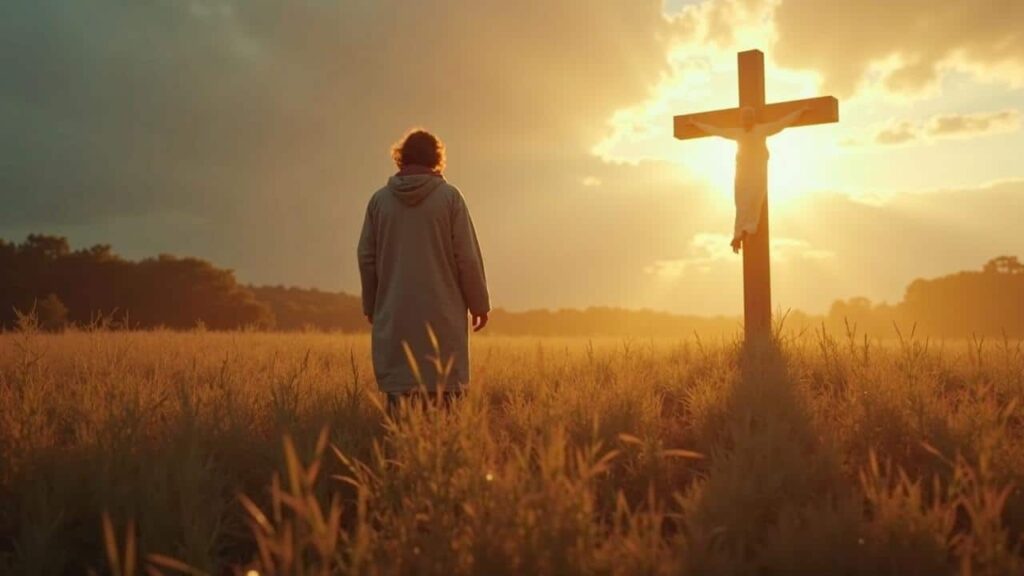
In his hand lay a 15-centimetre bronze figure of Jesus, arms open, face and torso still glinting with traces of medieval gilding.

Dybvik, who has spent more than a decade walking Norwegian farmland in search of historical objects, instantly understood he was looking at something exceptional. The figure was intact. No broken limbs. No crushed head. Just gentle wear and a faint golden sheen catching the oblique autumn light.
A medieval Jesus in a “well-known” landscape
At first glance, the landscape around Åndalsnes looks uneventful: a working field, a familiar valley, modern machinery parked nearby. Yet the small statue suggests that this apparently ordinary ground once held deep religious meaning.
Local expert Bjørn Ringstad, a former regional curator, estimates the piece dates from the 12th or early 13th century. That places it in the high Middle Ages, when Christianity had taken firm root in Scandinavia but still mingled with older traditions.
That time period matters. It was an era of church building, travelling clergy and shifting political alliances. Religious objects circulated across long distances, carried by merchants, priests and pilgrims along the coast and through the fjords.
The statue connects a modern farmed field to a moment when western Norway was plugged into wider European religious and artistic networks.
Not an isolated find
The Jesus figure is not the only object to emerge from this field. Just days earlier, detectorists had uncovered a Viking-age brooch on the same land. On the afternoon of the statue’s discovery, they also found several silver coins and at least seven metal buttons.
- A Viking brooch suggesting activity in the centuries before Christianisation
- Silver coins pointing to trade or regular movement of people
- Buttons and small fittings hinting at clothing, gatherings or repeated visits
For archaeologists, this scatter of finds tells a story of continuity. People used this place in the Viking Age, kept returning through the medieval period, and left behind the detritus of everyday life alongside sacred objects.
From muddy field to university lab
Once Dybvik realised what he had uncovered, he did what seasoned detectorists in Norway are strongly encouraged to do: he notified the authorities and handed over the object.
The statue was first taken to Molde, the nearest regional centre, before being transferred to the cultural heritage department at the Norwegian University of Science and Technology (NTNU) in Trondheim.
Conservators will analyse the alloy, the gilding technique and any microscopic traces of paint or fabric that may still cling to the surface.
These technical details can answer key questions. A high tin content, for instance, might point to specific medieval workshops. Certain gilding methods could indicate whether the piece followed English, German or local Scandinavian models.
What was the statue used for?
Researchers are weighing up several possibilities for its original function:
- Part of a processional cross carried during religious ceremonies
- A figure fixed to a portable altar used by travelling priests
- A personal devotional object owned by a wealthy cleric or landowner
Its size, detail and hints of fine gilding suggest it was not a cheap trinket. The open arms and frontal pose match common medieval depictions of Christ meant to be clearly visible to a small crowd or worshipper kneeling in front of an altar.

A field that may hide a lost church
The location of the find raises further questions. Historical sources mention an old religious site in the area, but visible remains have long since disappeared under agriculture and modern development.
With several medieval and early finds now confirmed, local authorities are considering a full geophysical survey of the field. Ground-penetrating radar, often called a georadar, can pick up buried walls, ditches and foundations without breaking the soil.
| Method | What it can reveal |
|---|---|
| Ground-penetrating radar | Hidden stone foundations, graves, ditches |
| Magnetometry | Burnt areas, hearths, metal-working zones |
| Drone-based mapping | Subtle surface depressions or raised platforms |
If a rectangular foundation or an apse-shaped end appears on the scans, that would strongly suggest a church. A cluster of graves aligned east–west would strengthen the case for a sacred site rather than a simple farmstead.
What looks like a “normal” field today may sit directly over a forgotten medieval parish centre.
The ethics and risks of metal detecting
Dybvik insists he has no interest in selling what he finds. For him, the value lies in rescuing objects before ever-larger machines destroy them. That attitude aligns with Scandinavian heritage laws, which generally require significant finds to be reported and handed to the state.
Not all detectorists behave the same way. Unreported finds and illegal digging can strip a site of context, making it much harder for archaeologists to reconstruct what actually happened there. A statue on its own is striking; a statue in a documented layer surrounded by other objects becomes historical evidence.
Responsible detectorists usually follow a few key practices:
- Get permission from landowners before searching
- Record exact find spots with GPS or phone apps
- Stop digging if they hit structural remains like stone walls
- Contact local museums or heritage offices quickly after a major discovery
How a 15-centimetre statue can reshape a map
Behind the headlines about a “farmer seeing Jesus” in his field lies a quieter, technical story about how single objects can alter archaeological maps.
Norwegian medieval studies rely on a mix of written sources, standing churches and scattered artefacts. Many valleys and coastal pockets are still blank or thinly documented. A high-quality religious object like this statue can act as a pin on the map, suggesting that priests, processions and perhaps local pilgrimages once passed through this very place.
If future excavations confirm a church or chapel, that will have knock-on effects for how historians understand settlement patterns, land ownership and religious influence along the fjord in the 1100s and 1200s.
What “gilded bronze” actually means
For non-specialists, the phrase “gilded bronze” can sound abstract. In practice, a medieval craftsman would first cast the figure in bronze, a mix of copper and tin, sometimes with traces of lead. Then he would apply a thin layer of gold to selected areas, such as the face, chest or halo.
This gave the object a warm, luminous quality in candlelight without the cost of solid gold. Over centuries, much of that outer layer corrodes or flakes away. The fact that Dybvik’s find still shows visible gilding suggests it has avoided heavy damage from ploughs and fertilisers, staying just deep enough — and just lucky enough — to survive until now.
The distance between loss and survival, in this story, was measured in only a few centimetres of soil.
As the statue undergoes careful study in Trondheim, the field outside Åndalsnes will keep producing crops. At first glance, nothing has changed. Yet for archaeologists quietly adjusting their maps, and for one man whose metal detector beeped at just the right moment, that landscape will never look quite the same again.
 Meteorologists warn early February may trigger an Arctic breakdown with global implications
