The bartender was discussing UFOs when the person next to him casually mentioned, “We’re clearly in a simulation. Look at the glitches—Mandela effect, déjà vu, TikTok filters… we’re NPCs with Wi-Fi.” Some laughed, a woman nodded too seriously, and for a moment, the room felt like a video game loading screen. Outside, traffic lights switched from red to green as if an invisible coder was pressing buttons, and someone’s phone buzzed with a deepfake ad promising “AI-designed happiness.”
Ever felt that flicker, that sense that reality is a bit… off?
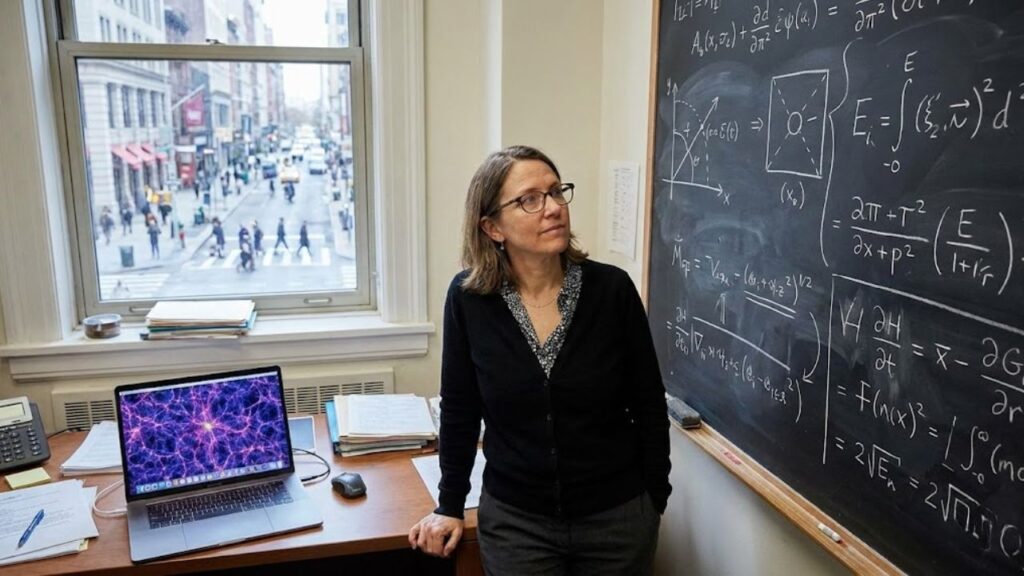
Now, a few mathematicians and physicists are quietly dismantling that fantasy with some cold, hard math.
The Cold Math That Dismantles the Cosmic Simulation
Scroll through social media for a few minutes, and you’ll come across the meme suggesting our lives are merely code running on a post-human server. It’s as comforting as a conspiracy theory and has the allure of a Marvel movie. You might blame the blue light and endless feeds, but the simulation theory resonates because it offers a neat explanation for life’s oddities.
However, some very serious individuals, armed with complex equations, are now arguing that this idea is not just unlikely—it’s impossible.
Take one specific hurdle: simulating quantum physics. Our universe doesn’t function like a clean, orderly spreadsheet; it behaves like a chaotic orchestra where every instrument can play multiple notes at once. To track this exactly, the required computing power grows exponentially with each added particle. We’re not talking about a “big data center”; we’re talking a system larger than the universe being simulated itself.
One line of research suggests that to simulate the universe in perfect detail, the simulator would need a memory system larger than the thing it’s simulating. Imagine needing a library bigger than Earth just to store a copy of Earth.
Why the Simulation Fantasy Doesn’t Hold Up
Many simulation theories operate on the idea that reality can be compressed like a .zip file: redundant elements are stripped away, and only patterns are stored, with the rest filled in as needed. But according to quantum information theory, the universe doesn’t cooperate. Every piece of space holds vast amounts of information, all intertwined in ways that can’t be simplified or skipped.
Here’s the bottom line: **reality seems too information-dense to replicate perfectly**.
Despite this, the simulation story persists. Elon Musk brings it up in interviews. Teenagers discover Nick Bostrom’s argument and feel too self-aware to focus on homework. Sci-fi from The Matrix to Rick and Morty wraps the idea in action and humor. The thought that “this is all code” offers some psychological relief—it suggests your failures don’t matter as much if you’re just part of a side quest in a cosmic RPG.
The New Mathematical Findings and Their Grounding Message
The new mathematical research doesn’t just show the flaw in the simulation theory—it challenges the underlying assumptions that make it feel comforting. The idea of compressing everything into a tidy program falls apart when you apply basic rules of physics and information theory. The math indicates that a perfect simulation of the universe would collapse under its own weight.
If life isn’t a simulation, how should we live with the real thing? The mathematicians shutting down the simulation hypothesis are subtly offering us an important message: this is **not test code**. This is the production server, the one reality we have.
That doesn’t mean you need to live with extreme intensity, trying to make everything Instagram-perfect. Instead, it could mean making smaller, more meaningful choices: answer that message, take a walk without distractions, or actually taste your coffee. These moments matter because they’re happening in the one reality we get.
Living in a Non-Simulated World
One trap when the simulation theory fades is the philosophical void that often follows. Without the comforting idea of a higher power “running” everything, you might start questioning who’s watching, who’s in charge. The honest answer from physics is: probably no one. But that realization doesn’t need to be a source of anxiety. It can be liberating. Instead of waiting for unseen programmers, you get to determine your own criteria for a fulfilling life.
| Key Point | Detail | Value for the Reader |
|---|---|---|
| Math vs. Simulation | Quantum information and complexity theory suggest a perfect universe-sim would require impossible resources. | Helps you read bold simulation claims with a sharper, calmer eye. |
| Why the Idea Seduces Us | It offers a tidy story, a hidden designer, and an excuse when life feels chaotic or unfair. | Lets you see your own attraction to the Matrix fantasy without being ruled by it. |
| Living in a Non-Sim World | If this is the only run, small, grounded choices gain real weight and meaning. | Encourages you to engage with your life as something real, not rehearsal. |