You’re brushing your teeth, still half-asleep, while your mind is already running through worst-case scenarios. The email left unanswered. The meeting that could derail. The car that might fail, the school calling “any moment.” By the time you rinse, your heart is beating a little too fast for 7:13 a.m.
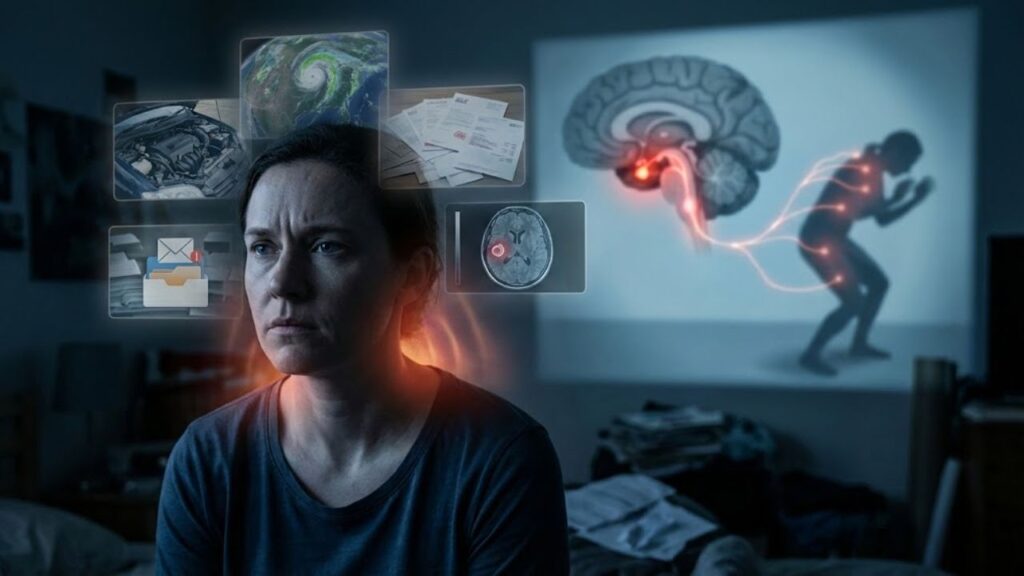
Nothing bad has happened yet.
But your body is reacting as if it already has.
Psychologists say this quiet mental habit — constantly asking “what if everything goes wrong?” — slowly reshapes the brain. Day after day, the mind stops living in the present and starts existing inside a permanent emergency mode.
You’re not being dramatic.
Your nervous system truly believes it’s under threat.
When your mind lives ahead, your body stays on alert
Psychologists often refer to this pattern as anticipatory anxiety: the brain’s tendency to replay worst-case scenarios on a continuous loop.
From the outside, everything looks fine. You respond to messages, arrive on time, smile when expected. Inside, a silent alarm keeps ringing: this could fail, that might break, someone could get hurt.
The brain doesn’t clearly separate a real danger from an imagined disaster. It only detects a perceived threat — and activates the same survival response each time.
When that switch stays stuck on “danger”, the cost is exhaustion.
- With 337 metres and 100,000 tonnes, the world’s largest aircraft carrier dominates the oceans
- A microfiber cloth and a simple homemade solution can revive old wooden furniture, restoration experts say
- A major polar vortex disruption is reportedly forming, with February intensity rarely seen in modern records
- A common household product cleared blocked pipes, leaving repair workers stunned
- Feeling emotionally alert all the time is linked by psychology to hypervigilance
- A Chinook salmon returns to its native California river for the first time in 100 years
- The breakfast cardiologists prefer to support heart health
- A Nobel-winning physicist says Elon Musk and Bill Gates may be right: more free time, but fewer jobs
Picture Léa, 34, a project manager with two children. She wakes already cataloguing problems: traffic, deadlines, the chance the babysitter cancels, the client who “seemed annoyed” yesterday.
By 10 a.m., she’s checked every file three times and rewritten emails “just in case.” Her heart is racing long before any real crisis appears.
At night, she scrolls through headlines, searching for signs the economy is collapsing or her job might disappear. One alarming story turns into three, all under the label of “staying informed.”
She falls asleep imagining disasters and wakes with a tight jaw and aching shoulders. Her body never registered that she was safe in bed.
Psychologists explain that constant anticipation keeps the amygdala — the brain’s threat detector — in overdrive. This small structure scans for danger, and when trained by chronic worry, it starts finding threats everywhere.
Stress hormones remain slightly elevated. Cortisol never fully drops. Muscles stay tense, breathing stays shallow, sleep stays light. Over time, that “slightly” becomes normal.
The prefrontal cortex, responsible for reasoning and planning, gets overridden by emergency signals. Instead of clear thinking, it over-plans, over-controls, and over-analyses.
You’re not simply careful. You’re living as if something is about to explode — constantly.
How to gently signal that the emergency has passed
Psychologists aren’t telling people to “just stop worrying.” That idea doesn’t work.
What they often recommend instead is a small, concrete habit: scheduled worry time. Choose a 10–15 minute slot each day, at the same time and place. During that window, write down every “what if” without filtering.
Outside that time, when a new fear appears, you tell yourself: “Not now.” You park it and return to it later.
This repetition trains the brain to move from constant background alarm to a contained, predictable outlet.
A common mistake is treating every imagined scenario as if it’s already happening. We open dozens of mental tabs and then wonder why we feel overwhelmed.
Psychologists often see vigilance confused with responsibility. If people stop scanning for danger, they fear they’re being careless. So the brain stays on surveillance duty 24/7.
No one maintains that level of alertness without a cost.
Over time, hyper-responsibility turns into self-distrust. You stop believing you’ll cope if something goes wrong, so you try to prevent everything from going wrong. That battle never ends.
Psychologist and researcher Luana Marques puts it simply: the issue isn’t protection — it’s when every email, silence, or unknown is treated like a tiger in the room.
- Micro-pause ritual: Before opening a stressful message, exhale slowly and feel your feet on the floor
- Reality check: Ask whether the problem is real now or just being mentally rehearsed
- Safe-enough plan: Create one workable plan and one backup, then stop
- Media limits: Step away from doom-scrolling at least two evenings a week
- Body signals: Notice where anticipation shows up — jaw, chest, stomach — and treat it as an early signal
Helping your brain remember what safety feels like
Leaving survival mode doesn’t mean fear disappears. Fear has a purpose. The shift happens when it no longer runs the entire day.
Psychologists often notice something subtle when people stop constant anticipation. Life doesn’t suddenly become easy — but ordinary moments become noticeable again.
Drinking coffee without replaying an argument. Walking the dog without rehearsing conflict. Listening without drafting tomorrow’s checklist.
When the brain isn’t spending all its energy on imagined emergencies, it reconnects with real life.
That quiet return — laughing without scanning for danger — may be the clearest sign your nervous system has finally stood down.
- Anticipatory anxiety: Constant “what if” thinking keeps the brain in survival mode, explaining ongoing exhaustion
- False control: Over-planning feels responsible but erodes trust in your ability to cope
- Simple resets: Small rituals can lower internal alarms and improve presence and sleep