The concept is both straightforward and ambitious: eliminate plastic burning, reduce toxic fumes, and transform waste into valuable resources. A cutting-edge plasma torch technology developed by South Korean researchers aims to achieve this goal—and it may revolutionize our approach to recycling.
Why Traditional Plastic Recycling Isn’t Enough
Many people believe they are contributing to recycling efforts by rinsing yoghurt pots and sorting plastic bottles. However, the reality behind the scenes is much less clean than the colorful bins suggest.
Conventional recycling relies primarily on two methods: mechanical recycling and incineration. Mechanical recycling, which involves cleaning, shredding, melting, and reshaping plastics, works well for certain types of plastics, but it typically degrades with each cycle. The quality of recycled plastic diminishes over time.
When plastics are heavily mixed, dirty, or degraded, they often end up being incinerated. While some facilities use this process to generate energy, it comes with a significant trade-off: greenhouse gases and potentially harmful emissions.
Another method, already in use on a smaller scale, is pyrolysis. In this process, shredded plastic is heated to around 600°C in the absence of oxygen, breaking it down into oils, gases, and solid residues. While some of this output can be converted into fuel or chemicals, it still results in low-value byproducts and carbon emissions.
Despite the “recyclable” label, only a small fraction of plastic returns as high-quality material. Most ends up being downcycled, burned, or buried.
South Korea’s Plasma Torch Breakthrough: A “World First”
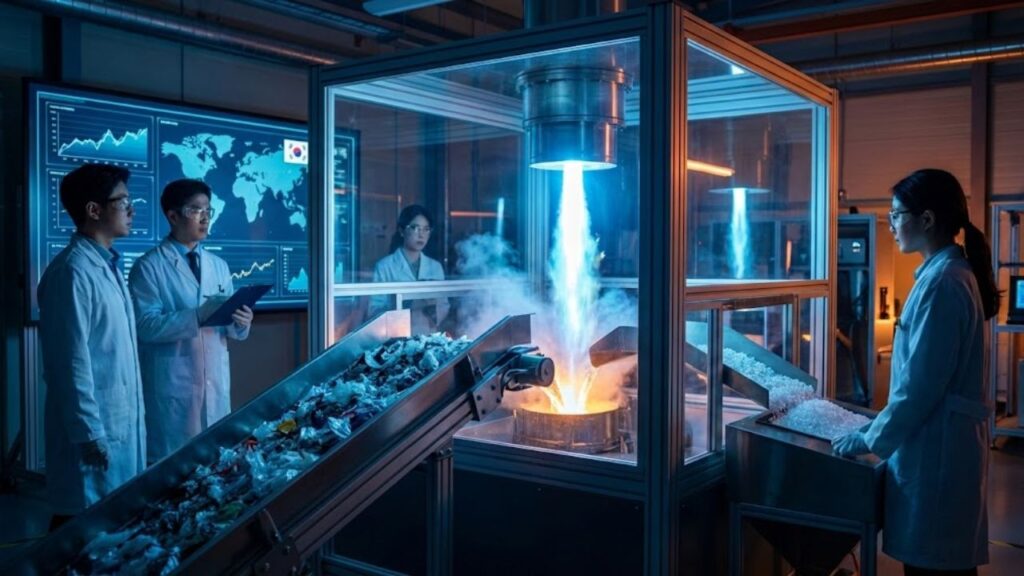
Researchers at the Korea Institute of Machinery & Materials (KIMM) claim to have advanced chemical recycling by several steps. Their plasma-based system targets mixed plastic waste—the type that typically ends up in incinerators or landfills.
The key claim: the technology can convert mixed plastic waste into valuable chemical building blocks in a single, ultra-fast process. According to KIMM, this is the first demonstration of such a conversion using a plasma torch at this level.
Mixed plastic waste can now be converted into usable raw materials “successfully,” marking what KIMM describes as a world-first achievement.
How Plasma Torch Technology Works: Breaking Down Plastic in Milliseconds
Plasma, often referred to as the “fourth state of matter,” is a superheated, ionized gas where atoms lose their electrons, creating a highly energetic environment.
In KIMM’s system, a plasma torch directs this ionized gas at temperatures ranging from 1,000°C to 2,000°C—much hotter than conventional pyrolysis. When mixed plastic waste encounters this jet, its long polymer chains break apart almost instantly.
According to KIMM, the plastic destruction occurs in just 0.01 seconds. The process doesn’t merely burn the waste; it disassembles it into smaller chemical molecules.
From Waste to Valuable Chemicals: Benzene and Ethylene
Instead of producing ash or low-grade fuel, the plasma torch system generates two highly valuable chemicals: benzene and ethylene, key components of the petrochemical industry.
Ethylene is a precursor for many plastics, such as polyethylene used in bottles, films, and bags. Benzene is essential for producing various materials, including synthetic fibers, resins, and rubber components.
The process transforms plastic waste into benzene and ethylene, core ingredients for creating new plastics without extracting fresh fossil resources.
If scaled, this technology could allow chemical plants to “feed” on plastic waste instead of crude oil or natural gas for part of their production.
A Step Toward Low-Carbon Recycling
KIMM researchers emphasize the importance of both the input and output of the process. The plasma torch is powered by hydrogen, not just fossil-based electricity or gas.
If this hydrogen is produced through low-carbon methods, such as electrolysis powered by renewable energy, the overall environmental impact of the recycling process could significantly decrease.
Comparing Recycling Methods: Pros and Cons
| Recycling Route | Main Output | Main Issues |
|---|---|---|
| Incineration with energy recovery | Heat, electricity | CO₂ emissions, toxic fumes, loss of material |
| Conventional pyrolysis | Oils, gases, residues | Mixed-quality products, high carbon footprint |
| Plasma torch (KIMM) | Benzene, ethylene | Needs large-scale validation, high energy demand |
Does This Solve the “Recycling Myth”?
Environmental groups have long argued that plastic recycling has been overhyped. A 2022 Greenpeace report, for instance, challenged the idea that recycling alone could solve the global plastic crisis, highlighting low recycling rates and continued growth in plastic production.
The Korean breakthrough does not provide an instant solution to these concerns. Turning waste into chemicals is only one piece of the larger puzzle. Questions remain regarding the technology’s costs, long-term performance, and whether the plastic industry might use these advances to justify increasing plastic production.
Nevertheless, KIMM’s work provides something that both environmentalists and the industry agree is urgently needed: new tools to manage the plastic waste that already exists—and is continuing to accumulate.
The Road Ahead: Scaling the Technology
The institute has discussed moving from lab success to “continuous demonstrations” and commercialization. This involves constructing pilot plants, testing the process with real-world mixed waste, and assessing its long-term reliability and maintenance needs.
Cost is a significant factor. High-temperature plasma systems are energy-intensive. To expand beyond niche facilities, operators will need a compelling business case, including stable waste supplies, demand for benzene and ethylene, and supportive regulatory frameworks.
Governments could treat such technologies as advanced recycling methods and link them to extended producer responsibility targets, requiring plastic producers to fund end-of-life treatment.
Key Concepts: Chemical Recycling Explained
Unlike mechanical recycling, which preserves plastics as plastics, chemical recycling breaks them down into simpler molecules. These molecules can then be used to create new products with properties similar to virgin plastic.
Types of chemical recycling include:
- Pyrolysis: Breaking plastics into oils and gases by heating without oxygen.
- Gasification: Converting waste into a synthesis gas (mainly hydrogen and carbon monoxide).
- Solvolysis: Using solvents to depolymerize plastics like PET or nylon.
- Plasma processes: Using high-energy ionized gas to crack polymers at extreme temperatures.
The Korean plasma torch technology sits at the high-energy, high-value end of this spectrum, targeting core petrochemical feedstocks.
The Role of Hydrogen in Recycling
Hydrogen plays a central role in the system. It’s already a crucial component in refineries and chemical plants, and combining it with plasma recycling could integrate smoothly into existing industrial facilities that already store and use gases.
If hydrogen production becomes cleaner through renewable-powered electrolysis, the combination of low-carbon hydrogen and advanced recycling methods could significantly reduce emissions from heavy industry.
Reimagining Everyday Plastic Use
Imagine a region where mixed plastic packaging—such as films, wrappers, trays, and caps—no longer requires perfect sorting. Instead, bales of mixed waste could head to a plasma recycling plant, feeding a nearby chemical complex.
In such a scenario, a shampoo bottle could, theoretically, become a component in a new detergent bottle or car part, without the need to extract fresh oil from the ground. Municipal waste contracts would shift from paying to burn or ship plastic abroad to supplying feedstock for local industries.
While there are risks—such as the potential for new technologies to soften the pressure to reduce packaging or for large plants to compete with other recycling methods—carefully deployed plasma-based systems could complement bans on single-use plastics, refill programs, and deposit return systems. Reduction works best when paired with smarter ways to handle the waste that remains.
Conclusion: A Step Toward a Circular Economy
As plastic production continues to rise, South Korea’s plasma torch technology may not offer a magical fix. However, it demonstrates how engineering efforts are shifting beyond merely melting and washing old packaging, aiming instead to break it down and rebuild it from the atomic level up.