It was 9 a.m. when Claire stepped into the salon, holding onto the same picture she’d carried for the last decade. A neat, rounded bob, perfectly blow-dried—the exact same style her mother wore back in the 90s. When her hairdresser, Léa, glanced at the photo, she smiled gently and said, “You know this cut is aging you, right?”
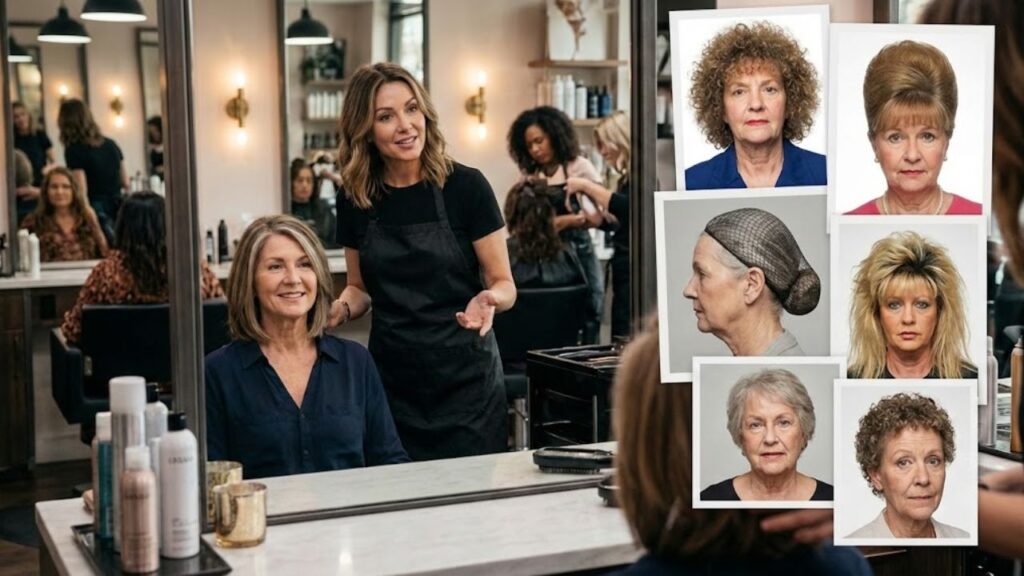
At first, Claire laughed it off. She’d always believed that “classic equals chic.” Yet, standing under the harsh salon lights, with her rigid bob and helmet of beige highlights, she suddenly realized—it wasn’t chic. It made her look older than she felt.
Léa promised to show her the five “granny-style” hair trends that secretly add ten years—and now, she bans these styles for women over 50.
1. The Stiff, Rounded “Helmet” Bob
The first culprit is the stiff, rounded bob that doesn’t move. Think of the type where the ends are curled under like a bowl—no layers, no air, no life. At 20, it can appear sharp and French. After 50, however, it clings to the jawline, accentuating every angle.
The issue isn’t with the bob itself, but with the “helmet” effect. When the hair sits like a cap on your head, it draws attention to jowls and flattens features, visually pulling everything down. When you turn your head and the hair stays still, your face can look frozen.
Léa remembers Dani, a 62-year-old client who had worn the same bob since 1998—same side parting, same curled-under ends, and the same weekly blow-dry. “Every time she came in, she showed me an old magazine tear-out,” Léa recalls, laughing. “She wanted to look like that forever.”
One day, Dani admitted that people had started asking her if she was tired. “I feel young,” she said, “but my reflection looks…stuck.” They softened her bob with light layers, a looser shape, and less curve under her chin. The result? Her colleagues asked, “Did you go on holiday? You look so fresh.” Not “Did you change your hair?” That’s the power of a small shift.
A rigid bob can create a harsh visual line right where many women begin to notice softening skin—jaw, neck, and lower cheeks. That hard curve highlights every little sag. By softening the line with texture and movement, those areas are blurred, giving you a youthful lift.
2. Over-Sprayed, “Set” Hair That Doesn’t Move
The second aging trap is over-sprayed hair that stays perfectly set in place. If your hairspray is strong enough to hold your hair like a sculpture, it may look secure—but it also looks dated.
Léa instantly notices when clients have hairspray that’s been applied liberally—roots glued in place, ends crisp, and a fringe that doesn’t budge even outdoors. “Frozen hair makes the face look frozen,” she explains. Fine lines, expression marks, and small asymmetries become more noticeable because there’s no softness to balance them.
We’ve all experienced it—the moment when you leave the salon with a perfect blow-dry, so stiff you’re afraid to sleep on your pillow. Léa’s regular client, Marie, 55, used to insist on “lots of lacquer” to keep her hair from falling flat. It looked great under the salon lights, but completely artificial in natural daylight.
One day, Léa filmed Marie turning her head. Her hair didn’t move—not one strand. Marie laughed at first, but then cringed. They cut back on the spray, switched to a flexible formula, and left the ends looser. The result? “People started saying I looked ‘softer’,” Marie said. Nobody mentioned her hair. That’s when she realized they were on the right track.
The psychological reason behind this is simple: heavy spray gives us a false sense of control. But ultra-set hair belongs to another era—one where women would visit the salon once a week for a perfect, untouchable hairstyle.
Soft, movable hair looks current, even when the cut is classic. Movement suggests vitality. Plus, hair that moves can be easily adjusted throughout the day, which is far more practical than redoing a full salon blow-dry every morning.
3. The “Too Safe” Color: Beige Blondes and Flat Browns
Next up, color traps. First on the list: beige blondes, often referred to as “granny blonde.” This is the shade many women gradually adopt, adding highlight after highlight until the hair becomes a flat, dull veil of yellow.
While this color is meant to soften the face, it often has the opposite effect. It drains the complexion, accentuates dark circles, and diminishes the sparkle in the eyes. A similar issue arises with flat, uniform brown tones that lack light or variation.
Léa remembers Sonia, 58, who had been chasing “as light as possible” for years. “She thought the blonder she went, the younger she’d look,” Léa says. But Sonia’s warm-olive skin clashed with the beige-yellow blonde, turning her complexion slightly greenish.
They introduced fine lowlights and a cooler beige at the front, leaving her natural salt-and-pepper at the back. Sonia was initially hesitant—“Won’t that look messy?” she asked. But when she saw herself in daylight, her skin appeared more vibrant and her face looked refreshed. Her friends even commented on her “glowing” complexion—without realizing it was her hair that had made the difference.
The key to flattering color at any age is depth. A single, flat color will make the face appear dull. Instead, opt for a shade with subtle highlights or a cooler tone that complements your natural skin tones.
4. Ultra-Short, Tight Cuts That Expose Everything
One major myth after 50 is that you “must” cut your hair short. Many women arrive in salons expecting a drastic pixie cut because they’ve heard long hair after a certain age is “forbidden.” But ultra-short, tight cuts often expose every millimeter of the head and neck.
While short hair can be incredible, tight cuts against the scalp with hard edges can appear harsh, especially when there’s any volume loss at the temples or crown. The neck and jawline are fully exposed, which can make you feel vulnerable rather than powerful.
Léa recalls Brigitte, 64, who came in with photos of sharp, celebrity pixie cuts. “I want low maintenance,” she said. Her hair was fine and sparse at the crown, and copying the pixie look would have made her scalp visible.
Instead, they found a middle ground. They kept the nape short for freshness but left longer pieces on top and around the ears, with wispy sideburns and a soft fringe. Brigitte later told Léa, “I feel like myself now, not like someone trying to be the cool aunt.” Her colleagues noticed her eyes and earrings, not her hairline. That’s when Léa knew they had achieved the perfect cut.
5. Overly Strict Partings and Pulled-Back Styles
The final “granny-style” trap is often overlooked: the way you part and tie your hair. A straight, rigid side part or tight ponytails and buns can make your face appear harsher and older.
When your hair is plastered to your scalp, it erases softness around the hairline, emphasizing thinning areas and deepening forehead lines. Léa’s client, Helena, 59, had worn the same sharp side part for decades. Over time, as thinning occurred along that part, it created a pale stripe in her hair.
Instead of changing her cut, Léa simply shifted the part slightly and added a bit of dry texturizing spray at the roots. Helena was amazed at the transformation. “I look less angry,” she said. The slight lift at the roots blurred forehead lines, and the softened part distracted from thinning areas. No one noticed what had changed, but everyone commented that she seemed more relaxed.
Léa’s rule is simple: when pulling your hair back, leave some softness. A few face-framing pieces, a looser tie at the nape, and a part that’s not perfectly straight will soften your look and add youthfulness.
Relearning Hair Freedom After 50
Ultimately, “granny-style” hair isn’t about length or color—it’s about rigidity. The cuts and colors that age you most are often the ones you chose years ago and never questioned. Letting go of them doesn’t mean chasing trends; it means allowing your hair to move with the life you live now.
Soft layers, movable hair, nuanced color, and subtle volume are the keys to hair that feels as vibrant as you do. And, most importantly, it’s about embracing a bit of imperfection—a strand out of place can look more youthful than a perfectly shellacked style.
Key takeaways:
- Avoid rigid, rounded bobs—opt for lighter layering around the jaw for a fresh, lifted look.
- Ditch frozen, over-sprayed styles—use flexible products that allow natural movement to soften your features.
- Update your color and parting—choose shades with depth and shift your part to disguise thinning and add luminosity.