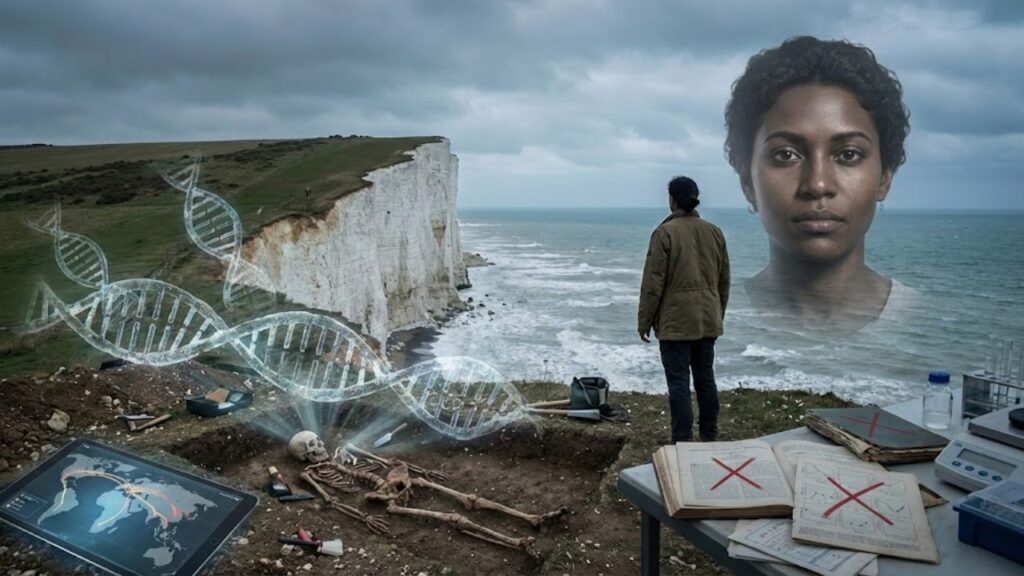
Her remains, discovered in a dusty box in Eastbourne, once held the weight of contemporary debates on race and identity in Roman Britain. Thirteen years and numerous technological advancements later, new genetic findings have challenged the initial claims, compelling archaeologists, museums, and the media to reevaluate how stories about the past are constructed.
From Forgotten Bones to National Symbol
The Beachy Head Woman’s story began in 2012 when she was rediscovered during a routine inventory of Eastbourne council’s collections. Staff uncovered a largely complete skeleton in a plain box in the basement, with only minimal labeling that indicated it had been unearthed in the 1950s from the cliffs of Beachy Head.
At first glance, there was no indication of a major discovery. The bones were placed into a local research project, “Eastbourne Ancestors,” which sought to better understand Roman and later burials in the area.
Initial analysis portrayed her life as fairly ordinary. She was a woman aged between 18 and 25, just over 1.5 meters tall. Her bones revealed a healed leg injury, suggesting she had survived a serious trauma long before her death. Radiocarbon dating placed her death between AD 129 and 311, comfortably within the Roman occupation of Britain.
From an archaeological perspective, this timeline made sense. Eastbourne was situated in a region with a mix of rural farms, villas, and military sites, with nearby Pevensey serving as a fortified harbor. Roman remains were common in places like Bullock Down and Birling, making her one of many pieces in this broader historical puzzle.
How a Tentative Idea Became a Defining Narrative
The case took an unexpected turn when her skull was sent to forensic artist Professor Caroline Wilkinson for facial reconstruction. Some features were interpreted as possibly indicative of sub-Saharan African ancestry. Wilkinson, however, was careful to note that this was merely a tentative interpretation, based on cranial shape rather than genetic evidence.
Facial features alone do not provide a definitive map of geographic origin, and the overlaps between different populations are central to the current debate surrounding the Beachy Head Woman.
Unfortunately, the nuance of this interpretation didn’t travel far. By 2016, a plaque in the local museum labeled her as “the earliest known black Briton.” The media quickly seized on the story, with the BBC’s documentary series “Black and British: A Forgotten History,” presented by historian David Olusoga, featuring her as a symbol of a more inclusive view of Britain’s past.
For many, this presented proof that Black individuals had been present in Britain since Roman times, offering a powerful image amid cultural debates on race, migration, and national identity.
The Fragility of the Evidence
Despite the compelling narrative, the underlying evidence was fragile. Cranial morphology had long been criticized within anthropology for its inability to reliably pinpoint ancestry. Many experts warned that such methods often obscure rather than clarify ethnic origins.
The Beachy Head Woman soon became a cautionary tale of how older techniques can mislead when used to answer complex questions about modern identity. Anthropologists have increasingly turned to biochemical methods—such as isotopes, DNA, and detailed contextual analysis—to uncover more accurate information.
However, genetics had not yet provided a clear answer. In 2017, a team at the Natural History Museum, led by ancient DNA expert Dr. Selina Brace, made a first attempt at extracting genetic material, which hinted at a possible Mediterranean link, possibly from Cyprus. But the DNA was highly degraded, and the sample was too thin to support any strong conclusions. The results were not published in a peer-reviewed journal due to their tentative nature.
In response, the museum removed the “first black Briton” plaque. Yet, the earlier narrative persisted, circulating online, in educational resources, and in public memory, long after doubts had emerged among specialists.
Advances in Genetic Technology
Everything changed by 2024 when advances in genetic technology allowed for a more precise analysis. Brace and her colleagues at the Natural History Museum, the University of Reading, and University College London utilized “capture arrays”—a cutting-edge tool designed to extract tiny fragments of ancient DNA that older techniques had missed.
This time, the team obtained a dataset about ten times denser than their 2017 efforts, enabling comparisons with hundreds of ancient and modern individuals stored in reference databases.
The results were striking: her closest genetic matches were people living in southern Britain during the Roman period. No evidence suggested a connection to Africa or the eastern Mediterranean.
Further analysis of genes linked to pigmentation offered additional insights. The markers most strongly associated with skin, hair, and eye color indicated that she likely had light skin, blue eyes, and fair hair. This new information led to a drastically different reconstruction of her facial features.
Where once the Beachy Head Woman was presented as an African migrant, she now appeared genetically indistinguishable from other local Romano-British individuals.
Published in the Journal of Archaeological Science in December 2025, the study reframes her as a local woman living under Roman rule, rather than a long-distance migrant to the province.
The Story of Roman Diversity and the New Findings
While this revised interpretation does not negate the evidence of diversity in Roman Britain—other graves, particularly in Dorset and Kent, show a mix of European and sub-Saharan African ancestry, especially in the early medieval period—the findings suggest that this particular woman was not one of those migrants. Her story had been over-simplified to fit a narrative that the data did not fully support.
- She lived between AD 129 and 311, during Roman occupation.
- Her skeleton fits a rural southern British context.
- Genetic analysis links her primarily to local Romano-British populations.
- No strong evidence connects her to Africa or the Mediterranean.
When Science, Storytelling, and Politics Collide
The revised findings have sparked mixed reactions. While many researchers feel relief that solid data has finally matched the public interest in the case, others worry that the new results may be misused to undermine discussions about long-term diversity in Britain.
Dr. Selina Brace emphasizes that the story is not about rewriting national identity but about doing justice to the individual woman. Her remains became a battleground for competing narratives, and the new research aims to bring the focus back to her own life history.
For archaeologist Professor Hella Eckardt, who co-authored the study, the case underscores the importance of combining genetic results with archaeological context and interpretive caution. The Roman Empire facilitated significant human movement, but each skeleton is embedded in a specific social and geographical setting.
The Beachy Head case serves as a reminder of how quickly a hypothesis can solidify into “fact” when it aligns with a story society is eager to tell.
The Role of Ancient DNA in Rewriting History
The Beachy Head Woman is far from the only case where ancient DNA has challenged established archaeological narratives. Over the past decade, improved sequencing technologies have reshaped debates about everything from Neolithic farming migrations to the origins of Vikings and early medieval Britons.
Ancient DNA works by comparing genetic variants across populations. When enough data is available, researchers can estimate broad ancestry, kinship, and even certain physical traits. However, results are heavily influenced by the quality of preservation and the reference datasets used for comparison. Poorly preserved bones or gaps in available samples can still lead to uncertainty.
Method Comparisons: What They Reveal and Their Limitations
- Cranial morphology: Reveals general health, age, sex, and trauma, but weakly links to ancestry, with significant overlap between populations.
- Isotope analysis: Provides insights into diet and possible childhood region, but offers broad estimates rather than precise origins and can be influenced by environmental factors.
- Ancient DNA: Uncovers ancestry, kinship, and some appearance traits, but requires good preservation, and results depend on existing reference datasets.