The florist’s shop carries the scent of damp earth mixed with tangerine peel. Outside, fairy lights flicker against a dull December sky. Inside, rows of netted Christmas trees lean by the entrance like weary guards. Still, many customers walk straight past them, heading instead toward the back of the shop, where a group of sleek, glossy plants stands out like pieces from a design studio rather than a woodland.
A woman in a camel coat gestures toward a tall plant with broad, polished leaves and asks, “Could this take the place of a tree?” The florist answers instantly, “That’s what everyone’s choosing this year.”
The message is clear: the Christmas tree is no longer unchallenged.
Its rival is fresher, more stylish, and meant to last well beyond the holidays.
From Spruce to Statement: The Rise of the Ficus Lyrata
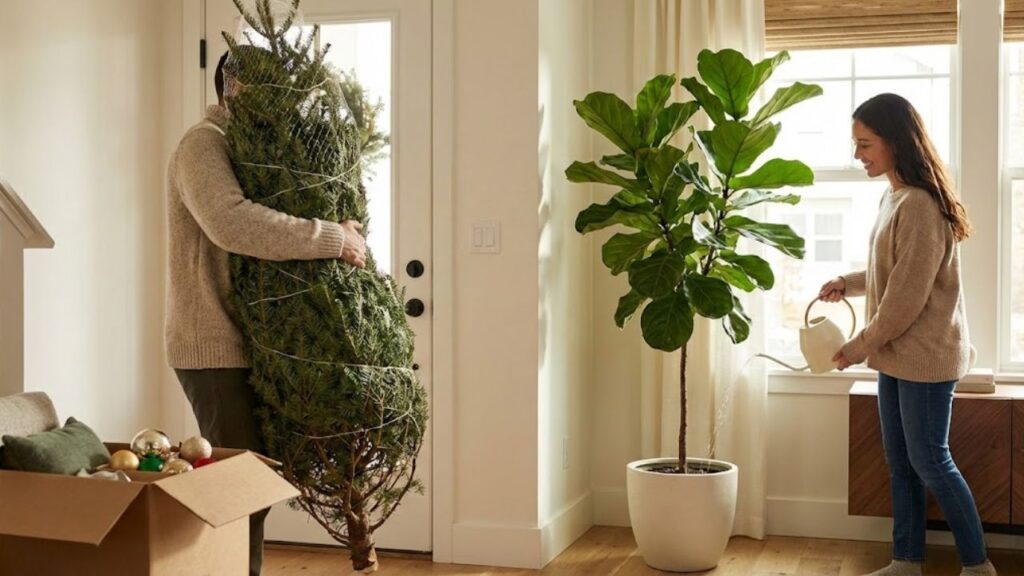
Step into any style-aware flower shop today and you’ll likely see it immediately. The fiddle-leaf fig, known botanically as Ficus lyrata, often takes center stage like a guest of honor. Its oversized, violin-shaped leaves shine under the lights, thick, dramatic, and undeniably bold. Unlike a traditional spruce that whispers heritage, this plant signals modern interiors, curated spaces, and understated luxury.
When I visited a florist in early December, she mentioned she had reduced her Christmas tree order by nearly a third. “People want something that stays alive after the season ends,” she said, smoothing a fig leaf with the care of a stylist. The familiar scent of pine remains, but the visual focus of the shop has clearly shifted.
A young couple I observed arrived with a baby in tow, debating between a compact Nordmann fir and a tall fiddle-leaf fig. They inspected the needles, compared prices, then slowly gravitated back to the fig display. The woman showed her partner a saved image on her phone: a living room without a tree, featuring a towering fiddle-leaf fig wrapped in warm lights.
They chose the fig as their main holiday feature. The florist dressed the pot in natural jute and tied a thin red ribbon around it, transforming it into something more editorial than traditional. This is how habits evolve, quietly shaped by aesthetics, inspiration boards, and rising energy costs.
Why Living Plants Are Replacing Cut Trees
The reasoning behind this shift is straightforward. A cut Christmas tree looks beautiful for a few weeks, then sheds needles and ends up discarded. A large indoor plant such as a fiddle-leaf fig may cost slightly more, but it can remain part of the home for years with basic care.
As conversations around waste, energy use, and consumption grow louder, this comparison resonates. There is also a sense of visual fatigue. The familiar red-and-green holiday palette has been endlessly repeated. Many people now prefer a cleaner backdrop for winter photos, one that complements soft-toned interiors, curved furniture, and neutral textiles.
A sculptural plant that can hold lights in December and still look calm and refined in January offers exactly that balance.
How Florists Are Reimagining the “Christmas Tree”
This season, florists are not simply selling plants. They are offering a complete, ready-styled centerpiece that requires minimal effort. Imagine a tall fiddle-leaf fig in a matte terracotta pot, wrapped in a removable linen cover, with warm micro-LED lights gently winding up the trunk.
There are no heavy branches to maneuver, no scratched ceilings, and no needles falling to the floor whenever the heating comes on. You leave the shop with something alive and already styled, yet easy to return to its natural form once the holidays pass.
This is the strength of the trend. It suggests the season rather than overwhelming the space with it.
Caring for a Holiday Ficus the Right Way
A common mistake is treating these plants like improved versions of pine trees. They are tropical by nature. Cold drafts, low light, and frequent watering do them no favors. Unlike a cut tree sitting in water, a fiddle-leaf fig prefers patience and restraint.
Florists who specialize in these plants now include simple care cards with each purchase. The guidance is brief and practical: place the plant near a bright window but away from cold glass, water thoroughly and allow the top soil to dry before watering again, and rotate the pot weekly to encourage even growth.
Even partial adherence to these steps is often enough for the plant to thrive long after the decorations are removed.
When Selling a Plant Feels More Meaningful
Some shop owners speak about this transition with genuine feeling.
“I know cut trees are tied to nostalgia,” says Sophie, who runs a busy city flower shop. “But when someone comes back in summer and shows me a photo of the fig they bought at Christmas, now twice the size and full of new leaves, that feels better than selling something that ends up on the curb in January.”
She now offers what she calls plant holiday kits, designed to make the switch feel simple and reassuring.
What a Typical Plant Holiday Kit Includes
- A medium or large fiddle-leaf fig already placed in a breathable decorative pot
- A string of warm, low-heat LED lights safe for use on foliage
- A neutral fabric wrap for the pot, reusable year after year
- A printed care card with three clear, concise instructions
- An optional discounted check-up visit in January if the plant struggles
The experience differs from choosing the tallest tree in a lot, but it fulfills the same desire to bring something green, substantial, and alive into the heart of the home.
A Quietly Emerging Holiday Tradition
What’s unfolding in florist shops feels like a gentle compromise between memory and modern needs. The Christmas tree is unlikely to vanish; it remains deeply tied to family rituals and childhood moments. Still, the growing number of living rooms centered around dramatic leafy plants wrapped in soft lights suggests that December is making room for new symbols.
Rather than asking whether a tree or a plant is better, the question becomes how people want the season to feel. A cut fir embodies a brief, fleeting magic. A large indoor plant placed in that same spot speaks of continuity, something you encounter again in spring, summer, and beyond.
The plant that stood beside the presents may one day cast shade over the sofa during a summer heatwave. It tells a slower, steadier story, one that continues long after the holidays fade.
Key Takeaways
- Fiddle-leaf fig as an alternative: A large, sculptural plant that can be styled with lights, offering a lasting and photo-friendly centerpiece.
- Ready-made florist kits: Bundled plants, lighting, fabric wraps, and care cards that make the transition from tree to plant easy and low risk.
- Long-term perspective: A living plant becomes part of the home year-round, reducing waste and creating a sense of continuity from winter through summer.