A grey drizzle lingers over the intersection as a man in a navy coat steps off the curb, just as a black SUV slows to let him pass. He’s not in a rush. He’s not running late. Yet, as he reaches the middle of the zebra crossing, he lifts his hand in a small, slightly awkward wave toward the driver.
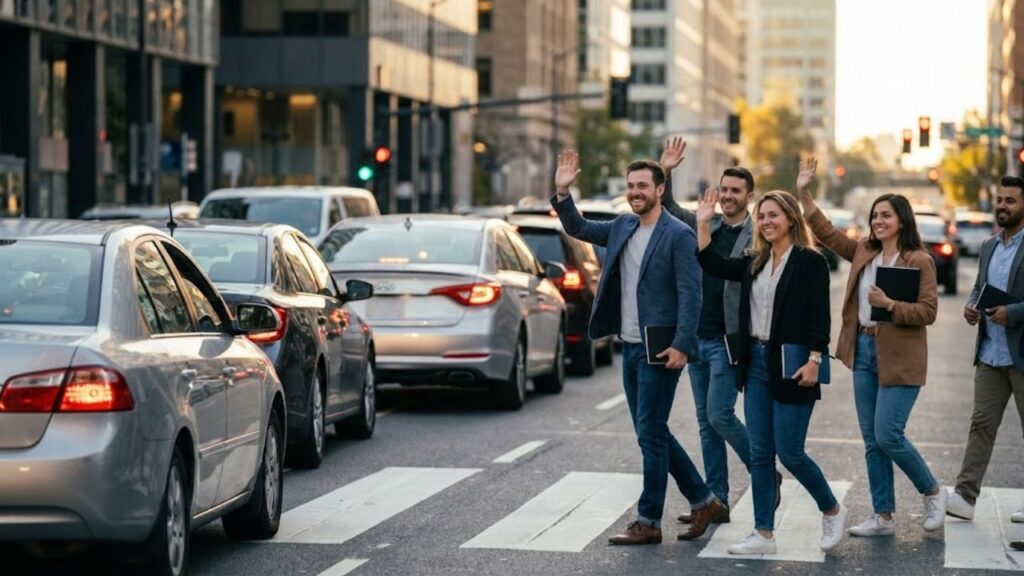
The SUV driver responds with a subtle nod. The man smiles, a brief flash of a grin. The cars keep moving, the city continues its hum, but something invisible just happened between two strangers sealed behind glass, fabric, and noise. A transaction with no receipt.
The Hidden Meaning Behind a Quick “Thank You” Wave
At first glance, the wave that pedestrians give to drivers may seem insignificant. A reflex. A habit. A polite “thank you” for not getting run over. However, when psychologists observe this gesture, it turns into data, revealing patterns about trust, power, and the subtle negotiations happening in public spaces.
This is why some researchers and psychologists train themselves to wave on purpose. They cross the street, following the rules, then raise their hand in a quick “thank you” to any car that yields. Not every time, but often enough to observe what happens next. It’s not the gesture itself that’s interesting. It’s how drivers respond.
The Influence of Gratitude on Behavior
In one study conducted in a European city, a psychologist spent a week crossing the same busy crosswalk, in similar clothing and at the same time each day. Sometimes, they walked with their eyes down. Other times, they made eye contact and waved thanks to the cars that yielded.
At first, the data seemed trivial—“stopped” or “didn’t stop” with a few notes like “smiled,” “ignored,” or “gestured back.” But then a pattern emerged: when the psychologist waved, the rate of drivers voluntarily slowing down increased sharply over the next few days. In some cases, it almost doubled. The study may have been small, but it echoed larger traffic psychology research: gratitude influences behavior, even without words.
The reason behind this is rooted in basic social dynamics. When driving, people often become anonymous—protected behind glass, harder to read. A pedestrian’s “thank you” breaks that anonymity, turning them from an obstacle into a person, someone who sees the driver’s power and acknowledges it. For many drivers, that recognition is enough to make them feel good, increasing the likelihood that they’ll slow down again the next time.
More Than Just Politeness: The Connection to Empathy
When psychologists examine this “thank you” wave, they don’t just focus on the act of politeness. They notice that people who wave tend to show other positive behaviors as well. These individuals are often more empathetic, trust others more, and have a greater sense of shared public space. In lab tests, these same people are more likely to help pick up dropped pens, hold doors open, or engage in cooperative tasks.
A traffic psychologist in Canada observed a pattern in their field notes: people who waved at cars were more likely to make eye contact with drivers, adjust their pace to match the slowing car, and nod slightly as they stepped onto the curb. These small, coordinated gestures indicate that they are not just focused on the street but also aware of the social cues around them.
The Uncomfortable Side of the Wave
However, there’s another, less flattering side to the wave. It’s sometimes tied to an acceptance of unequal power. Pedestrians are in the weaker position—they’re vulnerable, while drivers have the power to harm them. As a result, pedestrians often express gratitude for behavior that is technically just following the law, like not running them over. Psychologists observe this and relate it to social hierarchies. People from stricter or riskier environments often wave more, smiling more in these moments as if to smooth over potential conflict. While this behavior may appear soft, it’s also a learned survival strategy.
How the Wave Can Change the Whole Crossing
There’s an unexpected power in that simple wave. Psychologists often use it deliberately in field experiments. They time their steps so that the driver has a clear decision: either keep driving and force the pedestrian to wait or slow down and let them cross. Once the car yields, they don’t rush or freeze. Instead, they maintain a steady pace, raise a hand casually, and give a relaxed “thank you” to the driver.
The key is timing. The wave must happen early enough so the driver can see it without having to adjust. This is usually accompanied by a brief glance toward the windshield—not a stare-down, but a “I know you’re there” acknowledgment. In field experiments, this combination of eye contact and a simple wave doesn’t just improve driver courtesy in that moment—it can influence drivers behind them, creating a ripple effect of civility.
The Power of Small Gestures: Frustration and Change
At times, the gesture may feel ineffective. “I wave, but they still zoom past. What’s the point?” Streets can feel hostile and indifferent, and on bad days, it can feel almost fake to raise your hand in gratitude when you were just worried about getting hit.
But psychologists suggest using the wave not as a moral duty but as a small experiment. What happens on this corner, with this car, at this hour? Over time, patterns emerge. In residential areas, the wave softens drivers who are distracted. Near schools, parents respond more than commuters do. On main roads during rush hour, professional drivers are more likely to notice. You may not change traffic with a wave, but you can change how you feel in the middle of it.
The Bigger Picture: Small Acts Shape the City
Every small gesture on the street is a vote for the kind of city we want to live in. The wave is just the most visible version of that. Psychologists often make note of what makes these waves “work” in real life. They suggest choosing moments when drivers are already hesitant, not when they’re speeding through a yellow light. They note that pedestrians who appear grounded—feet firm, gaze calm, and no sudden movements—tend to receive more positive responses when they wave.
It’s not about being perfect or dressed well. It’s about showing that you’re predictable, not here to fight. Small actions like soft eye contact, an open palm, and a steady walking pace make the interaction feel cooperative, not confrontational.
Why the Wave Lingers in Your Mind
In a busy city, we pass hundreds of strangers each day, many of whom vanish from our memory. Yet, when asked about memorable walks, people often recall the rare driver who stopped and the moment they waved thanks. Or they remember the time they hesitated at the curb, waved awkwardly, and the car zoomed by, leaving them frozen by the gutter. These moments stick with us because we’re subconsciously recording whether our streets can be kind.
On the surface, the wave seems small, polite, and clean. But in reality, it’s tangled with stress, honking, headphones, wet shoes, and busy minds. On a rainy Tuesday, you might not wave. You might cross with a tight jaw, cursing every license plate. On another day, with the sun shining, you might wave without thinking. That inconsistency is human, and it’s why psychologists trust the gesture—it leaks out when we genuinely feel gratitude, not when we’re forcing it.
The Wave as a Social Training Ground
On a deeper level, the “thank you” wave at a crosswalk is a tiny training ground for social life. It allows you to experience vulnerability, being seen, and receiving a small favor before responding in kind. Each time you perform this gesture, your brain updates its model of “how others behave when they have power over me.” If drivers mostly ignore you, you’ll walk through the world a bit more guarded. If enough drivers notice your wave, smile back, or nod, you’ll carry a different story into the rest of your day—a story where strangers choose kindness when they don’t have to.
Key Takeaways
- Recognition Through a Simple Wave: The wave transforms an anonymous driver into a person, helping to reduce tension and road rage.
- Wave as a Social Indicator: People who wave often exhibit other prosocial habits, such as empathy and trust.
- Shaping Behavior Through Small Gestures: Drivers who receive a “thank you” wave tend to yield more in the future, demonstrating how tiny acts of kindness can shift street culture over time.