
The woman in the salon chair had three different hairstyles fighting for attention on the same head. At the roots, poker-straight and flat. Mid-lengths, fluffy and frizzy from old dye. The ends? Random corkscrew curls that had decided to appear out of nowhere after a summer of sun and seawater. She looked at herself in the mirror and gave the stylist a half-joke, half-plea: “Is this… fixable?”
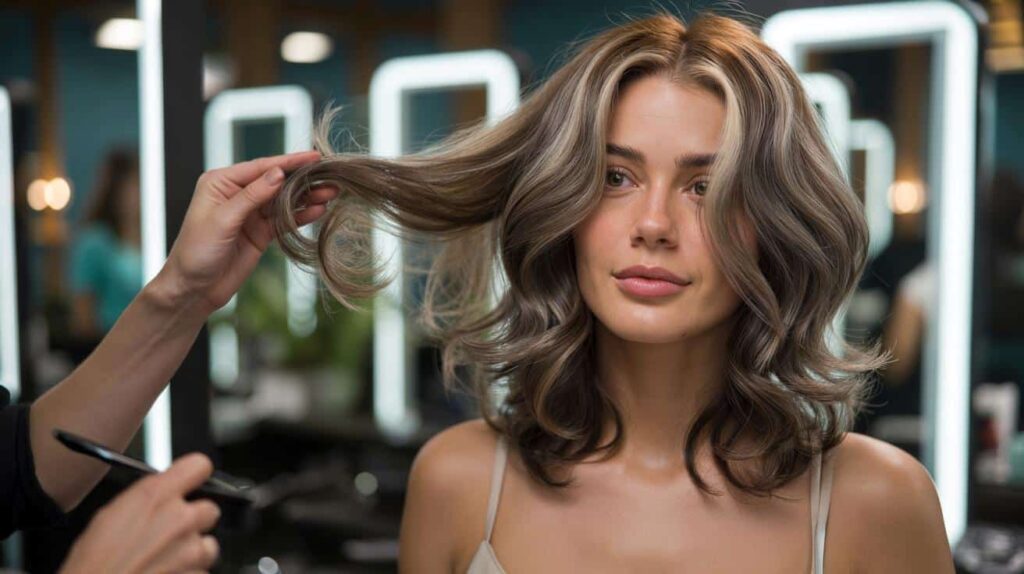
The stylist didn’t flinch. She just smiled, lifted the hair section by section, and said: “We’re going for a shag.”
The woman blinked. Then laughed.

Twenty-five minutes later, those “three hairstyles” looked like one cool, intentional cut.

The trick wasn’t to hide the uneven texture.
It was to give it a job.
The shag haircut: when your “messy” texture becomes the star
The modern shag is that cut you think you can’t pull off, until you see it on someone who definitely “wasn’t a hair person” five minutes earlier. It’s all soft layers, movement, and those piece-y bits that seem to fall perfectly without you doing much.
What makes it so special on uneven hair is simple. The shag doesn’t fight texture, it highlights it. Straight at the roots, wavy on the sides, ringlets popping up in the back? The cut turns all that into volume and character instead of chaos.
There’s a reason so many hairstylists quietly suggest it to clients who whisper, “My hair is just… weird.”
Picture this. You wake up with one side of your head bending outward, the other side bending inward, and a flat patch at the crown that refuses to lift. On Instagram, it looks like “bedhead chic.” In your bathroom mirror, it’s… not that.
A client I spoke to, Emma, had exactly this problem. After years of straightening, her lengths were damaged and kinked, while her new growth was smooth and limp. Her stylist cut a mid-length shag with long curtain bangs, removing bulky, heavy pieces and adding shorter layers around the face.
The next day, Emma sent a photo. No blowout, no curling iron, just air-dried. Her “uneven” texture now looked like expensive, cool-girl waves. Same hair. Different architecture.
This is the quiet genius of the shag: it redistributes weight. Instead of all your hair dragging down at the bottom, the cut carves subtle steps into the shape. That allows your varied textures to sit where they look their best. Tighter waves can live near the cheekbones, softer bits can frame the jaw, straighter sections can keep the top sleek.
From a distance, the eye doesn’t read “patchy” or “uneven.” It reads volume, movement, and softness. *The inconsistency that annoyed you yesterday suddenly reads as intentional today.*
It’s not magic. It’s just a haircut that finally works with what your hair already wants to do.

How to ask for a shag that actually fits your real-life hair
Walk into the salon with screenshots, but also with honesty. Tell your stylist what your hair does when you let it dry completely on its own. That “I swear it’s curlier when it’s humid” detail matters a lot for a shag.
The best way to get a version that works on uneven texture is to ask for soft, graduated layers rather than extreme chunks. Around the face, request long, face-framing pieces that can double as curtain bangs when styled. At the back, the goal is a light, lifted shape, not a mullet cosplay.
Ask your stylist to cut into the ends a little, so they look airy instead of blunt. That’s what gives the cut its movement and makes different textures blend visually.
The classic mistake with the shag is going too extreme, too fast. Heavy, short layers all over the head can look incredible on thick, uniform curls. On fine or uneven hair, that same approach can leave you with scraggly ends and no density where you actually need it.
Start softer. A “shag-lite,” grazing the collarbones or just below the shoulders, lets you test how your natural texture behaves with more layers. You can always go shorter or add more texture on your next appointment.
Be honest about your styling limits too. Let’s be honest: nobody really does this every single day. If you don’t own a round brush and never will, say it. Your stylist can adapt the cut so it falls well with a quick rough-dry and a bit of cream instead of a full-on blowout.
One stylist I interviewed summed it up with a sentence that stuck with me.
“Uneven texture isn’t a problem,” she said. “It’s just hair that hasn’t found the right shape yet.”
The right shape gets easier when you treat your shag like a simple routine, not a project. A few small anchors help:
- Choose one go-to product for “lazy days” (a lightweight curl cream or salt spray).
- Air-dry when you can, then tweak just the front pieces with a brush or iron.
- Schedule tiny, regular trims instead of dramatic, once-a-year chops.
- Sleep on a satin pillowcase to reduce frizz and weird overnight dents.
- On “I hate my hair” days, clip up the top layers and let the shag show off its angles.
Living with a shag: when “good enough” hair suddenly feels like a style
There’s a quiet kind of relief that comes when you stop trying to “fix” your hair and simply give it structure. The shag doesn’t promise perfection. It promises something more realistic: a shape that still looks like you on rushed Mondays, gym days, and those evenings when you half-dry your hair with the car’s heater vents.
The cut grows out in a way that stays interesting. After six weeks, it leans into a looser, softer shape. After three months, it can pass as a long, layered cut with a bit of rock-and-roll edge. At every stage, the uneven texture keeps the hair from looking flat or overdone.
We’ve all been there, that moment when you stare at your reflection and think, “If my hair would just behave, everything else would be easier.” The shag doesn’t fix your life, of course. But it can quietly remove one daily battle from your list.

And there’s something undeniably uplifting in walking out the door knowing your hair doesn’t have to match on every strand to look like it belongs on your head.

| Key point | Detail | Value for the reader |
|---|---|---|
| Shag suits uneven texture | Layered structure turns mixed textures into soft, intentional movement | Transforms “problem” hair into a style asset |
| Start with a soft version | Ask for gentle layers and face-framing pieces instead of extreme choppy sections | Reduces risk of regret and keeps options open as it grows out |
| Low-effort styling works | Air-drying, one key product, and light tweaking at the front are often enough | Makes the cut realistic for everyday life, not just salon days |
FAQ:
- Question 1Will a shag haircut work if my hair is straight at the top and wavy at the bottom?Yes. That mix is actually ideal for a modern shag. The straighter roots keep the top smooth, while the waves in the lengths give volume and texture once layers are added.
- Question 2Is a shag a high-maintenance haircut?Day to day, it can be very low effort. A small amount of product and a rough dry are often enough. The real maintenance is getting soft trims every 8–12 weeks to keep the shape.
- Question 3Can fine hair handle a shag cut?Yes, if the layers are done softly and not too short. Ask for minimal removal of bulk and longer layers, so your hair keeps its density while still gaining movement.
- Question 4What face shapes look best with a shag?Most face shapes can wear it, because the cut is so customizable. Round faces benefit from volume at the crown, while longer faces look great with fuller, cheek-level layers and curtain bangs.
- Question 5Do I need bangs for a shag to look good?No, but some kind of face-framing helps. You can choose full bangs, soft wispy bangs, or long curtain pieces that can be pushed back on days you want a cleaner look.
