Stomach overhang often creeps in gradually as the body ages, and without a clear plan, it tends to stick around. Many people don’t notice it forming until clothes fit differently or posture changes. To understand how to address this issue effectively, insights were shared by Karen Ann Canham, CEO and founder of Karen Ann Wellness, who focuses on sustainable movement strategies for aging bodies.
While many assume cardio workouts are the fastest way to burn fat due to their calorie-burning effect, that belief doesn’t always hold true later in life. Although cardio supports overall health, Canham highlights that consistent daily movements targeting strength and posture can reduce belly overhang more effectively than long cardio sessions after 60.
Why These Daily Movements Work Better Than Cardio
According to Canham, steady-state cardio such as treadmill walking or cycling mainly burns calories but does little to rebuild the deep core muscles and glutes that support abdominal tone. After 60, factors like muscle loss, reduced insulin sensitivity, and hormonal shifts influence belly fat more than calorie burn alone. Cardio without resistance may even accelerate muscle loss, making the midsection appear softer over time.

As the body ages, fat distribution shifts toward the midsection while stabilizing muscles weaken. Combined with posture changes, reduced hip strength, and increased stress, the abdominal area may protrude even in active individuals.
Four Daily Exercises That Help Tighten Belly Overhang
Below are four daily exercises Canham recommends to help firm and tighten the belly. These movements focus on rebuilding muscle, improving posture, activating the deep core, and lowering nervous system stress—key elements for sustainable fat reduction after 60. When practiced daily and paired with walking, they support long-term results better than cardio alone.
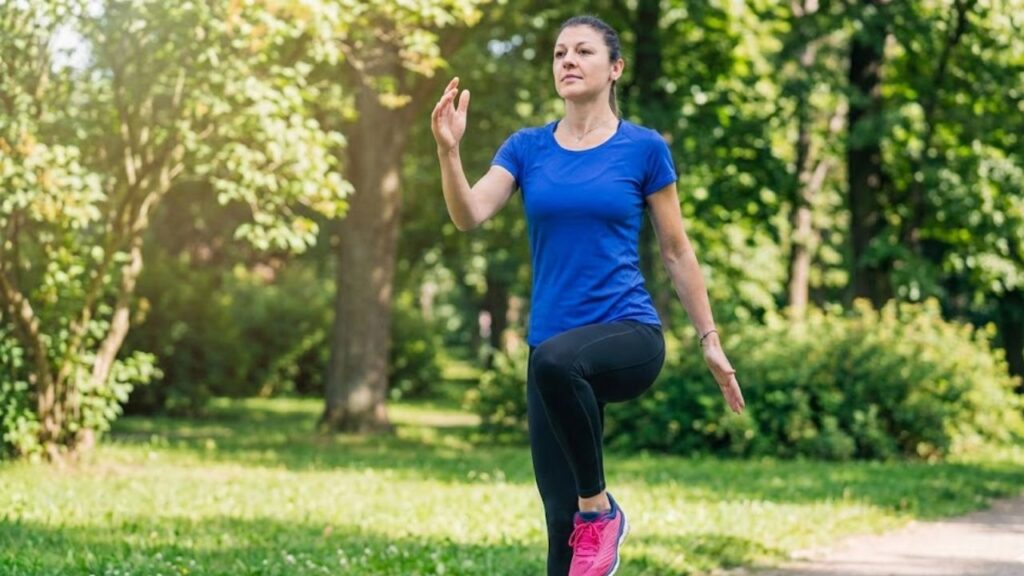
Standing March With Core Brace
This movement reinforces posture and core engagement. Canham advises engaging the abs as if “zipping up tight jeans” throughout the exercise.
- Stand tall with feet hip-width apart and arms relaxed at your sides.
- Lift the left knee to hip height while swinging the right arm forward.
- Lower the foot and repeat on the opposite side.
- Maintain steady breathing and upright posture.
- Perform 2–3 sets of 20 slow marches.
Sit-to-Stand
This exercise builds leg strength, balance, and total core activation using simple controlled movement.
- Sit near the front of a sturdy chair with feet under your knees.
- Lean slightly forward.
- Stand up without using hands or knees.
- Lower back down with control.
- Perform 3 sets of 8–12 repetitions.
Wall Pushups With Core Engagement
Wall pushups strengthen the upper body while reinforcing deep core stability.
- Stand arm’s length away from a wall.
- Place hands shoulder-width apart.
- Engage the core and bend elbows to lower toward the wall.
- Push back to the starting position slowly.
- Complete 2–3 sets of 10–15 reps.
Farmer’s Carry
This movement activates postural muscles and deep core support using everyday resistance.
- Hold dumbbells, kettlebells, or weighted bags at your sides.
- Stand tall and walk forward with a stable torso.
- Perform 3 rounds of 30–60 second carries.