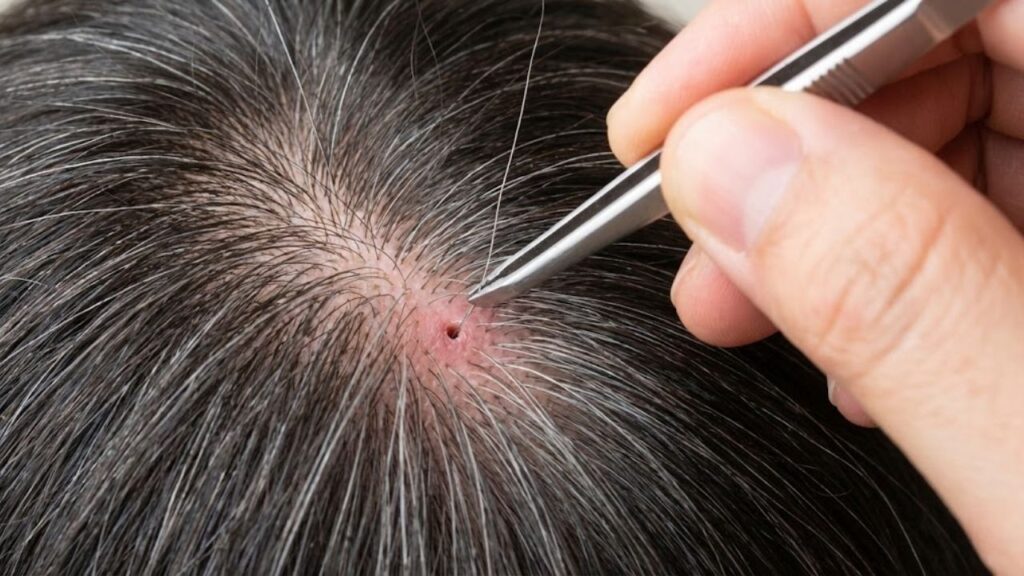
Her fingers rise almost without permission. Pinch and twist, a quick pull, a brief sting, then a tiny sense of relief. She exhales, half-laughing, already hearing the familiar warning in her head: don’t pluck grays. The strand lands in the sink, a single silver witness. What she doesn’t realize is that the real danger isn’t growing more gray hairs. The deeper risk is far quieter: one day nothing grows back.
Why plucking one gray doesn’t create more
The old saying offers comfort: pull one gray, two will return. It makes aging feel like a bargain you can negotiate. But hair biology doesn’t play that game. Each strand grows from its own follicle, a self-contained unit with its own cycle and pigment supply. Removing one hair doesn’t alert nearby follicles or speed up their aging. Those around it continue on their own silent timeline, unaffected.
Dermatologists hear this myth daily. People swear new grays appear exactly where they plucked. In reality, those hairs were already on their way, shorter and hidden beneath the surface. When they finally emerge together, it feels sudden and unfair. Color itself depends on melanocytes inside the follicle. As these cells weaken or disappear with age or stress, hair grows without pigment. Pulling the strand doesn’t fix that process. The same follicle simply produces another gray replay when its cycle restarts.
 4-minute seated workout after 60 highlights elite endurance when you complete every rep cleanly
The real risk no one expects
Plucking feels decisive, almost therapeutic. That small pop creates a sense of control. Yet it’s also trauma. Beneath the skin, each follicle is a delicate structure, supplied by blood vessels and surrounded by living tissue. Repeated pulling, especially in the same spot, can inflame this tiny socket. Over time, microscopic scarring may form.

At first, hair often returns thinner or slower. With enough repeated damage, it may stop returning altogether. Dermatologists see this pattern in thinning temples and sparse brows, often traced back to years of habitual plucking. What looks like random hair loss can actually be mechanical damage, caused strand by strand. Like soil compacted by constant uprooting, the follicle eventually reaches a point where nothing grows.
Safer ways to deal with a single gray
Experts quietly suggest a calmer alternative: trim instead of pull. If one gray catches your eye, use fine scissors to cut it close to the scalp. The visible issue disappears, while the follicle remains undisturbed and healthy.
Temporary color options work the same way. Root touch-up pens or powders soften silver instantly without pain or trauma. For more noticeable graying, strategic highlights or lowlights can blend new growth rather than fight each strand. This approach shifts the focus from constant correction to gradual adaptation.

The habit loop behind plucking
Most people don’t plan to pluck. It happens in passing: mirror, silver flash, quick pull. The damage isn’t immediate, so it’s easy to deny. Months later, a thinner patch appears where the habit lived. That delay is what makes the cycle dangerous.
The act itself can become addictive. Each gray feels like a challenge, offering a brief illusion of control. Over years, that reflex can quietly sabotage hair density. The scalp remembers repeated stress through chronic inflammation, especially in people prone to traction or autoimmune issues. The cost of those tiny victories is sometimes permanent empty skin.
Protecting follicles for the future
Dermatologists often agree on one point: the myth of multiplying grays is false, but permanent loss is real. The goal shifts from erasing silver to preserving active follicles. Less trauma, gentler habits, and patience matter more than winning against a single strand.

- Trim, don’t pull to avoid root damage
- Use temporary color for quick visual fixes
- Blend strategically with highlights or lowlights
- Protect follicles instead of targeting each gray
Seeing gray hair differently
Eventually, gray hairs follow their own schedule, regardless of what you do. They reflect genetics, stress, and time, not punishment for plucking. Removing them by force never addressed the cause; it only hid the signal briefly. In the end, gray hair invites a quieter choice: react with quick fixes, or respond with care. Aging can’t be stopped, but how gently you treat each follicle still shapes what remains.