
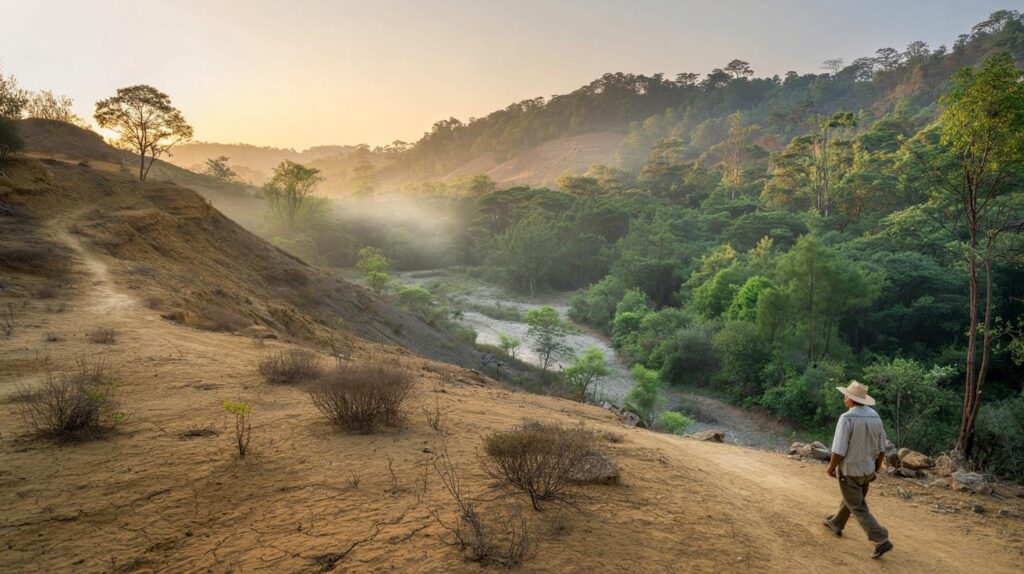
At first light, the valley looks almost unreal. A low mist snakes between hills now covered in young forest, leaves shining wet from the night. Twenty-five years ago, this same place in southern China was a dust bowl: cracked earth, scrub, and the constant taste of sand on the tongue. Old photos show a horizon the color of rust. Today, there’s birdsong loud enough to drown out the highway.
The surprising part is not just the beauty.
It’s what you can’t see hanging in the air anymore.

From bare dirt to a massive carbon sponge
Walk with a local ranger and you feel the time scale in your legs. He points at a line on the slope: “Up to there? That was rock. Nothing grew.” Now acacias, pines and native broadleaf trees crowd the path, their roots gripping soil that used to slip away with every storm. The air is cooler under the canopy. Your phone map still shades this area in beige. Reality is deep green.

Every tree trunk here is quietly holding on to years of atmospheric history.
This valley is not alone. Across China’s Loess Plateau, in parts of Ethiopia, in Costa Rica, Vietnam, India, once-barren lands have been planted, protected, or simply allowed to grow back. Satellite data shows tree cover expanding over hundreds of thousands of square kilometers. The numbers are staggering: reforested areas worldwide are now absorbing tens of millions of tons of CO₂ every single year.
Think of that as entire countries’ emissions being quietly cancelled out by leaves and roots.
Scientists explain it in simple terms. Young trees grow fast. Fast growth means fast carbon capture, as they pull CO₂ from the air and lock it into wood and soil. Whole landscapes behave like giant sponges, soaking up part of what factories, cars and planes throw out. Left alone long enough, soils under forests can store even more carbon than the trunks.
*The once-barren hills become long-term climate vaults, paid for by sunlight and rain.*
What made 25 years of reforestation actually work?
Behind the romantic idea of “planting trees” is a lot of messy, patient work. The projects that are thriving today often started with unglamorous actions: fencing off overgrazed slopes, training local farmers, choosing local species that actually survive. In some regions, people were paid to plant saplings one by one. Others tried a different tactic: stop cutting, stop burning, and simply wait for nature to come back.
The key was less about heroic gestures and more about quiet consistency.
There’s a pattern you hear from Brazil to Rwanda. When communities have secure land rights and a small income from restored forests – honey, fruit, shade-grown coffee, timber managed under rules – trees stay in the ground. When they don’t, reforestation fails. Let’s be honest: nobody really does this every single day if it means going hungry.
Projects that ignored this basic reality often saw saplings die, fences broken, and hills stripped bare again within a decade.

One researcher who has watched this shift unfold told me something that stuck:
“Planting trees is the easy part. Keeping them alive long enough to matter is where the real work begins.”
To make that work possible, successful programs tend to combine a handful of simple ingredients:
- Local species that fit the climate and culture, not just fast-growing exotics
- Clear benefits for nearby families within a few years, not only for future generations
- Protection from grazing, fire and logging during the fragile early years
- Monitoring with satellites and on-the-ground checks, so progress isn’t just a press release
- Long-term funding that survives election cycles and changing headlines
Each of these may sound obvious on paper. Lived on a hillside with thin soil and thin wallets, they’re anything but.
Where this leaves us, and what comes next
Twenty-five years on, the success stories are real. Former dust bowls are cooling their regions by a degree or two. Rivers that dried up in summer now flow longer. Millions of tons of CO₂ that would be in the sky are instead locked into forests spreading over once-bare ridges. The emotional frame is hard to ignore: we’ve all been there, that moment when a place you thought was lost suddenly shows a pulse again.
At the same time, no serious scientist says trees alone will “fix” the climate. The math doesn’t bend that way.
These reborn landscapes buy time. They soften floods, steady crops, and give threatened species somewhere to move as temperatures climb. They also reveal an awkward truth: large-scale change is possible when governments, local communities and money push in roughly the same direction for more than one election cycle. That might be the rarest resource of all.
Yet this is exactly what reforestation has quietly proven over 25 years – that long, slow work can still beat the headlines.
So the question hangs over these greened hills like the morning mist. Will we treat them as proof that we can go bigger and bolder, cutting emissions while expanding nature’s carbon sponge? Or will they remain comforting exceptions, little green stories we scroll past and forget?
**The trees will keep growing either way.**

What we choose to grow around them is still up to us.
 Pension cuts spark outrage because most people misunderstand how adjustments are calculated
| Key point | Detail | Value for the reader |
|---|---|---|
| Reforestation scale | Millions of hectares of degraded land restored over 25 years | Gives a sense of what sustained action can achieve in a single generation |
| Carbon impact | New and restored forests now absorb millions of tons of CO₂ annually | Shows how nature-based solutions fit into climate strategies |
| Success ingredients | Local species, community benefits, protection and long-term funding | Offers a clear mental checklist to judge future “tree-planting” announcements |
FAQ:
- How much CO₂ can reforestation really absorb each year?Estimates vary, but current reforestation and natural regeneration projects are already absorbing tens of millions of tons of CO₂ annually, with potential to scale to several hundred million tons if efforts expand wisely.
- Are all tree-planting campaigns good for the climate?No. Monoculture plantations, badly chosen species or projects that ignore local people can harm biodiversity, water and livelihoods, even if they sequester some carbon.
- Why does everyone talk about “native species”?Native trees are better adapted to local climates and wildlife, and they tend to support healthier soils and more resilient forests over decades, not just quick growth on paper.
- Can reforestation replace cutting fossil fuel use?It can’t. Forests can help offset part of our emissions and repair damaged ecosystems, but deep cuts in coal, oil and gas use remain non-negotiable for stabilizing the climate.
- What can an ordinary person do about this?You can support credible reforestation and conservation groups, back policies that protect existing forests, reduce your own footprint, and stay skeptical of “one tree equals one flight” style marketing.
